

Exercise 1
Read each group of sentences carefully. Choose the one sentence that is correctly punctuated, capitalised, and spelled. The other sentences contain one or more errors in punctuation, capitalisation, or spelling related to the topic of advertising and consumer behaviour.
Example: Which sentence is correct?
A. advertisers frequently exploit consumers psychological vulnerabilities to drive impulsive purchasing decisions.
B. Advertisers frequently exploit consumers' psychological vulnerabilities to drive impulsive purchasing decisions.
C. Advertisers frequently exploit consumers' psychological vulnerabilitys to drive impulsive purchasing decisions.
Answer: B. Advertisers frequently exploit consumers' psychological vulnerabilities to drive impulsive purchasing decisions.
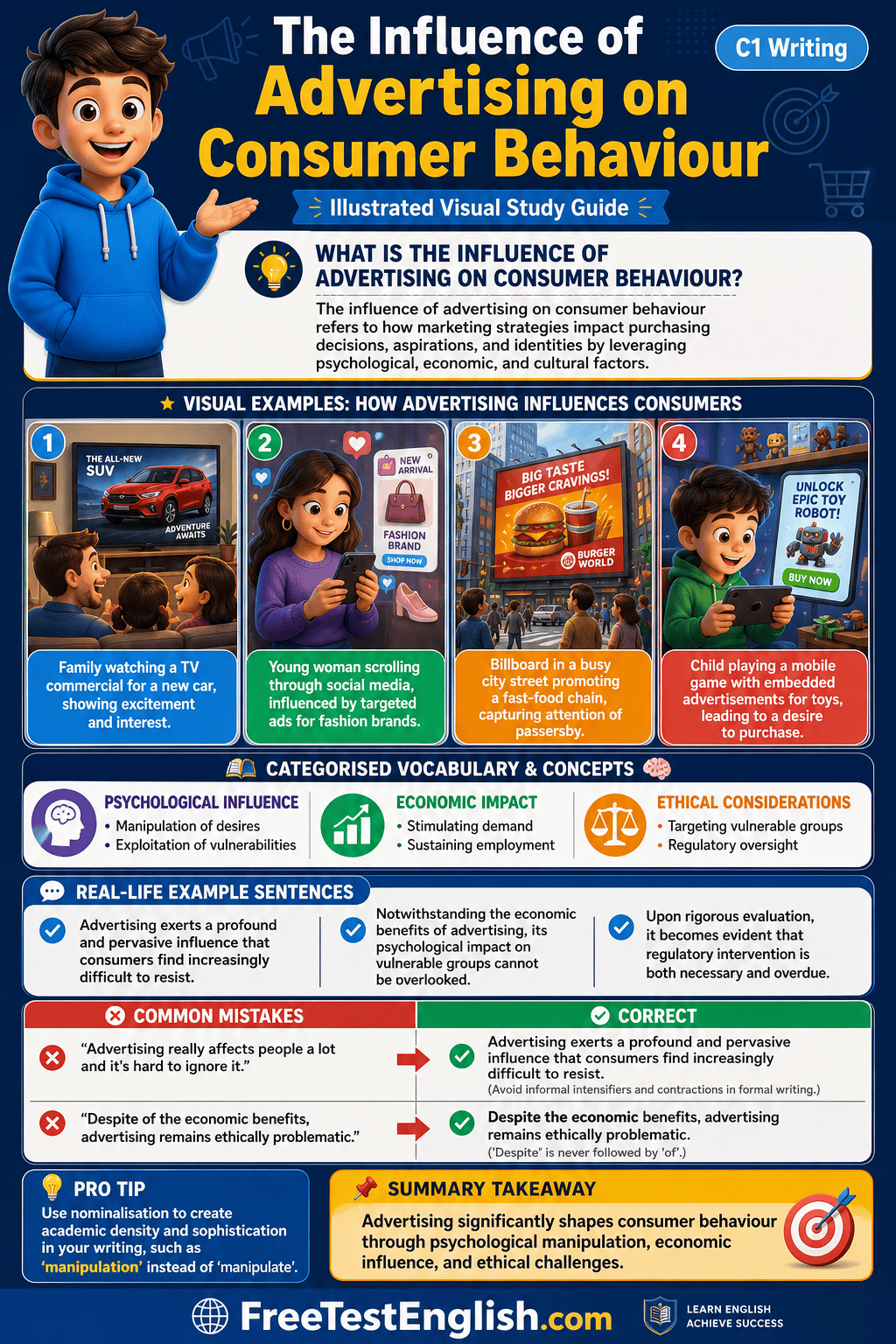
How to Write a Discursive Essay: The Influence of Advertising on Consumer Behaviour
At C1 Advanced level, one of the most demanding and rewarding writing tasks is the discursive essay. This genre requires you to explore a complex issue from multiple perspectives, evaluate competing arguments with critical precision, and arrive at a nuanced, well-justified conclusion. Rather than simply listing opinions, a C1 discursive essay demands intellectual engagement: you must weigh evidence, concede counterarguments gracefully, and demonstrate sophisticated command of academic style.
The topic of advertising and consumer behaviour is a rich area for discursive writing because it sits at the intersection of psychology, economics, ethics, and culture. Advertising permeates every aspect of modern life — from social media algorithms to billboards, from targeted email campaigns to product placement in streaming content. Understanding how it shapes purchasing decisions, aspirations, and even identities is a question of genuine social significance.
In real-world contexts, this type of writing appears in academic journals, opinion editorials, think-tank reports, and university entrance applications. In Cambridge C1 Advanced (CAE) examinations, discursive essays are assessed on four criteria: Content, Communicative Achievement, Organisation, and Language. Mastering this genre will therefore serve you both academically and professionally.
Essential Writing Rules & Structural Principles at C1
1. Construct a Clear, Sophisticated Thesis
Your opening paragraph must do more than introduce the topic — it must establish your analytical stance. A strong C1 thesis is neither a simple opinion nor a vague generalisation; it is a carefully qualified position that acknowledges complexity while committing to a defensible argument.
Weak thesis: "Advertising affects people in many ways."
Strong C1 thesis: "Whilst advertising undeniably stimulates economic activity, its more insidious effect lies in the systematic manipulation of consumer psychology — a phenomenon with far-reaching ethical implications."
2. Develop Arguments with Evidence and Reasoning
Each body paragraph should follow a disciplined structure: claim → elaboration → evidence or example → critical evaluation. Avoid presenting claims without justification. At C1, markers reward analysis over description — always ask yourself why or to what extent rather than simply what.
3. Use Advanced Syntax Consistently
C1 writing is distinguished by syntactic variety and precision. You should demonstrate confident use of:
- Non-finite participle clauses: "Having established the psychological mechanisms at play, one must consider the ethical dimension."
- Inversion for rhetorical emphasis: "Seldom has the reach of commercial persuasion been so pervasive or so difficult to resist."
- Cleft sentences: "What is particularly concerning is the degree to which subliminal advertising bypasses rational decision-making."
- Nominalisation: Instead of "Advertisers manipulate consumers," write "The systematic manipulation of consumer behaviour by advertising agencies raises profound ethical questions."
- Passive reporting structures: "It is widely contended that modern advertising exploits cognitive biases rather than informing genuine choice."
4. Maintain Consistent Formal Register
A C1 discursive essay must sustain a formal, academic register throughout. Avoid contractions, colloquial expressions, and vague intensifiers such as really or very. Replace informal constructions with precise academic equivalents at every opportunity.
5. Punctuate with Precision
- Use a comma after sentence-initial adverbials and discourse markers: "Nevertheless, the evidence suggests..."
- Use a semicolon between two closely related independent clauses: "Advertising drives consumption; however, its long-term effects on wellbeing remain contested."
- Use em dashes to introduce parenthetical elaboration for emphasis: "The phenomenon — now extensively documented in behavioural economics — warrants urgent regulatory scrutiny."
- Ensure relative clauses are correctly punctuated: use commas for non-defining clauses ("Consumer culture, which has intensified dramatically since the 1980s, is inextricably linked to advertising") and no commas for defining clauses.
Useful Linking Words (Connectors) for C1 Discursive Essays
The connectors you select signal your analytical sophistication to examiners. Move beyond basic connectors such as also, but, and and and incorporate the nuanced discourse markers listed below.
| Connector | Function / Use | Example Sentence |
|---|---|---|
| Notwithstanding | Formal contrast; acknowledging a point while maintaining your argument | Notwithstanding the economic benefits of advertising, its psychological impact on vulnerable groups cannot be overlooked. |
| Albeit | Concessive; introducing a qualification within the same clause | Advertising does foster brand awareness, albeit at the considerable cost of consumer autonomy. |
| Inasmuch as | Causal or limiting; specifying the extent or condition under which something is true | Inasmuch as consumers remain unaware of the techniques employed, advertising retains its manipulative power. |
| In light of the prevailing evidence | Drawing a conclusion based on accumulated reasoning | In light of the prevailing evidence, it would be premature to dismiss concerns about advertising's ethical implications. |
| Be that as it may | Formal concession followed by a counter-position | Be that as it may, the economic case for deregulating advertising remains unconvincing. |
| On the premise that | Introducing a foundational assumption | On the premise that consumers possess limited media literacy, targeted advertising becomes an inherently exploitative practice. |
| To substantiate this contention | Introducing supporting evidence for a claim | To substantiate this contention, one need only examine the exponential growth of behavioural data collection. |
| While this may superficially appear sound | Challenging a position with critical nuance | While this may superficially appear sound, closer scrutiny reveals significant methodological flaws in industry-funded research. |
| Upon rigorous evaluation | Formal conclusion marker signalling careful judgement | Upon rigorous evaluation, it becomes evident that regulatory intervention is both necessary and overdue. |
| A compelling case can be made for | Introducing a well-supported argument | A compelling case can be made for stricter controls on advertising directed at children. |
| In spite of the foregoing | Formal contrast after presenting preceding arguments | In spite of the foregoing, many economists continue to advocate for minimal advertising regulation. |
| To recapitulate | Formal summary at conclusion stage | To recapitulate, advertising exerts a profound and often underestimated influence on consumer decision-making. |
| It is widely contended that | Passive reporting; introducing a prevalent view without full personal endorsement | It is widely contended that digital advertising has rendered traditional consumer protection frameworks obsolete. |
| What remains incontrovertible is that | Cleft structure asserting a strongly evidenced conclusion | What remains incontrovertible is that advertising shapes consumer aspirations in ways that extend far beyond product awareness. |
| Seldom has... been more | Inversion for rhetorical emphasis | Seldom has the need for transparent advertising standards been more urgently felt than in the current digital landscape. |
Model Writing Sample: The Influence of Advertising on Consumer Behaviour
The following model essay responds to the Cambridge C1 Advanced (CAE) style prompt: "Some people believe that advertising is a necessary and beneficial force in modern society, whilst others argue that it manipulates consumers and distorts their values. Discuss both views and give your own opinion." (Target: 220–260 words)
Annotated Model Essay
[INTRODUCTION — Contextualise the debate and establish a nuanced thesis]
Few forces in contemporary society exert as pervasive an influence on human behaviour as advertising. Proponents argue that it drives economic growth and connects consumers with products that genuinely serve their needs; critics, however, contend that its more insidious function lies in the systematic exploitation of psychological vulnerabilities. Both perspectives merit careful consideration.
[BODY PARAGRAPH 1 — Present and develop the first view with critical analysis]
On the premise that a competitive market economy requires the efficient dissemination of product information, advertising performs an undeniably valuable function. It stimulates consumer demand, sustains employment across entire industries, and — when responsibly executed — empowers individuals to make informed purchasing decisions. Inasmuch as it broadens consumer awareness, advertising can be regarded as an instrument of economic inclusion rather than exploitation.
[BODY PARAGRAPH 2 — Present, develop, and critically evaluate the opposing view]
Notwithstanding these economic merits, the psychological dimension of modern advertising warrants serious scrutiny. It is widely contended that targeted digital campaigns, leveraging vast reservoirs of behavioural data, are engineered to bypass rational deliberation entirely. What is particularly concerning is the disproportionate exposure of children and financially vulnerable groups to techniques specifically designed to cultivate artificial desires and erode self-sufficiency.
[CONCLUSION — Synthesise, qualify, and justify your personal stance]
Upon rigorous evaluation, whilst advertising's contribution to economic dynamism is not without substance, a compelling case can be made for comprehensive regulatory oversight. Having weighed both perspectives, one must conclude that the unchecked manipulation of consumer psychology represents a societal cost that responsible governance can no longer afford to disregard.
Word count: 244 words
Essay Structure Breakdown
| Section | Function | Key Techniques Used |
|---|---|---|
| Introduction | Contextualises the debate; presents a nuanced dual-perspective thesis | Nominalisation ("pervasive influence"); semi-colon between contrasting clauses; formal register |
| Body Paragraph 1 | Develops the pro-advertising argument with qualified reasoning | "On the premise that..."; "Inasmuch as..."; complex non-finite clause |
| Body Paragraph 2 | Develops the critical argument with evidence-based analysis | "Notwithstanding..."; passive reporting ("It is widely contended"); cleft sentence; nominalisation |
| Conclusion | Synthesises both views; justifies a qualified personal stance | "Upon rigorous evaluation"; "a compelling case can be made for"; non-finite participle clause ("Having weighed...") |
Key Phrases & Sentence Starters
Introducing the Topic & Establishing a Thesis
- Few issues in contemporary society have generated as much debate as...
- The question of whether... is one that has attracted considerable academic and public attention.
- At the heart of this controversy lies a fundamental tension between... and...
- Whilst it would be tempting to adopt a simplistic stance, the reality is considerably more nuanced.
- This essay will critically examine both perspectives before advancing the argument that...
Presenting Arguments & Evidence
- On the premise that..., it follows that...
- To substantiate this contention, one need only consider...
- The available evidence strongly suggests that...
- It is purported to demonstrate that...
- A particularly illuminating illustration of this phenomenon can be found in...
- Behavioural research has consistently indicated that...
- What the data unequivocally reveals is that...
Contrasting & Conceding Points
- Notwithstanding the merits of this position, one must acknowledge that...
- Whilst this may superficially appear sound, closer scrutiny reveals...
- Albeit a persuasive argument, it nonetheless fails to account for...
- Be that as it may, the counterargument is equally compelling.
- In spite of the foregoing, there remains substantial evidence to suggest that...
- It would be disingenuous, however, to overlook the extent to which...
- Seldom has the complexity of this issue been more apparent than when one considers...
Concluding & Synthesising
- Upon rigorous evaluation, it becomes evident that...
- Having weighed the competing perspectives, one must conclude that...
- To recapitulate, the influence of advertising on consumer behaviour operates on multiple levels, both economic and psychological.
- What remains incontrovertible is that...
- All things considered, a compelling case can be made for...
- In light of the prevailing evidence, it would be irresponsible to...
- The implications of this analysis extend well beyond the immediate context of...
Common Writing Mistakes to Avoid
❌ Advertising really affects people a lot and it's hard to ignore it.
✅ Advertising exerts a profound and pervasive influence that consumers find increasingly difficult to resist.
Explanation: The incorrect version uses informal intensifiers (really, a lot) and a contraction (it's) that are wholly inappropriate in a formal discursive essay. At C1, replace vague intensifiers with precise academic collocations such as "exerts a profound influence" or "wields considerable power." Contractions must be avoided in formal writing at all levels above A2.
❌ Advertising can manipulate consumers, however it also has positive effects.
✅ Advertising can manipulate consumers; however, it also produces demonstrably positive economic effects.
Explanation: This is a comma splice — two independent clauses joined only by a comma, which is a punctuation error at any level. When however connects two independent clauses, it must be preceded by a semicolon and followed by a comma. Alternatively, restructure the sentence entirely: "Whilst advertising can manipulate consumers, it also produces demonstrably positive economic effects."
❌ Despite of the economic benefits, advertising remains ethically problematic.
✅ Despite the economic benefits, advertising remains ethically problematic.
Explanation: Despite is a preposition and is never followed by of. This is an extremely common error among C1 candidates. Compare: Despite + noun phrase ("Despite the evidence") versus In spite of + noun phrase ("In spite of the evidence"). Both are correct; "despite of" is never correct.
❌ Not until the regulation was introduced, consumers were protected from misleading claims.
✅ Not until the regulation was introduced were consumers protected from misleading claims.
Explanation: When a sentence begins with a negative adverbial such as Not until, Never, Seldom, or Rarely, the subject and auxiliary verb must be inverted. The structure is: Negative adverbial + auxiliary verb + subject + main verb. Failure to apply this inversion is one of the most frequently penalised syntactic errors at C1.
❌ The government should regulate advertising more. This would protect consumers. It would also reduce harmful content.
✅ Were the government to introduce more robust regulatory frameworks, not only would consumers benefit from enhanced protection, but the proliferation of harmful content would also be substantially curtailed.
Explanation: A sequence of short, simple sentences signals B1 rather than C1 proficiency. At C1, ideas must be integrated into complex, multi-clause sentences using subordination, inversion, and parallel structure. The corrected version demonstrates conditional inversion ("Were the government to..."), correlative structure ("not only... but also"), and sophisticated nominalisation ("robust regulatory frameworks").
Writing Checklist & Practice Task
C1 Discursive Essay: Pre-Submission Checklist
| Criterion | Check |
|---|---|
| Have I written between 220 and 260 words? | ☐ |
| Does my introduction contextualise the issue and establish a nuanced thesis? | ☐ |
| Does each body paragraph develop a distinct argument with evidence and critical evaluation? | ☐ |
| Have I addressed both perspectives before expressing and justifying my own view? | ☐ |
| Does my conclusion synthesise the argument and go beyond mere repetition of earlier points? | ☐ |
| Have I used at least three different types of complex sentence structure (inversion, cleft, non-finite clause)? | ☐ |
| Have I used sophisticated discourse markers rather than basic connectors (also, but, and)? | ☐ |
| Is my register consistently formal throughout — no contractions, colloquialisms, or vague intensifiers? | ☐ |
| Have I checked all semicolons, commas after discourse markers, and parenthetical dashes? | ☐ |
| Have I avoided "despite of," comma splices, and missing inversions after negative adverbials? | ☐ |
| Have I used nominalisation to create academic density where appropriate? | ☐ |
| Have I used precise academic collocations (e.g. exert influence, foster awareness, cultivate aspirations)? | ☐ |
Your Practice Writing Task
Read the following examination-style prompt carefully and write your discursive essay in 220–260 words.
Prompt:
Your university tutor has asked you to write a discursive essay in response to the following statement:
"The influence of advertising on consumer behaviour is overwhelmingly negative. Governments have a responsibility to impose far stricter controls on all forms of advertising, particularly those targeting young people and vulnerable consumers."
Write a discursive essay discussing both the arguments in favour of this view and those against it, before explaining your own position. Give reasons for your opinion and include any relevant examples.
Planning Your Essay: A Step-by-Step Approach
- Step 1 — Analyse the prompt: Identify the key claim (advertising is overwhelmingly negative), the policy recommendation (stricter government controls), and the specific focus (young people and vulnerable consumers). Decide whether you agree fully, disagree, or take a qualified position.
- Step 2 — Brainstorm both sides: List two or three strong arguments in support of the statement and two or three compelling counterarguments. Select the strongest from each side.
- Step 3 — Plan your structure: Introduction (context + nuanced thesis) → Body Paragraph 1 (arguments supporting stricter regulation) → Body Paragraph 2 (arguments against or qualifying the statement) → Conclusion (your justified, qualified position).
- Step 4 — Draft with sophisticated language: Apply the discourse markers, syntactic structures, and collocations practised in this lesson. Aim for variety — no two sentences should open with the same grammatical structure.
- Step 5 — Revise against the checklist: Check register, punctuation, word count, and structural completeness before finalising.
Now test your writing mechanics and sentence skills in the exercises below.
📄 Download the The Influence of Advertising on Consumer Behaviour PDF
Download this The Influence of Advertising on Consumer Behaviour grammar lesson as a free printable PDF.
It includes grammar rules, examples, and explanations so you can study offline anytime.