

Exercise 1
Read each group of sentences carefully. Choose the one sentence that has correct punctuation, capitalization, and spelling. The other sentences contain one or more errors related to these features.
Example: Which sentence is correct?
A) many young people believe that, a gap year helps them grow.
B) Many young people believe that a gap year helps them grow.
C) Many Young People believe that a gap year helps them grow.
Answer: B) Many young people believe that a gap year helps them grow.
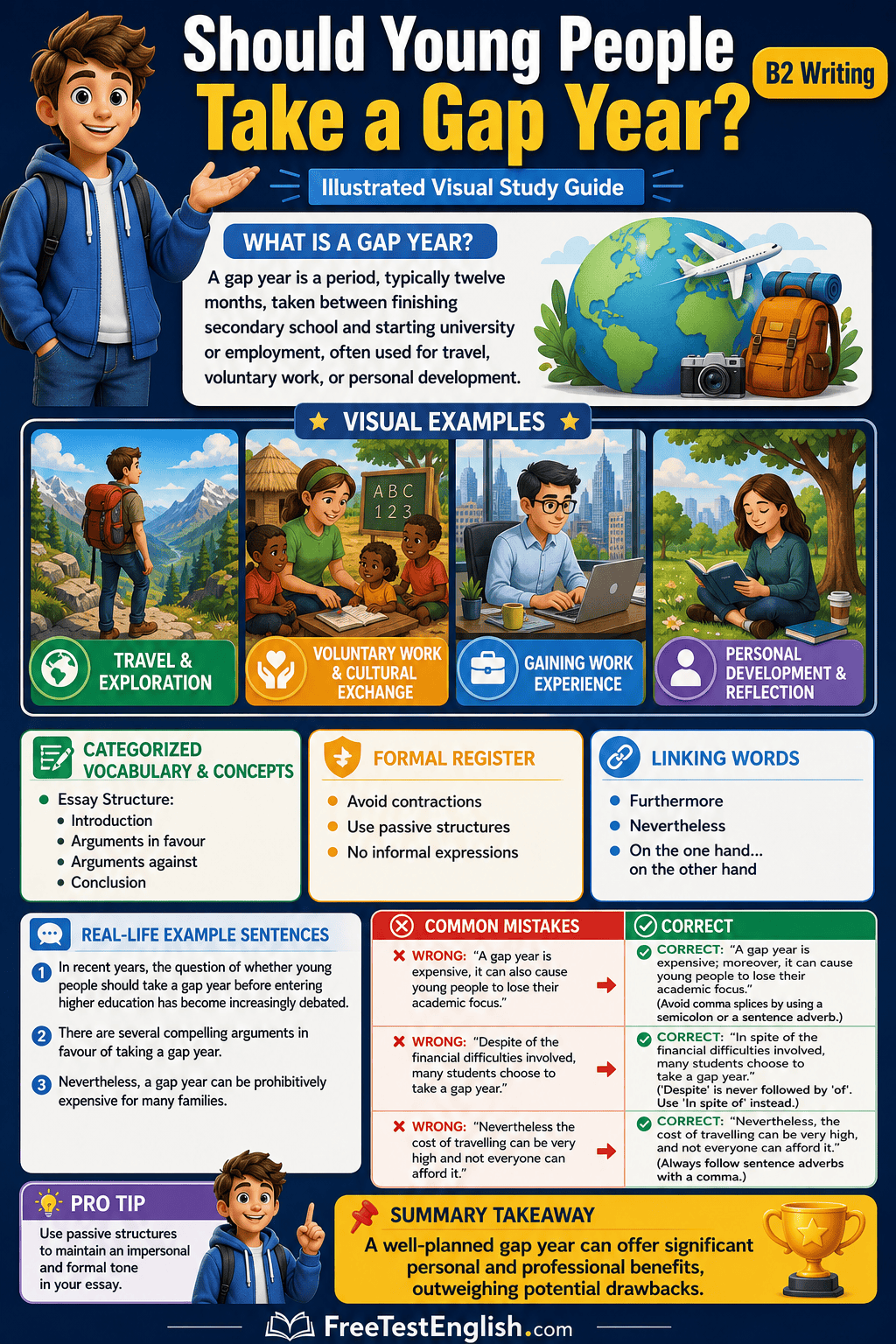
How to Write a For-and-Against Essay: Should Young People Take a Gap Year?
A for-and-against essay is a formal academic writing task in which you present the advantages and disadvantages of a particular issue in a balanced and organised way. Rather than simply expressing your personal opinion from the outset, you examine both sides of the argument carefully before arriving at a reasoned conclusion. This type of essay is commonly required in Cambridge B2 First (FCE) examinations and in real-life academic and professional contexts, such as university application statements, formal reports, and opinion columns in newspapers or educational journals.
In this lesson, you will learn how to write a well-structured for-and-against essay on the topic: Should young people take a gap year? A gap year is a period — typically twelve months — taken between finishing secondary school and beginning university or employment, often used for travel, voluntary work, or personal development.
Essential Writing Rules & Sentence Structure
1. Essay Structure for a For-and-Against Essay
A strong B2 for-and-against essay follows a clear four-paragraph structure:
- Paragraph 1 – Introduction: Introduce the topic and state why it is relevant or debated. Do not give your personal opinion here.
- Paragraph 2 – Arguments in favour: Present two or three advantages with supporting examples or reasoning.
- Paragraph 3 – Arguments against: Present two or three disadvantages with supporting examples or reasoning.
- Paragraph 4 – Conclusion: Summarise both sides and give your balanced personal verdict.
2. Writing a Strong Introduction
Your introduction should present the topic clearly without immediately revealing your opinion. Use impersonal or passive structures to sound formal and objective.
Formula: General statement about the topic + why people debate it + indication that both sides will be examined.
Example: In recent years, the question of whether young people should take a gap year before entering higher education has become increasingly debated. Proponents argue that such an experience builds independence and resilience, whereas critics suggest it may be a costly distraction. Both perspectives merit careful consideration.
3. Topic Sentences for Body Paragraphs
Each body paragraph must begin with a clear topic sentence that signals to the reader whether the paragraph will discuss advantages or disadvantages.
- For advantages: There are several compelling arguments in favour of taking a gap year.
- For disadvantages: Nevertheless, there are notable drawbacks that must be acknowledged.
4. Formal Register: What to Avoid
A for-and-against essay requires a consistently formal register. This means you must avoid:
- Contractions: write do not, not don't; it is, not it's
- Informal phrasal verbs: write investigate not look into; encounter not come across
- Colloquial expressions: avoid loads of, a lot of kids, pretty good
- First-person opinion in the introduction or body paragraphs (save it for the conclusion)
5. Using Passive Structures for Objectivity
Passive constructions help maintain an impersonal, academic tone throughout the essay body.
- It is widely believed that a gap year can significantly broaden a young person's perspective.
- It has been argued that taking time away from study may lead to a loss of academic momentum.
- Gap years are often regarded as a valuable opportunity for personal growth.
6. Punctuation with Discourse Markers
Sentence adverbs and linking phrases must be followed by a comma when they appear at the start of a sentence or clause.
- ✅ Furthermore, a gap year can improve employability.
- ✅ Nevertheless, financial constraints may prevent many students from benefiting.
- ✅ On balance, the advantages appear to outweigh the disadvantages.
Useful Linking Words (Connectors)
The following connectors are essential for writing a cohesive and sophisticated B2 for-and-against essay. Study the function of each connector and its example carefully before practising with your own sentences.
| Connector | Function / Use | Example Sentence |
|---|---|---|
| Furthermore | Adding a point that strengthens the same argument | Furthermore, a gap year provides young people with the opportunity to develop communication skills. |
| Moreover | Adding an additional, often stronger, supporting point | Moreover, employers frequently regard international experience as a significant advantage. |
| In addition to this | Introducing a supplementary point | In addition to this, voluntary work during a gap year can demonstrate social commitment. |
| Nevertheless | Introducing a contrasting point despite what has just been said | Nevertheless, a gap year can be prohibitively expensive for many families. |
| Nonetheless | Conceding a point while maintaining an overall argument | Nonetheless, careful financial planning can make a gap year accessible to most students. |
| Whereas | Contrasting two different ideas within one sentence | Whereas some students return from their gap year highly motivated, others struggle to readjust to academic life. |
| In spite of / Despite the fact that | Acknowledging a concession before making a contrasting point | In spite of the financial challenges involved, many students consider a gap year to be an invaluable experience. |
| On the one hand... on the other hand | Presenting two opposing ideas in a balanced structure | On the one hand, a gap year can foster independence; on the other hand, it may delay academic progression. |
| Consequently | Showing a result or consequence of the previous point | Consequently, students who take a gap year may find it difficult to return to a structured academic environment. |
| As a consequence | Indicating a result in a slightly more formal phrasing | As a consequence, the skills acquired during a gap year are often directly transferable to the workplace. |
| Taking everything into consideration | Introducing the final balanced conclusion | Taking everything into consideration, a gap year appears to offer more benefits than drawbacks for most young people. |
| On balance | Giving a final weighed verdict | On balance, the personal and professional benefits of a gap year outweigh the potential risks. |
Model Writing Sample: Should Young People Take a Gap Year?
Read the following model essay carefully. Notice how each paragraph has a clear purpose, how connectors are used to link ideas, and how a formal register is maintained throughout. The word count is within the Cambridge B2 First standard range of 140–190 words.
The question of whether young people should take a gap year before entering university has generated considerable debate in recent years. While some regard it as an invaluable opportunity, others view it with scepticism.
There are several compelling arguments in favour of a gap year. First and foremost, it allows young people to develop independence, resilience, and practical life skills that are rarely acquired in a classroom. Furthermore, voluntary work or international travel can significantly broaden one's cultural perspective, making graduates more adaptable and self-aware. Employers, too, are increasingly likely to view such experience as an asset.
Nevertheless, there are notable disadvantages to consider. A gap year can be financially demanding, and not all students have access to the resources required. Moreover, some individuals may lose academic momentum and consequently find it challenging to readjust to the demands of higher education.
Taking everything into consideration, a gap year can be enormously beneficial, provided it is approached with clear goals and careful planning. On balance, the advantages appear to outweigh the drawbacks for most young people.
Word count: 174 words
Model Essay Breakdown
| Paragraph | Purpose | Key Features |
|---|---|---|
| Paragraph 1 – Introduction | Introduces the topic and frames the debate | Impersonal tone; no personal opinion stated; topic clearly contextualised |
| Paragraph 2 – Arguments For | Presents two or three advantages with reasoning | Topic sentence; 'First and foremost', 'Furthermore'; formal vocabulary; no contractions |
| Paragraph 3 – Arguments Against | Presents key disadvantages with supporting reasoning | 'Nevertheless' signals the shift; 'Moreover', 'consequently'; balanced and objective |
| Paragraph 4 – Conclusion | Delivers a reasoned personal verdict | 'Taking everything into consideration', 'On balance'; conditional clause adds nuance |
Key Phrases & Sentence Starters
Introducing the Topic (Introduction)
- The question of whether ... has generated considerable debate in recent years.
- It is widely acknowledged that ... ; however, opinions remain divided.
- In recent years, the issue of ... has become increasingly prominent.
- Both perspectives merit careful consideration.
Presenting Arguments & Evidence
- There are several compelling arguments in favour of ...
- First and foremost, it is important to acknowledge that ...
- It is widely believed that ...
- It has been demonstrated that ...
- A further advantage is that ...
- Evidence suggests that young people who ... tend to ...
Contrasting & Conceding Points
- Nevertheless, there are notable drawbacks that must be acknowledged.
- On the other hand, critics argue that ...
- Whereas some students ..., others ...
- In spite of the benefits outlined above, ...
- Despite the fact that ... , it remains the case that ...
- While it is true that ..., it is equally important to recognise that ...
Concluding & Giving a Verdict
- Taking everything into consideration, ...
- On balance, the advantages appear to outweigh the disadvantages.
- In conclusion, while both sides present valid arguments, ...
- It would appear that ..., provided that ...
- Ultimately, the decision to ... should depend on individual circumstances.
Common Writing Mistakes to Avoid
Study these four typical errors made by B2 learners writing for-and-against essays. Make sure you understand why each error is wrong before completing your own writing task.
❌ A gap year is expensive, it can also cause young people to lose their academic focus.
✅ A gap year is expensive; moreover, it can cause young people to lose their academic focus.
Explanation: This is a comma splice — two independent clauses cannot be joined by a comma alone. Use a semicolon, a coordinating conjunction (such as and or but), or a sentence adverb followed by a comma (e.g. Moreover,).
❌ Despite of the financial difficulties involved, many students choose to take a gap year.
✅ In spite of the financial difficulties involved, many students choose to take a gap year.
Explanation: Despite is never followed by of. You must write either Despite + noun / -ing (e.g. Despite the cost) or In spite of + noun / -ing. The phrase despite of does not exist in standard English.
❌ Nevertheless the cost of travelling can be very high and not everyone can afford it.
✅ Nevertheless, the cost of travelling can be very high, and not everyone can afford it.
Explanation: Sentence adverbs such as Nevertheless, Furthermore, Moreover, and Consequently must always be followed by a comma when they introduce a new sentence or clause. Omitting this comma is one of the most common punctuation errors at B2 level.
❌ I think gap years are pretty great because you get loads of cool experiences and stuff.
✅ It is widely regarded that gap years offer young people a range of significant personal and professional benefits.
Explanation: A for-and-against essay requires a formal, impersonal register throughout the body paragraphs. Avoid informal vocabulary (pretty great, loads of, cool, stuff), first-person assertions in the body, and contractions. Use passive structures and formal vocabulary to maintain the appropriate academic tone.
Writing Checklist & Practice Task
B2 For-and-Against Essay Checklist
Before submitting your essay, go through each point on this checklist carefully. Tick each item only when you are confident it has been addressed.
- ☐ My essay has four clear paragraphs: introduction, arguments for, arguments against, and conclusion.
- ☐ My introduction presents the topic in an impersonal way without stating my personal opinion immediately.
- ☐ Each body paragraph begins with a clear topic sentence that signals the content of that paragraph.
- ☐ I have used at least three different linking devices (e.g. Furthermore, Nevertheless, Whereas) correctly with appropriate punctuation.
- ☐ I have maintained a consistently formal register — no contractions, no informal phrasal verbs, no colloquial expressions.
- ☐ I have used at least one passive structure (e.g. It is widely believed that... / It has been argued that...).
- ☐ I have avoided comma splices — every sentence is grammatically complete and correctly punctuated.
- ☐ All sentence adverbs (Furthermore, Nevertheless, Consequently) are followed by a comma.
- ☐ I have NOT written despite of — I have used either despite + noun or in spite of + noun.
- ☐ My conclusion presents a balanced personal verdict using an appropriate concluding phrase (e.g. On balance, Taking everything into consideration).
- ☐ My essay is within the target word range of 140–190 words.
Your Practice Writing Task
Now write your own for-and-against essay in response to the following Cambridge B2 First-style prompt. Aim for 140–190 words and follow the four-paragraph structure practised in this lesson.
Writing Task:
You have been discussing gap years in your English class. Your teacher has asked you to write a for-and-against essay on the following question:
Should all young people be encouraged to take a gap year before starting university?
Write your essay in 140–190 words. Remember to present arguments both for and against the idea before giving your own balanced verdict in the conclusion.
Planning Prompts to Help You
Before you write, spend five minutes making brief notes on each of the following:
- Arguments for: personal development, independence, work experience, travel, motivation upon returning
- Arguments against: financial cost, loss of academic focus, risk of wasted time, not suitable for all personalities
- Your verdict: Which side has the stronger argument? What condition or qualification makes your conclusion balanced? (e.g. provided it is planned carefully...)
Now test your writing mechanics and sentence skills in the exercises below.
📄 Download the Should Young People Take a Gap Year? PDF
Download this Should Young People Take a Gap Year? grammar lesson as a free printable PDF.
It includes grammar rules, examples, and explanations so you can study offline anytime.