

Exercise 1
Read the sentences below. Choose the one that uses correct punctuation, capitalization, and spelling for a formal email making a request or proposal.
Example: Which sentence is correct?
A) i am writing to request your approval for the proposed budget increase.
B) I am writing to Request your approval for the proposed budget increase.
C) I am writing to request your approval for the proposed budget increase.
D) I am writing, to request your approval, for the proposed Budget increase.
Answer: C) I am writing to request your approval for the proposed budget increase.
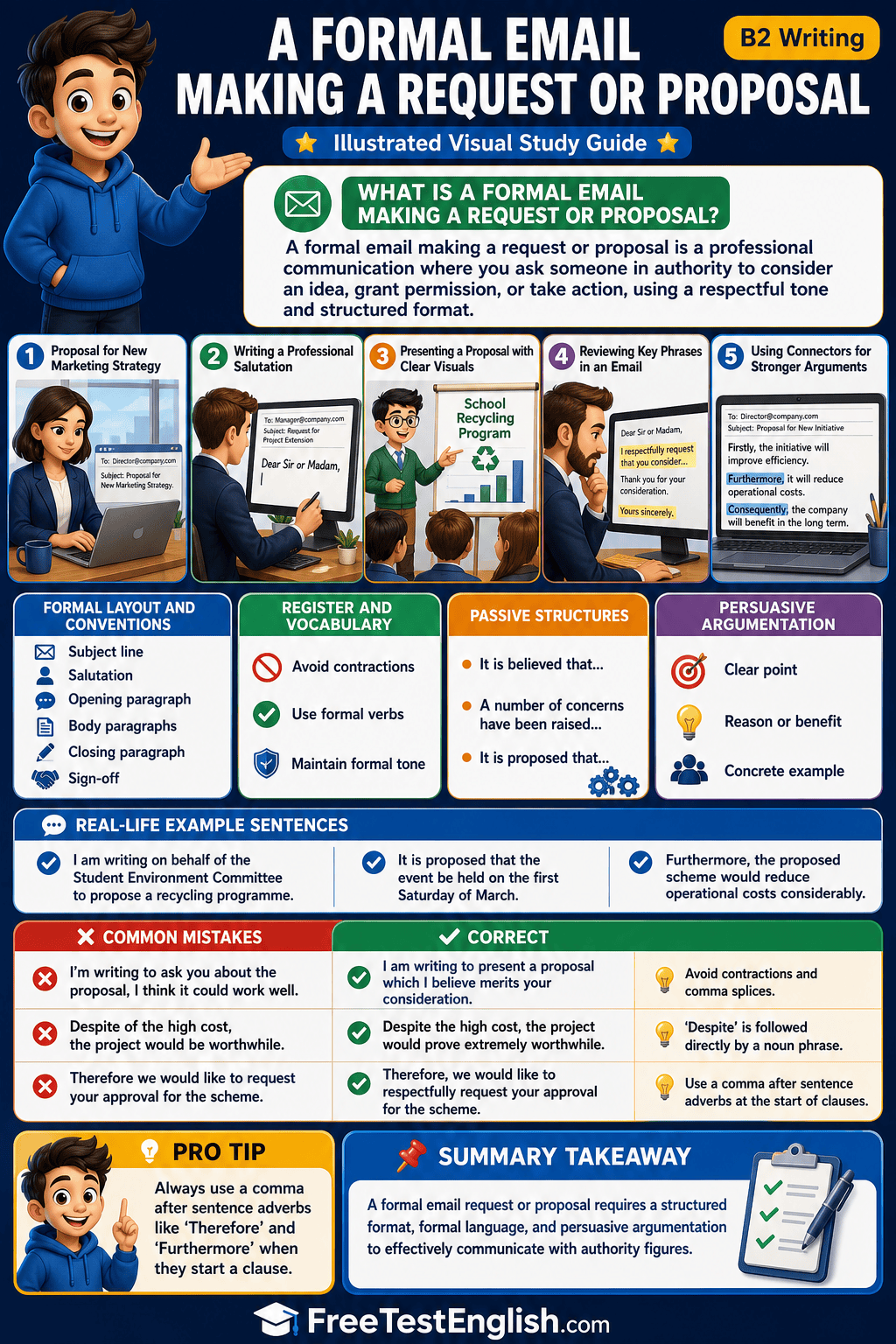
How to Write a Formal Email Making a Request or Proposal
A formal email making a request or proposal is a type of professional written communication in which you ask someone in authority — such as a manager, headteacher, company director, or public official — to consider an idea, grant permission, or take a specific action. Unlike an informal email to a friend, this type of writing requires a serious, respectful tone, precise vocabulary, and a clear, logical structure.
In real life, you might write this kind of email to request funding for a school project, propose a new workplace policy, ask a company to sponsor an event, or invite a guest speaker to a conference. In the Cambridge B2 First (FCE) examination, this task tests your ability to use formal conventions, organise ideas persuasively, and demonstrate a wide range of accurate language.
This lesson will guide you through every stage of writing a successful formal request or proposal email at B2 level.
Essential Writing Rules and Structure
1. Formal Layout and Conventions
A formal email follows a strict, predictable layout. Unlike a formal letter, you do not need to include postal addresses, but all other formal conventions must be respected. Follow this structure carefully:
- Subject line: Clear, specific, and professional (e.g. Proposal for an Environmental Awareness Campaign).
- Salutation: Use Dear Mr / Mrs / Ms / Dr [Surname] if you know the recipient's name. Use Dear Sir or Madam if you do not.
- Opening paragraph: State who you are, why you are writing, and where you heard about the opportunity or issue.
- Body paragraphs (x2): Present your request or proposal clearly, with reasons, benefits, and supporting details.
- Closing paragraph: Summarise your request, express willingness to discuss further, and thank the recipient.
- Sign-off: Use Yours sincerely (if you used a named salutation) or Yours faithfully (if you used Dear Sir or Madam), followed by your full name.
2. Register and Vocabulary
Maintaining a consistently formal register throughout the email is essential at B2 level. Avoid contractions (don't, I'm, it's), colloquial expressions, and phrasal verbs where a single formal verb is available.
- Use request instead of ask for
- Use inform instead of let you know
- Use propose instead of come up with
- Use enquire instead of check
- Use consider instead of think about
3. Passive Structures for Impersonal Tone
Using the passive voice adds formality and objectivity to your writing. It shifts the focus from the individual writer to the action or situation itself.
- It is believed that this initiative would greatly benefit the local community.
- A number of concerns have been raised regarding the current facilities.
- It is proposed that the event be held on the first Saturday of March.
4. Persuasive Argumentation
A request or proposal email must be persuasive as well as polite. Each paragraph should contain a clear point, a reason or benefit, and where appropriate, a concrete example or supporting detail. Avoid vague statements; instead, be specific and confident without being aggressive.
Useful Linking Words (Connectors)
The following connectors are appropriate for a formal email making a request or proposal at B2 level. Using a variety of these accurately will significantly improve the cohesion and professionalism of your writing.
| Connector | Function / Use | Example Sentence |
|---|---|---|
| Furthermore | Adding a related, equally important point | Furthermore, the proposed scheme would reduce operational costs considerably. |
| Moreover | Adding a stronger or more significant point | Moreover, similar projects have already proved successful in neighbouring districts. |
| In addition to this | Adding supplementary information | In addition to this, the initiative would create new employment opportunities for residents. |
| Consequently | Showing a result or outcome | Consequently, we believe the proposal merits serious consideration. |
| Therefore | Drawing a logical conclusion | Therefore, I would respectfully request that you review the attached plan. |
| For this reason | Explaining a cause leading to a request | For this reason, we feel it is essential that funding be secured before April. |
| Whereas | Contrasting two different situations | Whereas the current system is both costly and inefficient, the proposed model would offer significant savings. |
| Nevertheless | Conceding a point before asserting your argument | Nevertheless, we remain confident that the long-term benefits far outweigh any initial investment. |
| Despite the fact that | Conceding a difficulty or drawback | Despite the fact that resources are currently limited, this project could be implemented in stages. |
| Taking everything into consideration | Summarising before a final statement or request | Taking everything into consideration, I sincerely hope you will look favourably upon this proposal. |
Model Writing Sample: Proposal for a School Recycling Programme
Read the following model email carefully. Notice how it uses formal language, a clear structure, persuasive reasoning, and appropriate connectors throughout.
Subject: Proposal for a School-Wide Recycling Programme
Dear Ms Harrison,
I am writing on behalf of the Student Environment Committee to propose the introduction of a school-wide recycling programme at Westfield Academy. Having observed the considerable amount of waste produced on a daily basis, we believe that immediate action is both necessary and achievable.
It is proposed that clearly labelled recycling stations be installed in each corridor and classroom. Furthermore, a short awareness campaign — comprising informative posters and a brief assembly presentation — would be organised to educate students and staff on responsible waste management. Similar schemes have been introduced successfully in several local schools, and it has been demonstrated that participation rates increase significantly when students are actively involved in the planning process.
In addition to this, the programme would cost the school very little, as several local businesses have already expressed willingness to donate the necessary materials. Consequently, we feel this represents an excellent opportunity to reduce the school's environmental impact at minimal expense.
Taking everything into consideration, I would be most grateful if you could arrange a meeting at your earliest convenience to discuss this proposal further. I look forward to hearing from you.
Yours sincerely,
Jamie Fowler
Chair, Student Environment Committee
Model Text Breakdown and Annotation
- Subject line: Specific and professional — tells the reader exactly what the email concerns before they open it.
- Salutation: Dear Ms Harrison — named recipient, so Yours sincerely is used at the close.
- Opening paragraph: States the writer's identity, role, and clear purpose. The phrase I am writing on behalf of... is a formal and highly transferable opener.
- First body paragraph: Presents the core proposal with specific details (recycling stations, awareness campaign). Uses the passive (it is proposed that...) for formality. The connector Furthermore adds a related point smoothly.
- Second body paragraph: Strengthens the argument with evidence (local schools, business donations) and anticipated benefits. In addition to this and Consequently show logical development.
- Closing paragraph: Makes a polite, specific request (a meeting) and closes with a forward-looking phrase. Taking everything into consideration signals the conclusion effectively.
- Sign-off: Yours sincerely is correct because a named salutation was used. Full name and title are provided.
Word count: 182 words — within the B2 target range of 140–190 words.
Key Phrases and Sentence Starters
Opening and Stating Purpose
- I am writing to formally propose / request / enquire about...
- I am writing on behalf of [name / organisation] to suggest...
- The purpose of this email is to bring to your attention...
- Following our recent discussion / your advertisement regarding...
- It has come to our attention that...
Presenting the Request or Proposal
- I would like to propose that... / It is proposed that...
- We would be most grateful if you could consider...
- I respectfully request that you / the committee...
- It is suggested that the following measures be implemented...
- In light of the above, we believe that...
Providing Reasons, Benefits, and Evidence
- This initiative would significantly benefit... / greatly improve...
- It has been demonstrated that similar schemes have proved effective in...
- Furthermore / Moreover, this approach would also...
- Not only would this address [problem], but it would also...
- Evidence suggests that... / Research has shown that...
Conceding Difficulties or Acknowledging Concerns
- Despite the fact that initial costs may be a concern, it is important to note that...
- Whereas some may argue that..., it should be pointed out that...
- Nevertheless, we remain confident that...
- Although it is acknowledged that challenges exist, the long-term benefits...
Closing and Calling to Action
- Taking everything into consideration, I sincerely hope that...
- I would be most grateful if you could arrange / confirm / provide...
- I look forward to hearing from you at your earliest convenience.
- Please do not hesitate to contact me should you require any further information.
- I remain available to discuss this matter further at a time of your choosing.
Common Writing Mistakes to Avoid
❌ I'm writing to ask you about the proposal, I think it could work well.
✅ Correct: I am writing to present a proposal which I believe merits your consideration. — Never use contractions (I'm) in a formal email. Additionally, joining two independent clauses with only a comma creates a comma splice. Use a relative clause or a full stop instead.
❌ Despite of the high cost, the project would be worthwhile.
✅ Correct: Despite the high cost, the project would prove extremely worthwhile. — Despite is a preposition and is followed directly by a noun phrase, never by of. Compare: In spite of the high cost... (correct) or Despite the fact that the cost is high... (correct with a clause).
❌ Therefore we would like to request your approval for the scheme.
✅ Correct: Therefore, we would like to respectfully request your approval for the scheme. — Sentence adverbs such as Therefore, Furthermore, Nevertheless, and Consequently must always be followed by a comma when they appear at the start of a clause.
❌ We want to let you know that this programme will look into ways of cutting costs for students.
✅ Correct: We wish to inform you that this programme will investigate methods of reducing costs for students. — Avoid informal phrasal verbs (let you know, look into, cut costs) and replace them with formal single-word verbs (inform, investigate, reduce). Register consistency is critical in formal writing at B2 level.
Writing Checklist and Practice Task
B2 Formal Email Writing Checklist
Before you submit your writing, work through this checklist to ensure your email meets B2 standard:
- ☐ Have I included a clear, specific subject line?
- ☐ Have I used the correct salutation (Dear Mr / Mrs / Ms [Surname] or Dear Sir or Madam)?
- ☐ Have I stated who I am and my reason for writing clearly in the opening paragraph?
- ☐ Have I organised my proposal or request across two clear body paragraphs?
- ☐ Have I provided at least two reasons or benefits to support my request?
- ☐ Have I used at least two appropriate formal connectors (e.g. Furthermore, Consequently, Nevertheless)?
- ☐ Have I used at least one passive structure for formality?
- ☐ Have I avoided all contractions, informal vocabulary, and phrasal verbs?
- ☐ Have I placed a comma after sentence adverbs at the start of clauses?
- ☐ Have I ended with a polite call to action and forward-looking closing statement?
- ☐ Have I used the correct sign-off (Yours sincerely or Yours faithfully) followed by my full name?
- ☐ Is my email between 140 and 190 words?
Practice Task
Read the following exam-style prompt carefully and write your formal email in 140–190 words.
You are a member of your local community sports club. The club's facilities have not been updated in many years, and several members have expressed frustration. You have been asked to write a formal email to the local council representative, Ms Rachel Webb, proposing improvements to the facilities and requesting financial support for the project.
In your email, you should:
- explain the current situation and why improvements are needed
- propose two specific improvements to the facilities
- request financial support and explain why the council should consider this investment
- invite Ms Webb to visit the club and discuss the proposal further
Write your formal email in an appropriate style. Remember to use a subject line, correct salutation, formal register throughout, and the correct sign-off.
Now test your writing mechanics and sentence skills in the exercises below.
📄 Download the A Formal Email Making a Request or Proposal PDF
Download this A Formal Email Making a Request or Proposal grammar lesson as a free printable PDF.
It includes grammar rules, examples, and explanations so you can study offline anytime.