

Exercise 1
Arrange the words in the correct order to form a proper English sentence about a life-changing experience.
Instructions: Look at the words below. Put them in the correct order to make a grammatically correct sentence. Pay attention to verb tense, subject position, and sentence structure.
Example: completely / the / changed / accident / my / life / that
Answer: That accident completely changed my life.
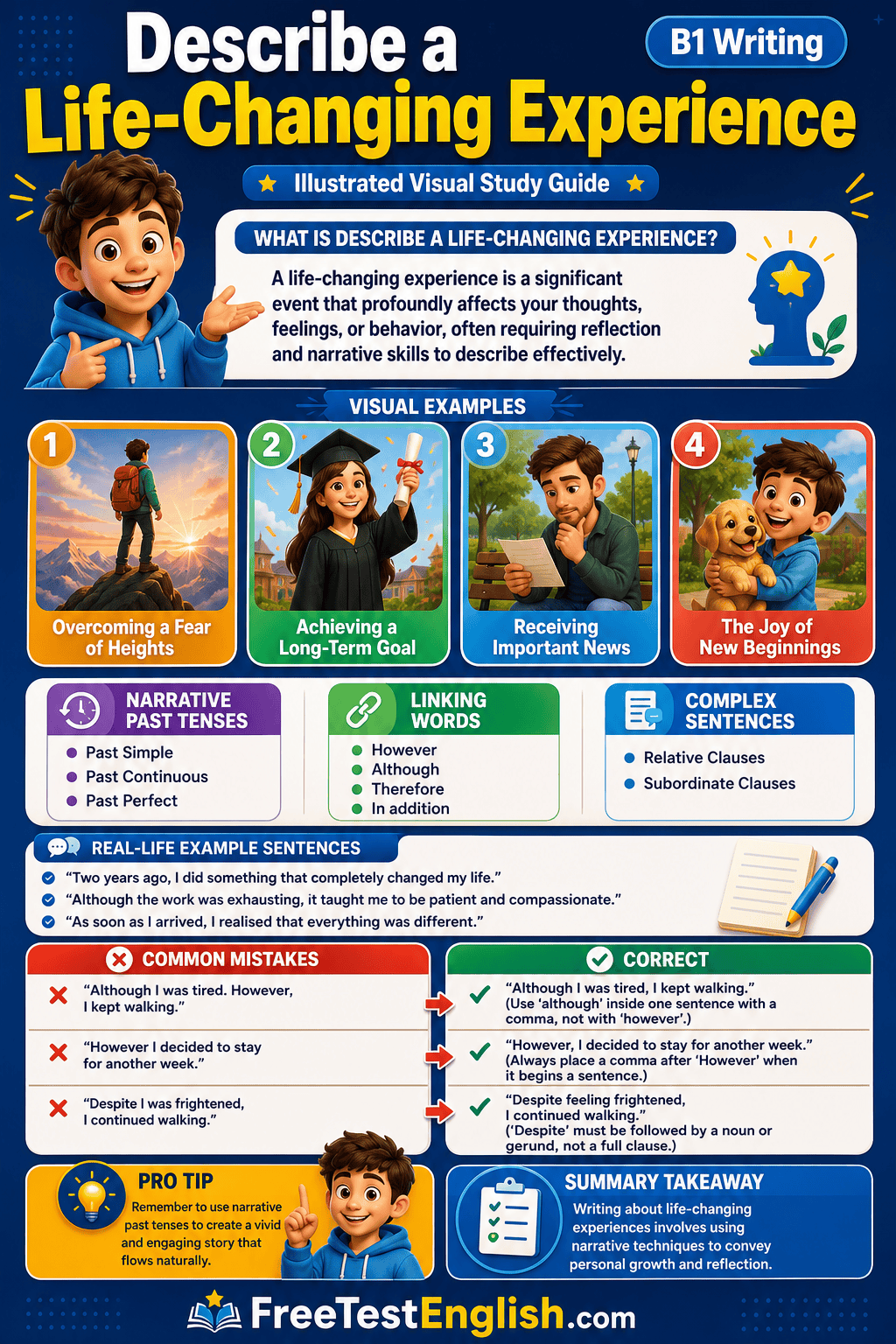
How to Write About a Life-Changing Experience in English
A life-changing experience is an event or moment that had a powerful effect on who you are — something that changed the way you think, feel, or behave. Writing about a personal experience like this is a common task in B1-level English exams, school magazines, and personal essays. You might be asked to write a short narrative story, an article for a website, or even an email to a friend describing something that happened to you.
Good writers at B1 level do more than simply retell events. They use narrative past tenses to build a story, linking words to connect ideas smoothly, and personal reflection to explain why the experience mattered. Real-life examples of life-changing experiences include travelling abroad for the first time, losing someone important, starting a new school, or overcoming a fear.
In this lesson, you will learn exactly how to write a powerful, well-organised personal narrative of 100–120 words that impresses examiners and engages readers.
Essential Writing Rules and Sentence Structure
1. Use Three or Four Clear Paragraphs
A well-structured B1 personal narrative should have the following shape:
- Paragraph 1 – Introduction: Introduce the experience. When and where did it happen? Who was involved?
- Paragraph 2 – What happened: Describe the key events in order. Use narrative past tenses and time sequencers.
- Paragraph 3 – How it changed you: Explain the impact. What did you learn? How did you feel afterwards?
- Paragraph 4 – Conclusion (optional): Reflect briefly on why this experience is still important to you today.
2. Use Narrative Past Tenses Correctly
B1 writers must use three past tenses together naturally in a narrative:
- Past simple — for completed actions in the story: I arrived at the airport early in the morning.
- Past continuous — for background actions or atmosphere: Everyone was rushing around and talking loudly.
- Past perfect — for actions that happened before another past action: I had never travelled alone before that day.
3. Build Complex Sentences with Relative Clauses
Avoid writing only short, simple sentences. Connect your ideas using relative clauses with who, which, that, and where.
- I met a woman who spoke four languages fluently.
- It was an experience that I will never forget.
- We stayed in a small village where there was no electricity.
4. Use Subordinate Clauses for Richer Sentences
Add detail and depth by including subordinate clauses with words like although, even though, because, since, as soon as, and while.
- Although I was frightened at first, I decided to keep going.
- As soon as I arrived, I realised that everything was different.
- While we were climbing the mountain, I began to feel truly alive.
5. Use Time Sequencers to Order Events
Keep your story easy to follow by using time sequencers to signal the order of events:
- First… Then… After that… Finally… In the end…
- A few hours later… The following morning… By the time…
Useful Linking Words (Connectors)
The table below shows the most important connectors for a B1 personal narrative. Study the function and example of each one carefully.
| Connector | Function / Use | Example Sentence |
|---|---|---|
| however | Introduces a contrast. Placed at the start of a new sentence. Always followed by a comma. | I was nervous about travelling alone. However, I knew it was the right decision. |
| although | Introduces a contrast within one sentence. Never followed by a comma when it starts a clause mid-sentence. | Although the journey was exhausting, it was completely worth it. |
| even though | Similar to 'although' but stronger in emphasis. | Even though I had prepared carefully, nothing went according to plan. |
| therefore | Shows a logical result or conclusion. Followed by a comma. | I had missed my connection. Therefore, I had to spend the night at the airport. |
| as a result | Shows a consequence of something. Followed by a comma. | We lost our way in the forest. As a result, we arrived two hours late. |
| in addition | Adds an extra piece of information. Followed by a comma. | The volunteer work was challenging. In addition, it taught me a great deal about myself. |
| as soon as | Shows that one thing happened immediately after another. | As soon as I saw the ocean for the first time, I burst into tears. |
| while | Shows two actions happening at the same time. Often used with the past continuous. | While I was waiting for my flight, I started to feel genuinely excited. |
| because | Gives a reason. Used in the middle of a sentence. | I decided to stay an extra week because I had fallen in love with the place. |
| since | Gives a reason (more formal) or indicates a point in time. | Since that day, I have seen the world very differently. |
| so that | Expresses purpose — explains why someone did something. | I saved for two years so that I could take this trip. |
| despite | Shows contrast. Always followed by a noun or gerund (-ing), never a full clause. | Despite the cold weather, we continued walking through the mountains. |
Model Writing Sample: The Day That Changed Everything
Read the model text below carefully. Notice how the writer uses narrative past tenses, linking words, relative clauses, and personal reflection. The word count is 115 words — exactly right for a B1 exam task.
Task Prompt
Write a short article for your school's English-language magazine about a life-changing experience. Describe what happened, how you felt, and what you learnt from it. Write 100–120 words.
Model Text
[Title] The Day That Changed Everything
[Introduction — sets the scene and hooks the reader]
Two years ago, I did something that completely changed my life. I volunteered at an animal rescue centre in the countryside, which was something I had always wanted to do but had never had the courage to try.
[Body Paragraph 1 — describes what happened using narrative past tenses and time sequencers]
On my first morning, I was feeling terrified. However, as soon as I started caring for a young dog that had been injured in an accident, my nerves disappeared completely. While I was feeding the animals, I realised that I had found something truly meaningful.
[Body Paragraph 2 — explains the impact and what the writer learnt]
Although the work was exhausting, it taught me to be patient and compassionate. In addition, I discovered that helping others — even animals — gives you a real sense of purpose. Since that experience, I have decided to study veterinary science at university.
[Conclusion — personal reflection, memorable closing line]
I would definitely recommend volunteering to anyone who feels lost or uncertain. Sometimes, the experiences that frighten you the most are the ones that change you for the better.
Model Text Annotation
- Catchy title: The Day That Changed Everything — grabs the reader's attention immediately.
- Narrative past tenses: Past simple (I volunteered), past continuous (I was feeling terrified), past perfect (I had always wanted).
- Relative clause: which was something I had always wanted to do
- Linking words used: However, as soon as, While, Although, In addition, Since
- Personal reflection: Explains feelings, lessons learnt, and future plans.
- Recommendation: Ends with advice to the reader — typical of a magazine article.
Key Phrases and Sentence Starters
Opening Lines — Introducing Your Experience
- Two years ago, I had an experience that completely changed the way I see the world.
- I will never forget the moment when…
- It all started on an ordinary morning, when something extraordinary happened.
- Last summer, I did something that I had always dreamed of doing.
- At first, I had no idea how much this experience would affect me.
Describing Events — What Happened
- As soon as I arrived, I realised that…
- While I was [doing something], I noticed that…
- Before I knew it,…
- After a few hours / days / weeks,…
- By the time we finished, I had completely forgotten my earlier worries.
- I had never [done something] before, so I felt…
Expressing Feelings
- I was absolutely terrified / amazed / overwhelmed / moved.
- Although I felt nervous at first, I soon began to feel…
- I couldn't believe how [adjective] it all was.
- It was one of the most [adjective] moments of my life.
Explaining the Impact and What You Learnt
- This experience taught me that…
- Since that day, I have looked at [something] very differently.
- As a result, I decided to…
- I now realise that…
- In addition, I discovered that…
Closing Lines — Reflection and Recommendation
- I would definitely recommend this experience to anyone who…
- If I could give one piece of advice, it would be to…
- Looking back, I am so glad that I had the courage to…
- It was an experience that I will carry with me for the rest of my life.
- Sometimes the things that scare us the most are the ones that change us for the better.
Common Writing Mistakes to Avoid
Mistake 1 — Confusing 'although' and 'however'
❌ Although I was tired. However, I kept walking.
✅ Although I was tired, I kept walking. — Use although inside one sentence with a comma. Do not add however after it. They both show contrast but cannot be used together in the same sentence.
Mistake 2 — Forgetting the comma after linking adverbs
❌ However I decided to stay for another week.
✅ However, I decided to stay for another week. — Always place a comma after However, Therefore, In addition, and As a result, when they begin a sentence.
Mistake 3 — Using 'despite' with a full clause
❌ Despite I was frightened, I continued walking.
✅ Despite feeling frightened, I continued walking. — Despite must be followed by a noun or an -ing verb (gerund), never by a subject and verb. Use although or even though if you want to use a full clause.
Mistake 4 — Mixing up past tenses incorrectly
❌ While I walked to the station, I see a rainbow.
✅ While I was walking to the station, I saw a rainbow. — Use the past continuous (was walking) for a background action in progress, and the past simple (saw) for the shorter action that interrupts it. Never use the present tense in a narrative about the past.
Mistake 5 — Misspelling key B1 vocabulary
❌ It was definately the most importent experiance of my life.
✅ It was definitely the most important experience of my life. — Learn these commonly misspelled words by heart: definitely, necessary, recommend, comfortable, disappointed, experience, environment.
Writing Checklist and Practice Task
Writing Checklist
Before you submit your writing, go through this checklist carefully. Tick each point when you are confident:
- ✅ Structure: Did you write 3–4 clear paragraphs with an introduction, main events, personal reflection, and a closing sentence?
- ✅ Word count: Is your text between 100 and 120 words?
- ✅ Narrative past tenses: Did you correctly use the past simple, past continuous, and past perfect in your story?
- ✅ Linking words: Did you use at least three different connectors from the table above (e.g. although, however, as a result, since, while)?
- ✅ Complex sentences: Did you include at least one relative clause using who, which, that, or where?
- ✅ Feelings and reflection: Did you explain how you felt and what you learnt from the experience?
- ✅ Comma after linking adverbs: Did you check that However, Therefore, and In addition, are followed by a comma?
- ✅ Spelling: Did you check the spelling of key words such as definitely, experience, necessary, and recommend?
- ✅ Title and opening: If writing an article, did you include a catchy title and an engaging opening sentence?
Your Practice Task
Now write your own piece of 100–120 words using the prompt below:
Write a short article for your school's English-language magazine about a life-changing experience you have had. You should include:
- what the experience was and when it happened
- what happened during the experience
- how you felt and what you learnt from it
- why you would or would not recommend it to other people your age
Use the model text, key phrases, and linking words from this lesson to help you. Try to include a catchy title, at least one relative clause, and three different connectors.
Now test your writing mechanics and sentence skills in the exercises below.
📄 Download the Describe a Life-Changing Experience PDF
Download this Describe a Life-Changing Experience grammar lesson as a free printable PDF.
It includes grammar rules, examples, and explanations so you can study offline anytime.