

Exercise 1
Read the words below. Arrange them in the correct order to form a proper English sentence about plans or future activities.
Example: going / to / I / am / visit / my / friend / weekend / this
Answer: I am going to visit my friend this weekend.
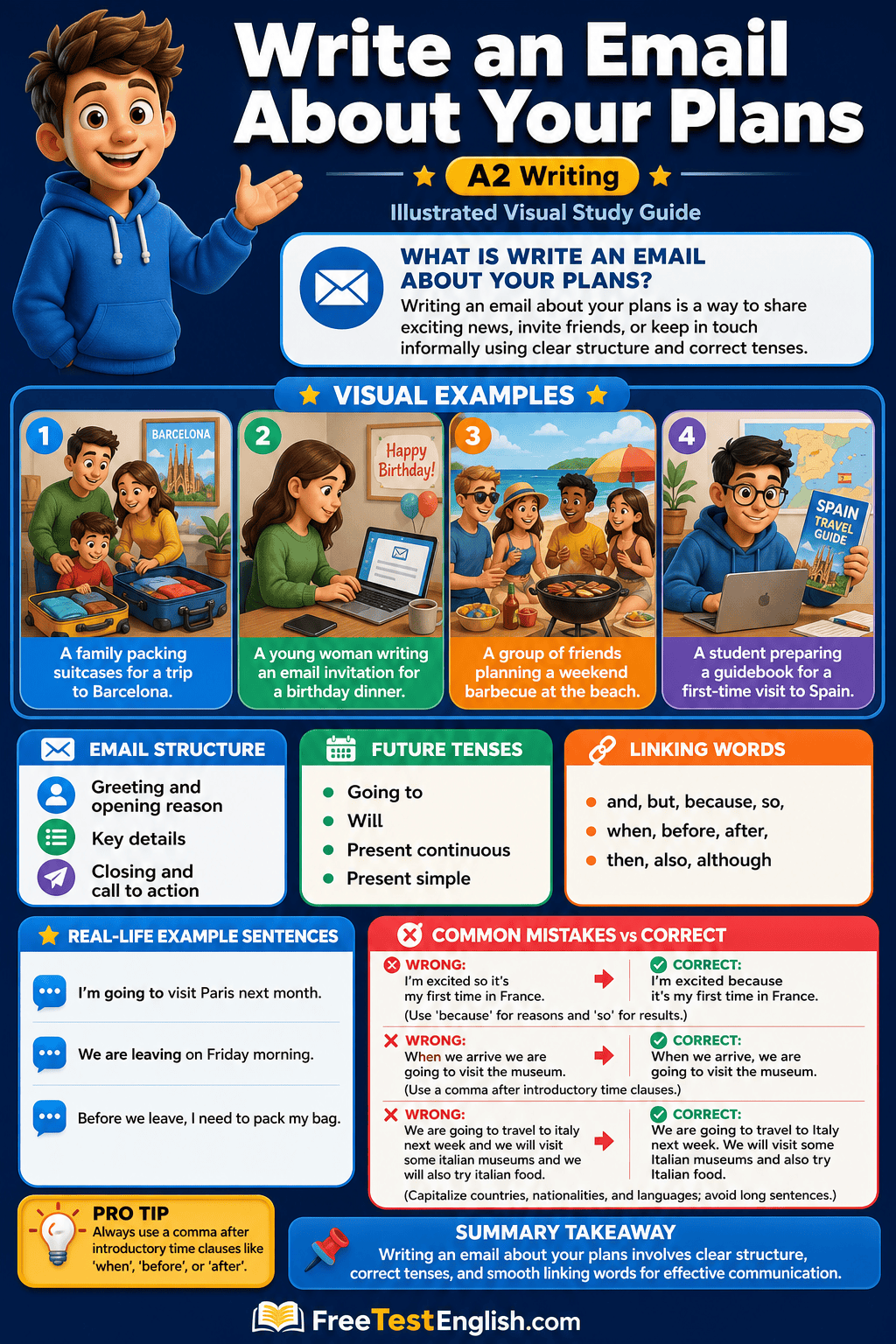
How to Write an Email About Your Plans in English
Do you want to tell a friend about something exciting you are going to do? Writing an email about your plans is a very common and useful skill in everyday English. We write this kind of email to share news, invite people to join us, or simply keep in touch with friends and family.
For example, you might write to a friend to say you are going to visit a new city, start a new class, or have a party at the weekend. This type of email is informal, which means it is relaxed and friendly — not like a business letter.
In this lesson, you will learn how to organise your email clearly, use the correct tenses to talk about the future, and connect your ideas with useful linking words. By the end, you will be ready to write your own email about your plans confidently!
Essential Writing Rules & Sentence Structure
1. Organise Your Email into Clear Paragraphs
A good A2 email has three short paragraphs. Each paragraph has a specific job:
- Paragraph 1 — Greeting and opening reason: Say hello and explain why you are writing.
- Paragraph 2 — Key details: Give information about your plans (what, when, where, who with).
- Paragraph 3 — Closing and call to action: Ask a question, make an invitation, or say goodbye warmly.
2. Use the Correct Tenses for Plans
When you write about future plans and arrangements, use these tenses:
- Going to — for personal plans you have already decided: "I'm going to visit Paris next month."
- Will — for offers, decisions made at the moment, or predictions: "It will be so much fun!"
- Present continuous — for fixed arrangements: "We are leaving on Friday morning."
- Present simple — for facts, feelings, and preferences: "I love travelling with my family."
3. Use Commas Correctly with Time Clauses
When a time clause comes at the beginning of a sentence, always use a comma after it.
- "When we arrive, we are going to visit the old market." ✅
- "Before we leave, I need to pack my bag." ✅
- "When we arrive we are going to visit the old market." ❌ (missing comma)
When the time clause comes at the end of the sentence, you do not need a comma.
- "I am going to pack my bag before we leave." ✅
4. Keep Your Sentences Short and Clear
At A2 level, aim for short, clear sentences. Connect two ideas using linking words, but avoid joining too many ideas in one sentence. One or two connectors per sentence is enough.
Useful Linking Words (Connectors)
Good writers connect their ideas smoothly. Use these linking words in your email about plans:
| Connector | Function / Use | Example Sentence |
|---|---|---|
| and | Adding information | I am going to visit Rome and see the Colosseum. |
| but | Showing contrast or a problem | I want to go swimming, but the weather might be cold. |
| because | Giving a reason (explains WHY) | I'm excited because it's my first time in Spain. |
| so | Giving a result (explains WHAT HAPPENS NEXT) | We finish school on Friday, so we are going to celebrate. |
| when | Connecting two events at the same time | When we arrive, I am going to find a nice café. |
| before | Saying what happens first (time sequence) | Before we leave, I need to buy some new clothes. |
| after | Saying what happens second (time sequence) | After the tour, we are going to have dinner together. |
| then | Showing what happens next in a sequence | We are going to the beach, then we will have a barbecue. |
| also | Adding an extra point | We are going to visit a museum. We are also going to try local food. |
| although | Making a simple concession or contrast | Although the trip is short, I'm very happy about it. |
Important: Do not confuse because and so. Remember: because gives the reason, and so gives the result.
- ✅ "I'm packing warm clothes because it will be cold." (reason = it will be cold)
- ✅ "It will be cold, so I'm packing warm clothes." (result = I'm packing warm clothes)
Model Writing Sample: An Email to a Friend About Holiday Plans
Read this example email carefully. Notice how it is organised and how the writer uses linking words and future tenses.
Subject: My holiday plans!
Hi Chloe,
How are you? I hope you're well. I'm writing because I have some exciting news about my summer plans!
My family and I are going to travel to Barcelona next month. We're leaving on the 15th of July and we're going to stay for five days. Before we go, I need to buy a good guidebook because it's my first time in Spain. When we arrive, we're going to visit the famous Sagrada Família, and then we're going to relax on the beach. It will be wonderful!
Would you like to meet up when I get back? I'd love to tell you all about it. Let me know!
Best wishes,
Natalia
(Word count: 85 words)
Model Text Breakdown
| Part of the Email | What It Does | Example from the Text |
|---|---|---|
| Greeting | Addresses the reader by name in a friendly way | "Hi Chloe," |
| Opening sentence & reason | Asks how the reader is and says why you are writing | "How are you? I hope you're well. I'm writing because I have some exciting news about my summer plans!" |
| Main body — key details | Gives details: when, where, what you are going to do | "We're leaving on the 15th of July and we're going to stay for five days." |
| Linking words used | Connects ideas smoothly | because, before, when, and, then |
| Closing question / call to action | Invites a response or suggests a future plan | "Would you like to meet up when I get back? Let me know!" |
| Sign-off | Ends the email in a warm, friendly way | "Best wishes, Natalia" |
A Second Model Text: A Shorter Email About Weekend Plans
Here is a second, shorter example to show you a different type of plan email.
Subject: This weekend!
Dear James,
How are you? I'm writing because I want to invite you to my birthday dinner this Saturday!
We're going to eat at the new Italian restaurant in the town centre. Dinner starts at 7 o'clock. Although the restaurant is small, the food is fantastic. After dinner, we will go back to my flat for cake and music. It's going to be a great evening!
Can you come? Let me know soon because I need to book a table.
See you soon,
Marco
(Word count: 77 words)
Key Phrases & Sentence Starters
Use these ready-made phrases to help you write your own email. You can copy and adapt them for your writing task.
Greetings
- Hi [Name],
- Dear [Name],
- Hello [Name],
Opening Lines & Reason for Writing
- How are you? I hope you're well.
- I'm writing because I have some exciting news!
- I'm writing to tell you about my plans for [the summer / next weekend / the holidays].
- I'm writing to invite you to [my birthday / a dinner / a trip].
- I have some great news — I'm going to [visit / travel / start / try]...
Giving Details / Explanations
- I'm going to [destination / activity] on [date / day].
- We are leaving on [day / date] and we're going to stay for [number] days.
- When we arrive, we are going to...
- Before we leave, I need to...
- After that, we are going to...
- I'm excited because it's my first time in [place].
- Although [problem], I'm really looking forward to it.
- It's going to be [wonderful / amazing / so much fun]!
- We are also going to...
Ending Your Message & Sign-offs
- Would you like to come?
- Can you join us?
- Let me know if you can come.
- Could you let me know soon?
- I'd love to hear your news too!
- Hope to see you soon!
- Write back soon!
- Best wishes, [Your name]
- See you soon, [Your name]
- All the best, [Your name]
- Love, [Your name]
- Take care, [Your name]
Common Writing Mistakes to Avoid
Here are four mistakes that A2 writers often make. Study each one carefully so you can avoid them in your own writing.
❌ I'm excited so it's my first time in France.
✅ I'm excited because it's my first time in France. — Use because to give a reason (it explains WHY you are excited). Use so to give a result. These two words are not interchangeable.
❌ When we arrive we are going to visit the museum.
✅ When we arrive, we are going to visit the museum. — Always use a comma after an introductory time clause (a clause starting with when, before, or after) when it comes at the beginning of the sentence.
❌ We are going to travel to italy next week and we will visit some italian museums and we will also try italian food.
✅ We are going to travel to Italy next week. We will visit some Italian museums and also try Italian food. — Always capitalise the names of countries, nationalities, and languages (Italy, Italian). Also, avoid joining too many ideas in one long sentence. Break it into two or three shorter sentences.
❌ I dont know the exact time but I think it will be fun.
✅ I don't know the exact time, but I think it will be fun. — Use an apostrophe in contractions: don't (not dont), I'm (not Im), it's (not its when meaning "it is"). Also, use a comma before 'but' when it connects two complete clauses.
Writing Checklist & Practice Task
Writing Checklist
Before you submit your email, check each point on this list. Tick each box when you are happy with it.
- ☐ Greeting: Did you start with a friendly greeting, e.g. Hi [Name], or Dear [Name],?
- ☐ Opening line: Did you ask how your friend is and explain why you are writing?
- ☐ Key details: Did you include details about your plans — what, when, where, and who with?
- ☐ Future tenses: Did you use going to, will, or the present continuous correctly for future plans?
- ☐ Linking words: Did you use at least two linking words, such as because, so, when, before, after, or although?
- ☐ Commas: Did you add a comma after time clauses at the start of a sentence?
- ☐ Capitals: Did you capitalise countries, nationalities, languages, and names correctly?
- ☐ Apostrophes: Did you use apostrophes correctly in contractions: I'm, don't, it's, we're?
- ☐ Closing question: Did you invite a response or ask a question at the end?
- ☐ Sign-off: Did you end with a friendly sign-off and your name?
- ☐ Word count: Is your email between 60 and 90 words?
Your Practice Task
Read the writing prompt below and write your own email. Use the model texts, key phrases, and checklist above to help you.
Writing Prompt:
You are going to do something special next month. Write an email to your English friend, Sam. In your email:
- Say why you are writing and ask how Sam is.
- Tell Sam what you are going to do, when, and where.
- Give two details about your plans (activities, who you are going with, how you feel, etc.).
- Invite Sam to join you OR ask Sam to meet up when you return.
- End with a friendly sign-off.
Write 60–90 words.
Now test your writing mechanics and sentence skills in the exercises below.
📄 Download the Write an Email About Your Plans PDF
Download this Write an Email About Your Plans grammar lesson as a free printable PDF.
It includes grammar rules, examples, and explanations so you can study offline anytime.