

Exercise 1
Arrange the words in the correct order to form a proper English sentence about future plans.
Example: next / I / to / want / year / travel / Europe / to
Answer: I want to travel to Europe next year.
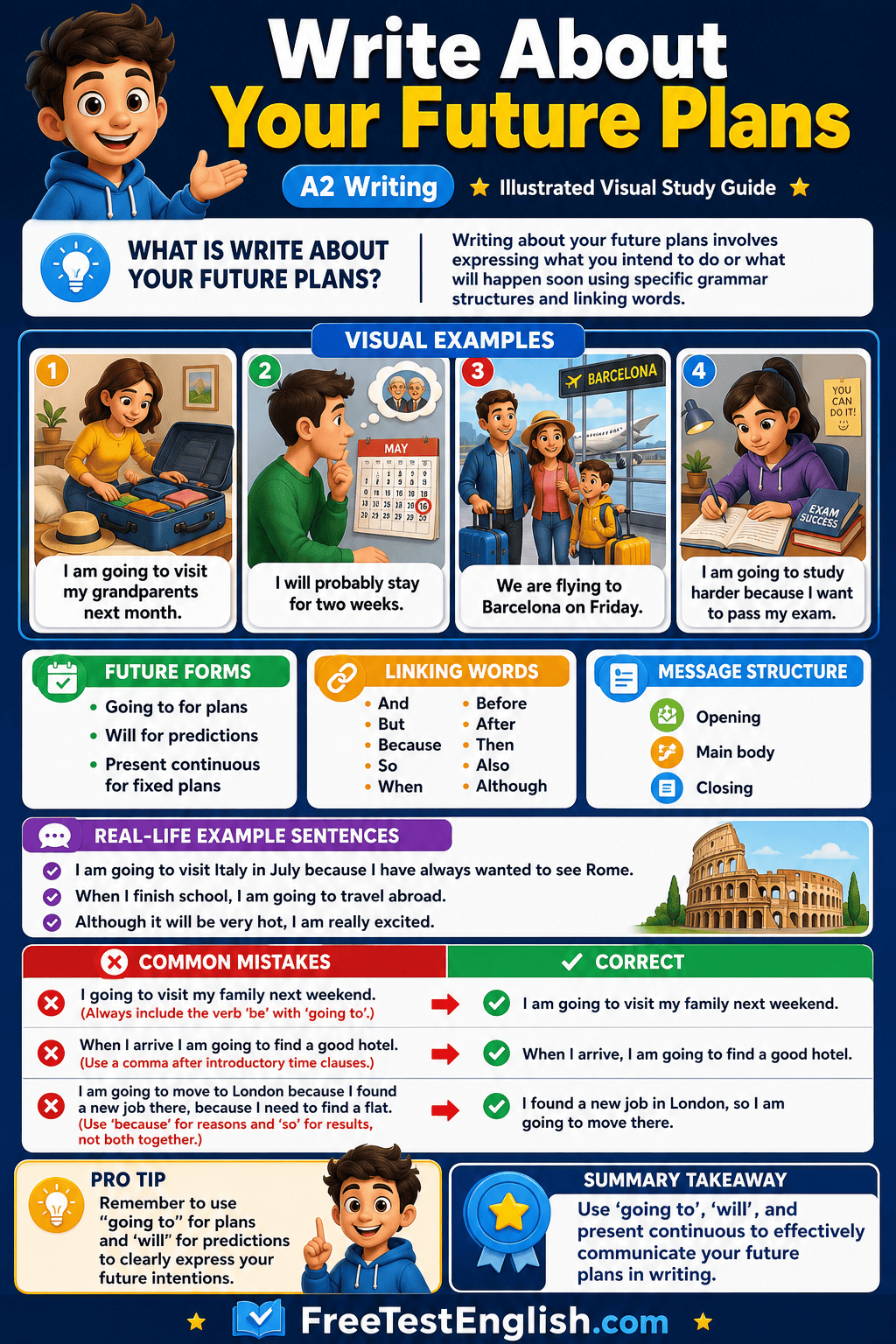
How to Write About Your Future Plans in English
When you write about your future plans, you tell someone what you are going to do or what will happen soon. This is a very common type of writing in everyday life. You might write a short message to a friend about your holiday plans, send an email about a new job, or tell someone about your plans for next week.
In this lesson, you will learn how to write a short, clear message or email about your future plans using the correct grammar, linking words, and layout. By the end, you will be able to write 60–90 words in a natural, friendly style.
Essential Writing Rules and Sentence Structure
1. Use "going to" for personal plans and intentions
Use going to when you have already decided to do something or when you have a clear plan.
I am going to visit my grandparents next month.
We are going to move to a new flat in September.
2. Use "will" for predictions or decisions made at the moment of writing
Use will when you are making a prediction or a quick decision.
I think it will be a fantastic trip.
I will probably stay for two weeks.
3. Use the present continuous for fixed, arranged plans
Use present continuous when something is already arranged and confirmed.
I am flying to Barcelona on Friday.
We are meeting our cousins on Saturday afternoon.
4. Organise your message clearly
A good message about future plans has three clear parts:
- Opening: A friendly greeting and a reason for writing.
- Main body: Your plans — what, where, when, and why.
- Closing: A friendly question or call to action, and a sign-off.
5. Use commas correctly after time clauses
When a time clause comes at the beginning of a sentence, put a comma after it.
✅ When I arrive in Rome, I am going to visit the Colosseum.
✅ Before I leave, I will pack my bags.
When the time clause comes at the end of a sentence, you do not need a comma.
✅ I am going to visit the Colosseum when I arrive in Rome.
Useful Linking Words (Connectors)
Use these linking words to connect your ideas and make your writing flow naturally.
| Connector | Function / Use | Example Sentence |
|---|---|---|
| and | Adding information | I am going to visit Paris and I will also go to Lyon. |
| but | Showing contrast | I want to go to the beach, but the weather will be cold. |
| because | Giving a reason | I am going to study harder because I want to pass my exam. |
| so | Giving a result | I have a new job, so I am going to move to London. |
| when | Talking about time (two things happen together) | When I finish school, I am going to travel abroad. |
| before | Something happens first | Before I leave, I will say goodbye to everyone. |
| after | Something happens second | After I arrive, I am going to find a good restaurant. |
| then | Showing a sequence of plans | I am going to visit the museum, then I will have lunch. |
| also | Adding another plan or idea | I am also going to learn to drive next year. |
| although | Showing a simple contrast or concession | Although it is expensive, I am going to buy a new laptop. |
Model Writing Sample: An Informal Email About Future Plans
Read this realistic model email carefully. Notice how it is organised and how the writer uses linking words and future forms.
— Model Email 1 —
Hi Lena,
How are you? I hope you are well. I am writing to tell you about my plans for the summer.
I am going to visit Italy in July because I have always wanted to see Rome. I am flying there on the 5th and I will stay for ten days. After I arrive, I am going to visit the Colosseum and then I will try lots of Italian food! Although it will be very hot, I am really excited.
Are you going to travel anywhere this summer? Let me know!
Best wishes,
Clara
Now look at the breakdown of this model email:
| Part of the Email | Example from the Text | What It Does |
|---|---|---|
| Greeting | Hi Lena, | Opens the message in a friendly, informal way. |
| Opening sentence and reason | How are you? I hope you are well. I am writing to tell you about my plans for the summer. | Shows friendliness and states clearly why you are writing. |
| Main body – Plan 1 | I am going to visit Italy in July because I have always wanted to see Rome. | States the plan and gives a reason using because. |
| Main body – Plan 2 | After I arrive, I am going to visit the Colosseum and then I will try lots of Italian food! | Adds more detail using after and then. |
| Concession | Although it will be very hot, I am really excited. | Adds a contrast using although. |
| Closing question | Are you going to travel anywhere this summer? Let me know! | Involves the reader and ends the message warmly. |
| Sign-off | Best wishes, Clara | Ends the message in a friendly, appropriate way. |
— Model Email 2 —
Here is a second model text so you can see another style and a different topic.
Hello Mark,
How are you? I have some exciting news! I am going to start a new job next month. I will work for a small travel company in Manchester, so I am going to move there in August. Before I leave, I am going to have a small party at my flat. Would you like to come? It will be on Saturday the 10th. I am also going to invite Tom and Sara. Let me know if you can make it!
All the best,
Ryan
Notice that Ryan uses going to for his decided plans (new job, moving, the party), will for a prediction (it will be on Saturday), and so to show a result (new job so he is moving).
Key Phrases and Sentence Starters
Greetings
- Hi [Name],
- Hello [Name],
- Dear [Name],
Opening Lines and Reason for Writing
- How are you? I hope you are well.
- I am writing to tell you about my plans for [month / the summer / next year].
- I have some exciting news to share with you!
- I wanted to let you know about my plans.
- I am writing because I have some big news!
Talking About Future Plans
- I am going to [visit / start / move / travel / study] …
- I will [stay / fly / arrive / be] …
- I am [flying / moving / starting] on [date].
- I am going to [verb] because [reason].
- I have a new [job / flat / course], so I am going to …
- When I [arrive / finish / start], I am going to …
- After [the trip / the course / my exam], I will …
- Before I [leave / go / start], I am going to …
- Then I will … / I am also going to …
- Although it will be [hard / expensive / far], I am really [excited / happy / looking forward to it].
Ending Your Message and Sign-offs
- Let me know what you think!
- Are you going to [do anything / travel] this [summer / year]?
- I hope we can meet soon.
- Write back soon!
- Hope to hear from you!
- Best wishes, [Name]
- All the best, [Name]
- See you soon, [Name]
- Love, [Name]
Common Writing Mistakes to Avoid
Mistake 1: Confusing "because" and "so"
❌ I am going to move to London because I found a new job there, because I need to find a flat.
✅ I found a new job in London, so I am going to move there.
Remember: Use because to give a reason. Use so to give a result. Do not use both together for the same idea.
Mistake 2: Missing the comma after an introductory time clause
❌ When I arrive I am going to find a good hotel.
✅ When I arrive, I am going to find a good hotel.
Remember: When a time clause (starting with when, before, after, although) comes at the beginning of a sentence, always put a comma after it.
Mistake 3: Using "going to" without the verb "be"
❌ I going to visit my family next weekend.
✅ I am going to visit my family next weekend.
Remember: The full form is subject + am/is/are + going to + verb. Never miss the verb "be".
Mistake 4: Writing a run-on sentence with no connector
❌ I am going to travel to Spain, it will be very hot, I am excited.
✅ I am going to travel to Spain. Although it will be very hot, I am really excited.
Remember: Do not join three ideas with commas only. Use a full stop to separate sentences, or use a linking word such as although, but, or and to connect two ideas.
Mistake 5: Forgetting to capitalise nationalities and languages
❌ I am going to learn italian before my trip.
✅ I am going to learn Italian before my trip.
Remember: Always use a capital letter for nationalities (Italian, French, Spanish) and names of languages.
Writing Checklist and Practice Task
Writing Checklist
Before you send or submit your writing, check each point below:
- ✅ Did you include a friendly greeting (e.g. Hi Sofia,) and an appropriate sign-off (e.g. Best wishes, Tom)?
- ✅ Did you write an opening sentence that states why you are writing?
- ✅ Did you use going to for your plans and intentions?
- ✅ Did you use will for at least one prediction?
- ✅ Did you use at least two linking words from the table (e.g. because, so, when, after, although)?
- ✅ Did you put a comma after introductory time clauses (e.g. When I arrive,)?
- ✅ Did you include a closing question or friendly call to action?
- ✅ Did you write between 60 and 90 words?
- ✅ Did you check your spelling, especially nationalities and languages (capital letters)?
- ✅ Did you avoid run-on sentences (three ideas joined by commas only)?
Your Practice Task
Read the task below and write your email.
Task:
You are going to do something exciting next month. Write an informal email to your English friend, Jamie. In your email:
- Tell Jamie what you are going to do and where you are going.
- Give one reason why you are doing this.
- Describe two things you are going to do or see there.
- Ask Jamie about his or her plans.
Write 60–90 words. Use at least three linking words from the table above. Start with "Hi Jamie," and end with an appropriate sign-off.
Now test your writing mechanics and sentence skills in the exercises below.
📄 Download the Write About Your Future Plans PDF
Download this Write About Your Future Plans grammar lesson as a free printable PDF.
It includes grammar rules, examples, and explanations so you can study offline anytime.