

Exercise 1
Arrange the words in the correct order to form a proper English sentence about your last birthday.
Example: cake / my / ate / friends / birthday / my
Answer: My friends ate my birthday cake.
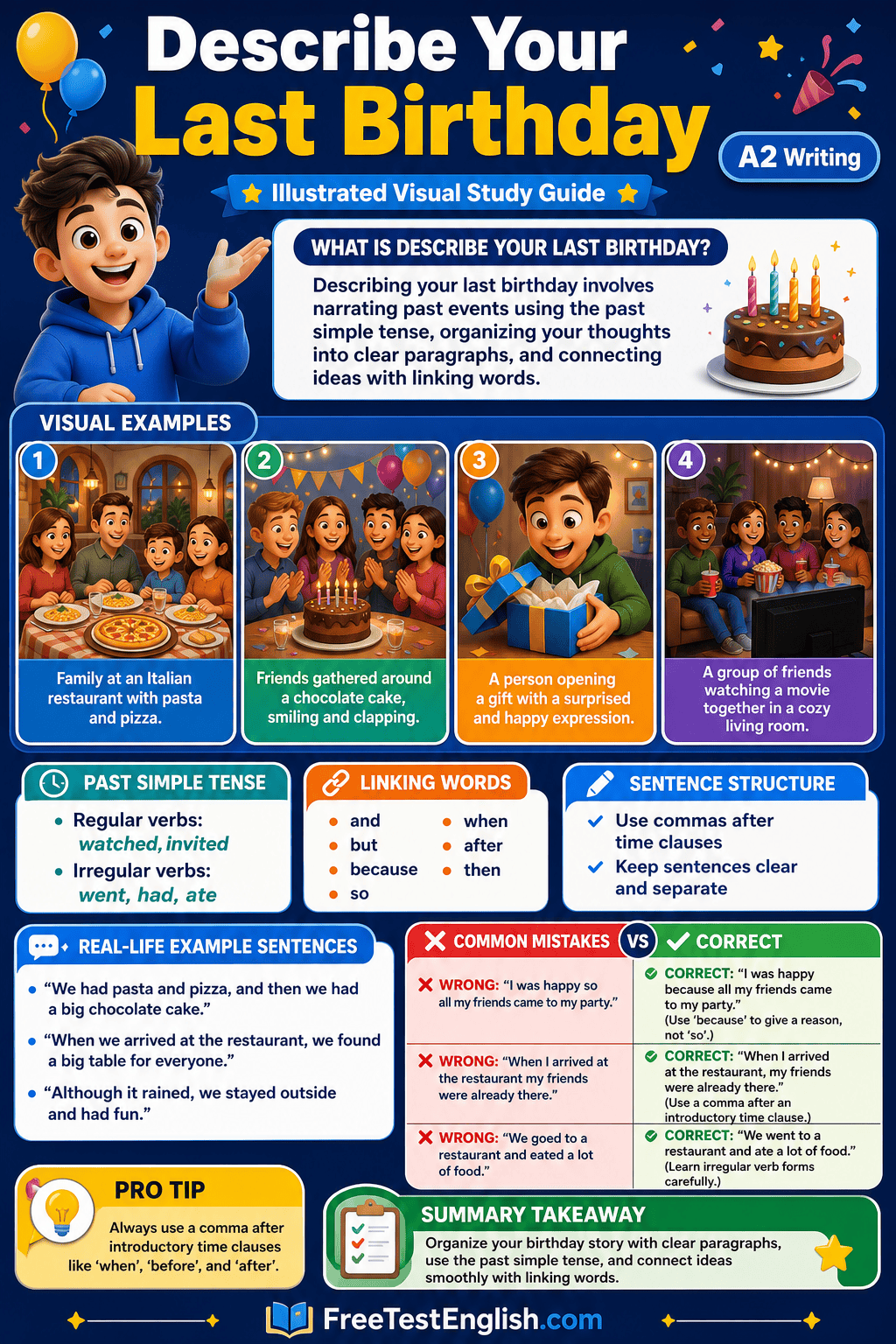
How to Describe Your Last Birthday in English
Describing a past event like your birthday is a very common and useful writing task in English. You might write a short message to a friend, an informal email, or even a postcard telling someone about your special day. This type of writing helps you practise telling a story about the past — what happened, where you went, who was there, and how you felt.
In real life, you might write this kind of message to a friend who could not come to your party, a relative who lives far away, or a classmate who wants to know about your weekend. It is a friendly, informal piece of writing, so the language is relaxed and personal.
In this lesson, you will learn how to organise your writing clearly, use the past simple tense correctly, connect your ideas with linking words, and avoid common mistakes that many A2 learners make.
Essential Writing Rules and Sentence Structure
1. Organise Your Writing into Paragraphs
Even a short message of 60–90 words should have a clear structure. Divide your writing into 2–3 short paragraphs:
- Paragraph 1 — Greeting and opening: Say hello and introduce the topic. Tell your friend why you are writing.
- Paragraph 2 — Main details: Describe what happened on your birthday. Use the past simple tense. Include details like where you went, who came, what you did, and what you ate or received.
- Paragraph 3 — Closing: Ask a question, make a comment about the future, or end with a friendly remark and sign-off.
2. Use the Past Simple Tense to Narrate Events
When you describe a past birthday, you need the past simple tense. This tense tells us about finished actions in the past.
- Regular verbs: add -ed → watched, invited, celebrated, received, stayed, opened
- Irregular verbs: learn the form → went, had, ate, gave, came, saw, met, bought, wore
- Negative form: did not / didn't + base verb → I didn't go out. We didn't stay late.
- Question form: Did + subject + base verb → Did you have a good time?
3. Use Commas Correctly After Time Clauses
When you begin a sentence with a time word or phrase, use a comma after the introductory clause before the main part of the sentence.
- When we arrived at the restaurant, we found a big table for everyone.
- After we ate dinner, we had a chocolate cake.
- Before my friends came, I helped my mum prepare the food.
However, when the time clause comes at the end of the sentence, you do not need a comma:
- We had a chocolate cake after we ate dinner.
- I felt very happy when my friends arrived.
4. Keep Sentences Clear and Separate
At A2 level, avoid writing very long sentences. Use a full stop to end one idea and start a new sentence for the next idea. You can also join two related ideas with a connector like and, but, or so.
Useful Linking Words (Connectors)
Good writing connects ideas smoothly. Here are the most important linking words for this type of writing task:
| Connector | Function / Use | Example Sentence |
|---|---|---|
| and | Adds information | We had pizza and we danced all night. |
| but | Shows contrast or surprise | The weather was cold, but we had a great time. |
| because | Gives a reason (answers "why?") | I was happy because all my friends came. |
| so | Gives a result (answers "what happened?") | It was my birthday, so we went to a restaurant. |
| when | Shows a point in time | When I opened my presents, I felt very excited. |
| before | Shows something happened earlier | Before the party, I helped my mum prepare the food. |
| after | Shows something happened later | After we ate, we watched a film together. |
| then | Shows the next event in a sequence | We had cake, and then we opened the presents. |
| also | Adds an extra point | My cousin came to the party. My aunt also came. |
| although | Shows a simple contrast or concession | Although it rained, we stayed outside and had fun. |
Important reminder: Do not confuse because and so. Because introduces a reason. So introduces a result. Compare:
- I was tired because we stayed up very late. (reason → why were you tired?)
- We stayed up very late, so I was tired the next day. (result → what happened because of this?)
Model Writing Sample 1: An Informal Email to a Friend
Read this complete model text carefully. Notice how it is organised, which tenses are used, and how the linking words connect the ideas.
— Start of Model Email —
Hi Jessica,
How are you? I'm writing to tell you about my birthday last Saturday. It was a wonderful day!
In the afternoon, my family took me to an Italian restaurant because it is my favourite place to eat. We had pasta and pizza, and then we had a big chocolate cake. After dinner, my friends came to my flat and we watched a film together. I also received some lovely presents.
Although I was very tired at the end, I felt really happy. I hope we can celebrate together next year!
Love,
Maria
— End of Model Email —
Annotated Breakdown of the Model Email
| Part of the Email | Example from the Text | Why It Works |
|---|---|---|
| Greeting | Hi Jessica, | Friendly and informal. Uses a comma after the name. |
| Opening sentence and reason for writing | How are you? I'm writing to tell you about my birthday last Saturday. | Greets the reader and clearly states the purpose of the email straight away. |
| Main body — Key details | My family took me to an Italian restaurant because it is my favourite place to eat. We had pasta and pizza, and then we had a big chocolate cake. | Uses past simple verbs (took, had) and connectors (because, and then) to describe events clearly in order. |
| Additional detail | After dinner, my friends came to my flat and we watched a film together. | Uses 'after' at the start of the sentence followed by a comma. Continues the story logically. |
| Closing comment and friendly remark | Although I was very tired at the end, I felt really happy. I hope we can celebrate together next year! | Uses 'although' for a simple contrast. Ends with a warm, forward-looking comment. |
| Sign-off | Love, Maria | Informal and friendly. Suitable for writing to a close friend. |
Word count: 87 words ✅ (within the A2 target of 60–90 words)
Model Writing Sample 2: A Short Message to a Friend
Here is a second, slightly different model. This one is a short informal message, like something you might send online or in a note.
— Start of Model Message —
Dear Tom,
I hope you're well! My birthday was last weekend and it was brilliant. My parents gave me a new bag, which I really love.
On Saturday evening, we went to a café near my house. When we arrived, my friends were already there waiting for me — what a surprise! We ate a lot of food and then we danced. Before I went home, I opened all my presents. It was a perfect day!
Best wishes,
Anna
— End of Model Message —
Word count: 84 words ✅
Key features in this model:
- Uses past simple irregular verbs: gave, went, arrived, were, ate, danced, opened, went
- Uses a time clause with a comma: When we arrived, my friends were already there.
- Uses before + a time clause to show sequence: Before I went home, I opened all my presents.
- Uses then to continue the story: We ate a lot of food and then we danced.
- Uses and to add information and a dash (—) for an informal, dramatic effect
Key Phrases and Sentence Starters
Greetings
- Hi [Name],
- Dear [Name],
- Hello [Name],
Opening Lines and Reason for Writing
- How are you? I hope you're well!
- I'm writing to tell you about my birthday last [day / weekend / week].
- I wanted to tell you about my birthday — it was amazing!
- Guess what? I had a wonderful birthday last [Saturday]!
- My birthday was last [weekend] and I had such a great time.
Giving Details and Descriptions
- In the morning / afternoon / evening, we …
- My family / friends took me to … because …
- We had [food / drinks / cake] and then we …
- When I arrived / opened my presents / saw my friends, I felt …
- Before the party, I … / After the party, we …
- I received / got some lovely presents, for example …
- Although it was [cold / late / raining], we still …
- It was so much fun because …
- Everyone was there, so we …
Describing Feelings
- I felt really happy / excited / surprised / tired.
- It was a wonderful / fantastic / perfect / brilliant day!
- I was so pleased because …
- I couldn't believe it when …
Ending Your Message and Sign-offs
- I hope we can celebrate together soon!
- I can't wait to see you and tell you more about it.
- Let me know how you are!
- Hope to hear from you soon.
- Write back soon!
- Love, / Best wishes, / See you soon, / All the best, [Your name]
Common Writing Mistakes to Avoid
Mistake 1: Confusing 'because' and 'so'
❌ I was happy so all my friends came to my party.
✅ I was happy because all my friends came to my party.
Use because to give a reason (why you were happy). Use so to give a result of something.
Mistake 2: Missing the comma after an introductory time clause
❌ When I arrived at the restaurant my friends were already there.
✅ When I arrived at the restaurant, my friends were already there.
When a sentence starts with a time word like when, after, or before, always put a comma at the end of that opening clause.
Mistake 3: Using the wrong past simple form
❌ We goed to a restaurant and eated a lot of food.
✅ We went to a restaurant and ate a lot of food.
The verbs go and eat are irregular. Their past simple forms are went and ate. Always learn irregular verb forms carefully.
Mistake 4: Writing a run-on sentence (joining too many ideas without proper punctuation)
❌ It was my birthday so we went to a restaurant and we had cake and then my friends came and we watched a film and it was great.
✅ It was my birthday, so we went to a restaurant. We had cake, and then my friends came. We watched a film together. It was a great day!
Break long, rambling sentences into shorter, clearer ones. Use a full stop when you finish one idea and want to start a new one.
Mistake 5: Forgetting apostrophes in contractions
❌ Im writing to tell you about my birthday. I didnt go out in the morning.
✅ I'm writing to tell you about my birthday. I didn't go out in the morning.
When you shorten two words together, you must use an apostrophe (') to replace the missing letter(s): I am → I'm, did not → didn't, we are → we're.
Writing Checklist and Practice Task
Writing Checklist
Before you finish your writing, check each point below. Tick each one when you are happy with it.
- ✅ Greeting: Did you start with a friendly, informal greeting (e.g. Hi Tom, / Dear Anna,)?
- ✅ Opening line: Did you write a clear opening sentence that tells the reader why you are writing?
- ✅ Past simple tense: Did you use the correct past simple forms for both regular verbs (watched, invited) and irregular verbs (went, ate, gave, had)?
- ✅ Linking words: Did you use at least two connectors from the table (e.g. because, so, when, after, then, although)?
- ✅ Commas after time clauses: If you started a sentence with when, before, or after, did you use a comma after the introductory clause?
- ✅ Apostrophes: Did you check your contractions? (I'm, didn't, we're, couldn't)
- ✅ Paragraphs: Does your message have 2–3 clear paragraphs (greeting and opening / main details / closing)?
- ✅ Word count: Is your message between 60 and 90 words?
- ✅ Sign-off: Did you end with a friendly sign-off and your name (e.g. Love, / Best wishes, / See you soon,)?
- ✅ Task completion: Did you answer all parts of the prompt? Did you say what you did, where you went, who was there, and how you felt?
Your Practice Task
Now it is your turn to write! Read the task below and write your response.
Writing Task:
You have a friend called Sam who could not come to your last birthday celebration. Write a short informal email to Sam. In your email:
- Tell Sam where you celebrated your birthday and who came
- Describe two things you did or ate
- Say how you felt about your birthday
- Ask Sam a friendly question at the end
Write 60–90 words. Use at least two linking words from the table in this lesson.
Now test your writing mechanics and sentence skills in the exercises below.
📄 Download the Describe Your Last Birthday PDF
Download this Describe Your Last Birthday grammar lesson as a free printable PDF.
It includes grammar rules, examples, and explanations so you can study offline anytime.