

Exercise 1
Arrange the words in the correct order to form a proper English sentence about plans for tomorrow.
Example: going / tomorrow / I / am / to / school
Answer: I am going to school tomorrow.
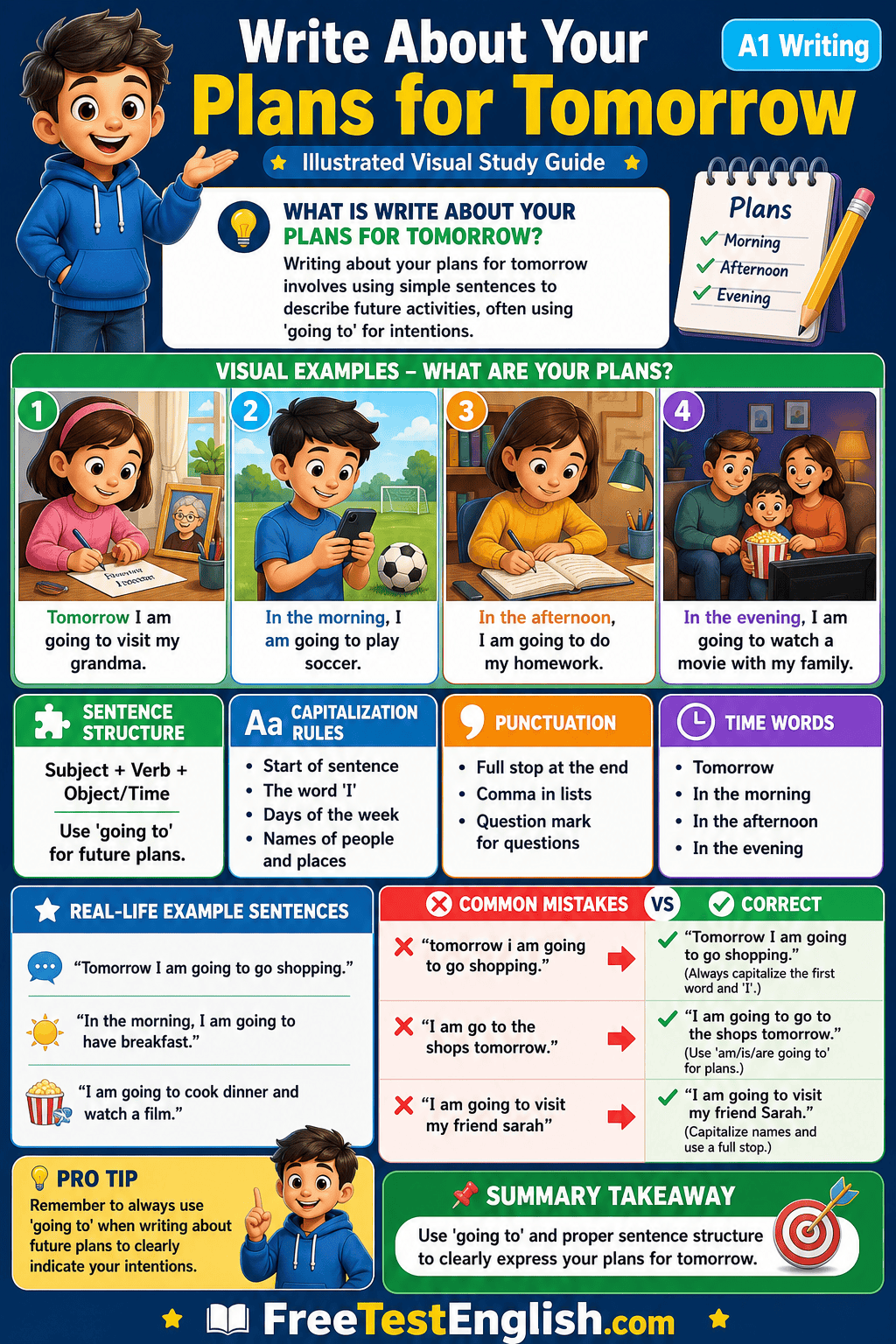
How to Write About Your Plans for Tomorrow
When we talk about the future, we often tell people what we plan to do. Writing about your plans for tomorrow is a very common and useful writing task. You might write a short note to a friend, a message to a family member, or a diary entry about what you are going to do the next day.
In real life, people write about future plans in text messages, short emails, postcards, and personal diaries. At Level A1, you will practise writing short, simple sentences about tomorrow using easy vocabulary and basic grammar.
By the end of this lesson, you will be able to write 5–8 clear sentences about your plans for tomorrow. Let's start!
Essential Writing Rules and Sentence Structure
Rule 1: Word Order — Subject + Verb + Object / Time Word
In English, every sentence needs a subject (who) and a verb (action). For plans, we often add a time word (when) or an object (what).
| Subject | Verb | Object / Place / Time |
|---|---|---|
| I | am going to | visit my friend. |
| I | am going to | cook dinner at home. |
| She | is going to | go to the shops. |
| We | are going to | watch a film in the evening. |
The key grammar for plans: Use "going to" to talk about plans for tomorrow.
- I am going to + verb (base form)
- He / She / It is going to + verb (base form)
- We / You / They are going to + verb (base form)
Rule 2: Capitalization
Always use a capital letter for these:
- The first word of every sentence — Tomorrow I am going to cook.
- The word I — always a capital letter — I am going to the park.
- Days of the week — Monday, Tuesday, Wednesday, Thursday, Friday, Saturday, Sunday
- Names of people and places — Sarah, London, McDonald's
- Months of the year — January, February, March
Rule 3: Punctuation
- End every sentence with a full stop (.) — I am going to have breakfast.
- Use a comma (,) in a list — I am going to buy milk, eggs, and bread.
- Use a question mark (?) for questions — Are you going to come?
Rule 4: Time Words for Tomorrow
Time words help your reader understand when things will happen. Place them at the beginning or the end of a sentence.
| Time Word / Phrase | Example Sentence |
|---|---|
| tomorrow | Tomorrow I am going to go shopping. |
| in the morning | In the morning, I am going to have breakfast. |
| in the afternoon | In the afternoon, I am going to visit my mum. |
| in the evening | In the evening, I am going to watch TV. |
| at night | At night, I am going to sleep early. |
| first | First, I am going to have a shower. |
| then | Then, I am going to eat lunch. |
| after that | After that, I am going to go to the park. |
Useful Linking Words (Connectors)
Linking words connect your sentences and make your writing easier to read. At Level A1, focus on these four important connectors:
| Connector | Function / Use | Example Sentence |
|---|---|---|
| and | Adds more information (two positive ideas together) | I am going to cook dinner and watch a film. |
| but | Shows a contrast or an opposite idea | I want to go to the park, but it is going to rain. |
| because | Gives a reason (why) | I am going to sleep early because I am tired. |
| so | Shows a result (what happens next) | I am hungry, so I am going to make a sandwich. |
Model Writing Sample: A Short Message to a Friend
Read this short message. Notice how it is organised. Each part is labelled for you.
Greeting:
Hi Anna,
Opening sentence (introduce the topic):
I am very excited about tomorrow!
Main body (plans for the day — morning, afternoon, evening):
In the morning, I am going to have a big breakfast and go for a walk in the park. Then, in the afternoon, I am going to meet my friend Tom for lunch. We are going to eat at our favourite café. In the evening, I am going to cook a nice dinner at home because it is my mum's birthday. After that, we are going to watch a film together.
Closing sentence (how you feel about your plans):
I am so happy because tomorrow is going to be a great day!
Sign-off:
See you soon,
Maria
Analysis of the Model Text
| Part of the Message | What It Does | Example from the Text |
|---|---|---|
| Greeting | Starts the message in a friendly way | Hi Anna, |
| Opening sentence | Introduces the topic and grabs attention | I am very excited about tomorrow! |
| Morning plans | Describes what happens first | In the morning, I am going to have a big breakfast and go for a walk. |
| Afternoon plans | Adds more detail about the day | In the afternoon, I am going to meet my friend Tom for lunch. |
| Evening plans | Completes the day with a reason | I am going to cook a nice dinner because it is my mum's birthday. |
| Closing sentence | Ends with a feeling or opinion | I am so happy because tomorrow is going to be a great day! |
| Sign-off | Finishes the message politely | See you soon, Maria |
Key Phrases and Sentence Starters
Greetings
- Hi [Name],
- Hello [Name],
- Dear [Name],
Opening Sentences (Introduce Your Plans)
- Tomorrow is going to be a busy day!
- I am very excited about tomorrow.
- I have a lot of plans for tomorrow.
- Let me tell you about my plans for tomorrow.
Talking About Your Plans
- In the morning, I am going to …
- In the afternoon, I am going to …
- In the evening, I am going to …
- First, I am going to …
- Then, I am going to …
- After that, I am going to …
- I want to … because …
- I am going to … with my friend / family / mum / dad.
Giving Reasons
- … because I am tired.
- … because it is fun.
- … because I love it.
- … because it is my day off.
Closing Sentences (How You Feel)
- I am so excited!
- Tomorrow is going to be great!
- I cannot wait for tomorrow!
- I think tomorrow is going to be a good day.
Sign-Offs
- See you soon,
- Bye for now,
- Take care,
- Your friend,
Common Writing Mistakes to Avoid
❌ tomorrow i am going to go shopping.
✅ Tomorrow I am going to go shopping. — Always use a capital letter at the start of a sentence and for the word I.
❌ I am going to visit my friend sarah
✅ I am going to visit my friend Sarah. — Names of people always start with a capital letter. Don't forget the full stop at the end.
❌ In the morning I am going to have breakfast and in the afternoon I am going to go to park and in the evening I am going to watch TV.
✅ In the morning, I am going to have breakfast. In the afternoon, I am going to go to the park. In the evening, I am going to watch TV. — Use full stops to separate ideas. Don't connect everything with and.
❌ I am go to the shops tomorrow.
✅ I am going to go to the shops tomorrow. — For plans, always use am / is / are + going to + verb.
❌ I am going to buy milk eggs and bread.
✅ I am going to buy milk, eggs, and bread. — Use commas to separate items in a list.
❌ Tomorrow i am going to meet my friend on monday.
✅ Tomorrow I am going to meet my friend on Monday. — Days of the week always start with a capital letter. The word I is always a capital letter.
❌ I am going to sleep early because I tired.
✅ I am going to sleep early because I am tired. — Always use the verb to be (am / is / are). Do not leave it out.
❌ In the morning i am going to have a shower
✅ In the morning, I am going to have a shower. — Use a comma after a time phrase at the start of a sentence. Don't forget the full stop at the end.
Writing Checklist and Practice Task
Before You Send or Hand In Your Writing, Check These Points:
- ✅ Did I write a greeting at the top? (e.g. Hi Anna,)
- ✅ Did I use a capital letter at the start of every sentence?
- ✅ Did I always write I with a capital letter?
- ✅ Did I use capital letters for names and days of the week?
- ✅ Did I end every sentence with a full stop?
- ✅ Did I use am / is / are going to for my plans?
- ✅ Did I use time words like in the morning, then, or after that?
- ✅ Did I use connectors like and, but, because, or so?
- ✅ Did I write a closing sentence about how I feel?
- ✅ Did I write a sign-off at the end? (e.g. See you soon, [Your name])
Your Practice Task
Write a short message to your friend about your plans for tomorrow. Follow the steps below:
- Step 1 — Greeting: Write a greeting. Use your friend's name.
- Step 2 — Opening sentence: Tell your friend how you feel about tomorrow. (e.g. I am very excited about tomorrow!)
- Step 3 — Morning plans: Write one or two sentences about what you are going to do in the morning.
- Step 4 — Afternoon plans: Write one or two sentences about what you are going to do in the afternoon. Use a connector like because or and.
- Step 5 — Evening plans: Write one or two sentences about what you are going to do in the evening.
- Step 6 — Closing sentence: Write how you feel about your plans. (e.g. I cannot wait for tomorrow!)
- Step 7 — Sign-off: End your message with a sign-off and your name.
Write 5–8 sentences in total. Use the Key Phrases and the Model Text above to help you. Check your writing with the checklist before you finish.
Now test your writing mechanics and sentence skills in the exercises below.
📄 Download the Write About Your Plans for Tomorrow PDF
Download this Write About Your Plans for Tomorrow grammar lesson as a free printable PDF.
It includes grammar rules, examples, and explanations so you can study offline anytime.