

Exercise 1
Arrange the words in the correct order to form a proper English sentence about your favourite sport.
Example: football / I / like / very much
Answer: I like football very much.
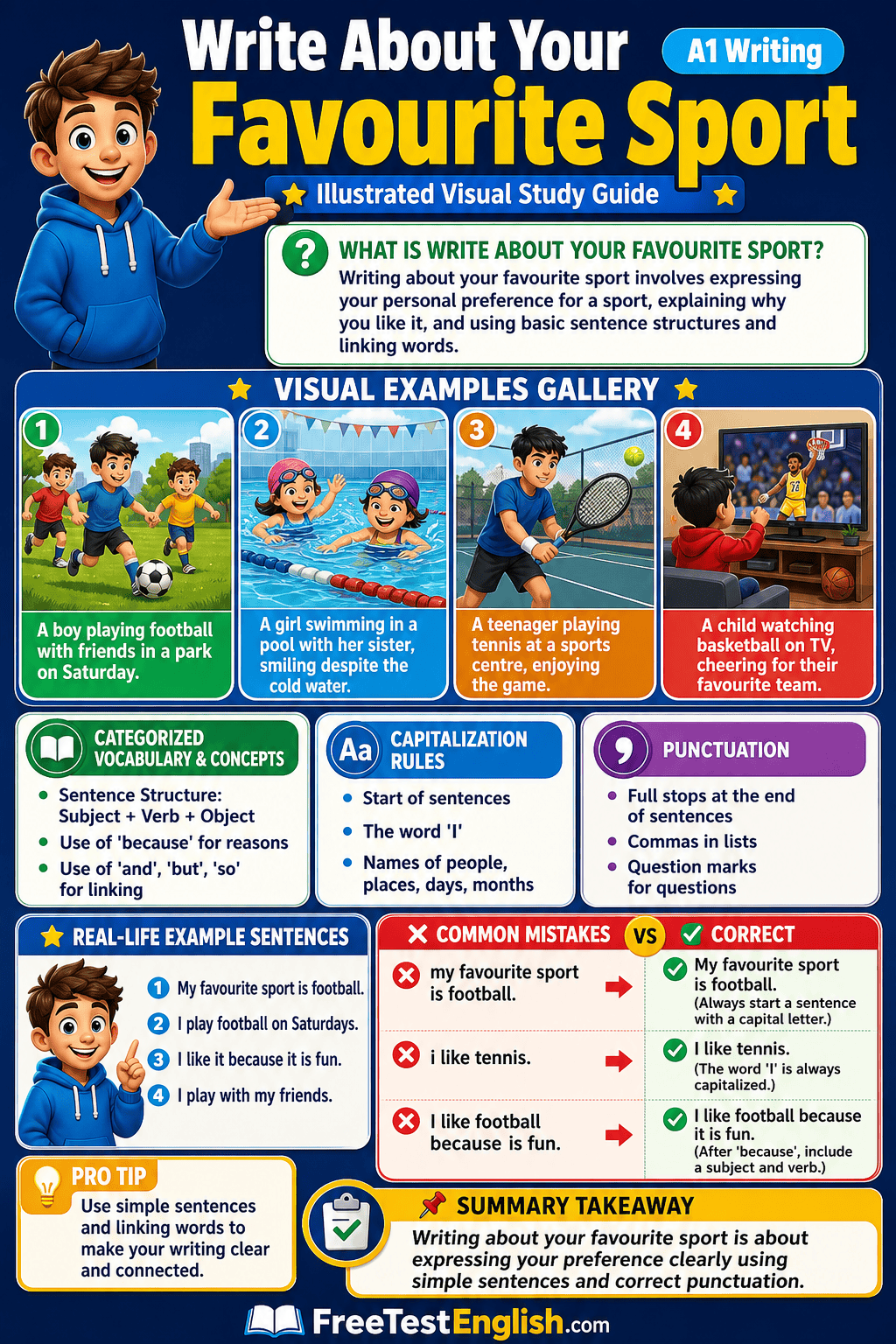
How to Write About Your Favourite Sport in English
In this lesson, you will learn how to write a short paragraph about your favourite sport. This is a very common writing task in English. You might write about your favourite sport in a school project, on a personal profile, or in a message to a friend.
At the end of this lesson, you will be able to:
- Write simple sentences about a sport you like
- Say why you like the sport
- Use basic linking words like and, but, and because
- Use correct capital letters and full stops
Essential Writing Rules and Sentence Structure
Rule 1: Word Order (Subject + Verb + Object)
In English, sentences follow a clear order. We use: Subject + Verb + Object.
| Subject | Verb | Object / Extra Information |
|---|---|---|
| I | like | football. |
| I | play | tennis every Saturday. |
| My favourite sport | is | swimming. |
| I | watch | basketball on TV. |
Remember: Always put the subject first, then the verb, then the object or extra information.
Rule 2: Capital Letters
You must use capital letters in these situations:
- At the start of every sentence — I like football.
- For the word "I" — always write I, never i
- For names of people — My friend is called Marco.
- For names of places — I live in London.
- For days of the week — I play on Monday.
- For months of the year — My favourite month is June.
Rule 3: Full Stops and Punctuation
- End every sentence with a full stop (.) — I like swimming.
- Use a comma (,) in a list — I like football, tennis, and swimming.
- Use a question mark (?) at the end of a question — Do you like sport?
Sentence Builder: Your Sport Paragraph
Use this simple formula to build your sentences:
| Sentence Number | What to Write | Example Sentence |
|---|---|---|
| Sentence 1 | Name your favourite sport | My favourite sport is football. |
| Sentence 2 | Say when or where you do it | I play football on Saturdays. |
| Sentence 3 | Say why you like it | I like it because it is fun. |
| Sentence 4 | Say who you do it with | I play with my friends. |
| Sentence 5 | Add one more fact | My favourite player is Messi. |
Useful Linking Words (Connectors)
Linking words help you connect two sentences or two ideas. At A1 level, use these four important connectors:
| Connector | Function / Use | Example Sentence |
|---|---|---|
| and | Adds more information | I like football and I like swimming. |
| but | Shows a contrast or difference | I like tennis but I don't like running. |
| because | Gives a reason | I like football because it is exciting. |
| so | Shows a result | Football is fun, so I play every week. |
Top tip: Use one or two linking words in your short paragraph. This makes your writing more interesting and connected.
Model Writing Sample: My Favourite Sport
Read this model text carefully. It is written by an A1 student called Lena. Notice how she uses simple sentences, linking words, and correct punctuation.
--- START OF MODEL TEXT ---
[Opening Sentence — Names the sport]
My favourite sport is swimming.
[Body — Gives details: when, where, who with]
I swim every Saturday at the sports centre. I go with my sister. The water is cold but I love it.
[Reason — Uses "because"]
I like swimming because it is good for my body. It is also very relaxing.
[Extra Fact — Adds a personal detail]
My favourite swimmer is Katie Ledecky. She is amazing.
[Closing Sentence — Ends the paragraph]
Swimming is my favourite sport and I am very happy when I swim.
--- END OF MODEL TEXT ---
Model Text Breakdown
| Part of the Text | What It Does | Example from the Text |
|---|---|---|
| Opening Sentence | Names the favourite sport | My favourite sport is swimming. |
| Body — Detail 1 | Says when and where | I swim every Saturday at the sports centre. |
| Body — Detail 2 | Says who with + uses "but" | The water is cold but I love it. |
| Reason | Uses "because" to explain | I like swimming because it is good for my body. |
| Extra Fact | Adds a personal detail | My favourite swimmer is Katie Ledecky. |
| Closing Sentence | Ends with a positive feeling | I am very happy when I swim. |
Key Phrases and Sentence Starters
Use these phrases when you write about your favourite sport. Copy and adapt them for your own paragraph.
Naming Your Sport
- My favourite sport is ...
- I love ...
- I really like ...
Saying When and Where
- I play ... every Saturday / Sunday / Monday.
- I play ... at school / at the park / at the sports centre.
- I swim / run / play ... in the morning / in the evening.
Saying Who You Do It With
- I play with my friends.
- I play with my brother / sister / family.
- I play alone.
Giving a Reason (Use "because")
- I like it because it is fun / exciting / fast / relaxing.
- I like it because it is good for my body.
- I like it because I am good at it.
Adding an Extra Fact
- My favourite player / team is ...
- I also watch ... on TV.
- I want to be a ... player one day.
Closing Your Paragraph
- ... is my favourite sport and I love it.
- I am very happy when I play ...
- I think ... is a great sport.
Common Writing Mistakes to Avoid
Look at these common mistakes. Make sure you do not make them in your writing.
❌ my favourite sport is football.
✅ My favourite sport is football. — Always start a sentence with a capital letter.
❌ i like tennis.
✅ I like tennis. — The word "I" is always a capital letter.
❌ I like football because is fun.
✅ I like football because it is fun. — After "because", you need a subject + verb. Don't forget "it".
❌ I play football on saturday.
✅ I play football on Saturday. — Days of the week always start with a capital letter.
❌ My favourite sport is Football.
✅ My favourite sport is football. — Sports do not start with a capital letter (unless they are proper nouns like a team name).
❌ I like football but I like tennis.
✅ I like football and I like tennis. — Use "but" for contrast (opposite ideas). Use "and" to add similar ideas.
❌ I play tennis I play every Saturday
✅ I play tennis. I play every Saturday. — Use a full stop to end each sentence. Do not join two sentences without a connector or a full stop.
❌ My favourite player is messi
✅ My favourite player is Messi. — Names of people always start with a capital letter. Don't forget the full stop.
Writing Checklist and Practice Task
Writing Checklist
Before you finish your paragraph, check these points carefully. Tick each one when you are sure it is correct.
- ✅ Did I start every sentence with a capital letter?
- ✅ Did I always write I with a capital letter?
- ✅ Did I use capital letters for names, days, and months?
- ✅ Did I end every sentence with a full stop?
- ✅ Did I name my favourite sport in the first sentence?
- ✅ Did I say when or where I do the sport?
- ✅ Did I use because to give a reason?
- ✅ Did I use and, but, or so to connect ideas?
- ✅ Did I write 5 or more sentences?
- ✅ Did I check my spelling of common words?
Your Practice Task
Now it is your turn! Write a short paragraph (5 to 7 sentences) about your favourite sport. Use the sentence builder, the key phrases, and the model text to help you.
Follow these steps:
- Step 1: Write your opening sentence. Name your favourite sport. (My favourite sport is ...)
- Step 2: Write one or two sentences about when and where you do the sport. (I play ... every ...)
- Step 3: Write a sentence about who you do the sport with. (I play with ...)
- Step 4: Write a sentence using because to say why you like it. (I like it because ...)
- Step 5: Add one extra fact about the sport. (My favourite player is ...)
- Step 6: Write your closing sentence. (I love ... and I am very happy when I play.)
- Step 7: Check your paragraph with the writing checklist above.
Remember: Short, clear sentences are better than long, confusing ones. Keep it simple and be accurate!
Now test your writing mechanics and sentence skills in the exercises below.
📄 Download the Write About Your Favourite Sport PDF
Download this Write About Your Favourite Sport grammar lesson as a free printable PDF.
It includes grammar rules, examples, and explanations so you can study offline anytime.