

Exercise 1
Arrange the words in the correct order to form a proper English sentence about your town.
Example: park / there / a / is / big / in / town / my
Answer: There is a big park in my town.
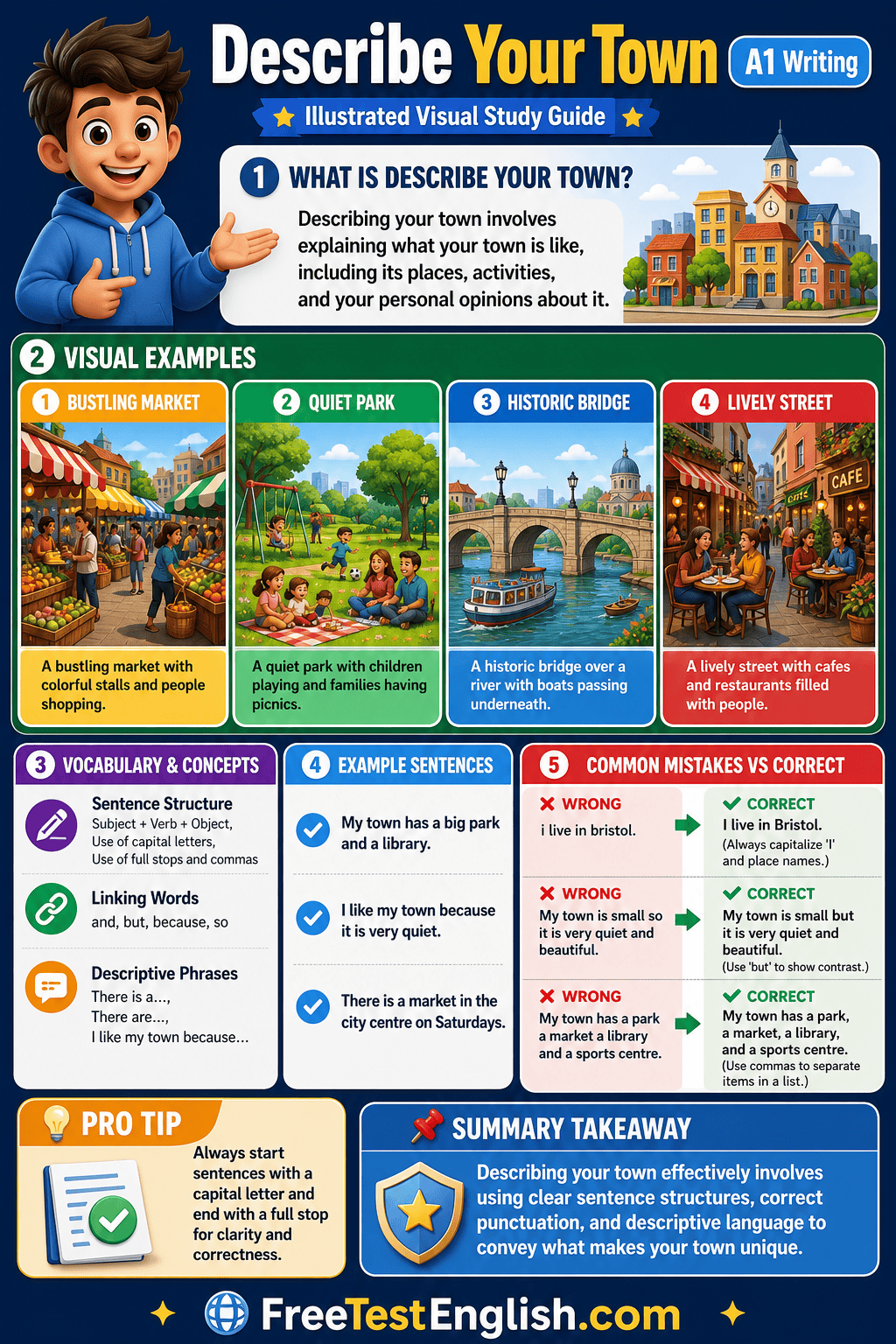
How to Describe Your Town in English
In this lesson, you will learn how to write a short description of your town in English. This is a very common writing task. You might write about your town in a message to a new friend, on a postcard, or in a short school project.
When you describe your town, you tell people what your town is like. You talk about the places in your town, what you can do there, and what you like or do not like about it.
Real-life examples of when you write about your town:
- A short message to a new pen pal
- A postcard to a friend or family member
- A short profile on a language learning website
- A simple school writing task
Essential Writing Rules and Sentence Structure
Rule 1: Use the Correct Word Order
In English, a basic sentence follows this pattern:
Subject + Verb + Object or Place or Description
Look at these examples:
- I + live + in a small town.
- My town + has + a big park.
- There + is + a market in the centre.
- The shops + are + very nice.
Rule 2: Use Capital Letters Correctly
You must use a capital letter in these situations:
- At the start of every sentence — My town is small.
- For the word "I" — I like my town.
- For names of towns, cities, and places — I live in Leeds. I live near Oxford Street.
- For names of people — My friend Maria lives here too.
- For days and months — On Saturday, the market is open.
Rule 3: Use Full Stops and Commas
- Use a full stop (.) at the end of every sentence.
- Use a comma (,) to separate items in a list — My town has a park, a market, and a library.
- Use a comma (,) after a time phrase at the start of a sentence — In the morning, the town is very quiet.
Rule 4: Keep Your Sentences Short and Clear
At A1 level, write short sentences of between five and nine words. Short sentences are easy to read and easy to write correctly.
- ✅ My town is small but very friendly.
- ✅ There is a big supermarket near my house.
- ❌ My town is a very small and quiet and friendly town with a big park and a market and many nice shops. — This is too long. Break it into smaller sentences.
Useful Linking Words (Connectors)
Linking words connect your sentences and ideas. Use these four basic connectors to make your writing flow better.
| Connector | Function / Use | Example Sentence |
|---|---|---|
| and | Adds information. Joins two similar ideas. | My town has a park and a library. |
| but | Shows contrast. Joins two different or opposite ideas. | My town is small but it is very beautiful. |
| because | Gives a reason. Explains why something is true. | I like my town because it is very quiet. |
| so | Shows a result. Explains what happens next. | The park is big, so I go there every weekend. |
Model Writing Sample: A Short Message About My Town
Read this short message from a student called Anna. She is writing to her new pen pal, Tom. Notice how Anna uses simple sentences, connectors, and correct punctuation.
---
Hi Tom,
My name is Anna and I live in Bristol. Bristol is a big city in the south-west of England. It is a very busy and exciting place.
My town has many interesting places. There is a large harbour and a beautiful old bridge. There are also lots of cafés and restaurants near the city centre. I like the harbour because it is very pretty in the evening.
There is a market in the city centre on Saturdays. I go there with my mum every weekend. The market sells fruit, vegetables, and street food. It is very lively and fun.
My town is quite noisy but I love it. I think you should visit Bristol one day!
Write soon,
Anna
---
Breakdown of the Model Text
| Part of the Message | What Anna Writes | Why She Writes It |
|---|---|---|
| Greeting | Hi Tom, | She opens the message in a friendly, informal way. |
| Opening Sentence | My name is Anna and I live in Bristol. | She introduces herself and names her town. |
| Main Body — Places | There is a large harbour and a beautiful old bridge. | She describes the key places in her town. |
| Main Body — Opinion | I like the harbour because it is very pretty. | She gives her personal opinion with a reason. |
| Main Body — Activities | I go there with my mum every weekend. | She explains what she does in her town. |
| Closing Sentence | I think you should visit Bristol one day! | She ends with a friendly, positive statement. |
| Sign-off | Write soon, Anna | She closes the message in a warm, informal way. |
Key Phrases and Sentence Starters
Use these ready-made phrases to help you write your description. You can change the words in italics to write about your own town.
Introducing Your Town
- I live in a small town / a big city / a quiet village.
- My town is called Brighton / Cork / Dundee.
- I am from the north / the south / the centre of England / Ireland / Scotland.
- My town is a busy / quiet / beautiful / friendly place.
Describing Places in Your Town
- There is a big park / small market / lovely beach / old castle in my town.
- There are many shops / lots of restaurants / some nice cafés near the centre.
- My town has a library / sports centre / train station / museum.
- Near my house, there is a supermarket / school / bus stop.
Giving Your Opinion
- I like my town because it is very quiet / very friendly / very beautiful.
- My favourite place is the park / market / beach.
- I love the old streets / the harbour / the city centre.
- My town is small but it is very charming.
Describing What You Do There
- On Saturdays / Sundays / weekends, I go to the market / park / beach.
- I often walk in the park / town centre / old streets.
- I go shopping with my mum / my friends / my family.
- In the evening, I like to walk by the river / eat at a café.
Ending Your Message
- I think you should visit my town one day!
- I hope you can come and see my town soon.
- Write soon and tell me about your town!
- I hope to hear from you soon.
Common Writing Mistakes to Avoid
Look at these common mistakes. Make sure you do not make them in your writing.
Mistake 1: Forgetting Capital Letters for Place Names
❌ I live in bristol. It is near london.
✅ I live in Bristol. It is near London. — Always use a capital letter for the name of a town or city.
Mistake 2: Forgetting to Capitalise "I"
❌ i like my town because i go to the park every day.
✅ I like my town because I go to the park every day. — The word "I" is always a capital letter.
Mistake 3: Missing the Full Stop at the End of a Sentence
❌ My town is very beautiful There is a big park near my house
✅ My town is very beautiful. There is a big park near my house. — Every sentence must end with a full stop.
Mistake 4: Wrong Word Order
❌ Is there a big park in my town.
✅ There is a big park in my town. — Use Subject + Verb + Place for a statement, not a question structure.
Mistake 5: Forgetting a Comma in a List
❌ My town has a park a market a library and a sports centre.
✅ My town has a park, a market, a library, and a sports centre. — Use a comma between items in a list.
Mistake 6: Using the Wrong Connector
❌ My town is small so it is very quiet and beautiful.
✅ My town is small but it is very quiet and beautiful. — Use but to show contrast between two different ideas.
Mistake 7: Forgetting a Capital Letter at the Start of a Sentence
❌ there is a lovely beach near my town. on sundays, i go there with my family.
✅ There is a lovely beach near my town. On Sundays, I go there with my family. — Every sentence starts with a capital letter. Days of the week also need capital letters.
Writing Checklist and Practice Task
Your Writing Checklist
Before you give your writing to your teacher or send your message, use this checklist. Tick each box when you are sure your writing is correct.
- ☐ Capital letters: Did I use a capital letter at the start of every sentence?
- ☐ Capital "I": Did I write "I" with a capital letter every time?
- ☐ Place names: Did I use capital letters for the names of towns and places?
- ☐ Days of the week: Did I use capital letters for days (Monday, Saturday, Sunday)?
- ☐ Full stops: Did I put a full stop at the end of every sentence?
- ☐ Commas in lists: Did I use commas between items in a list?
- ☐ Word order: Did I use Subject + Verb + Object or Place?
- ☐ Connectors: Did I use and, but, because, or so at least once?
- ☐ Greeting and sign-off: Did I open and close my message correctly?
- ☐ Short sentences: Are my sentences between five and nine words long?
Your Practice Task
Write a short message to a new pen pal about your town. Write 50 to 70 words. Use the model text and the key phrases in this lesson to help you.
Follow these steps:
- Step 1 — Greeting: Start with "Hi [name]," or "Dear [name],"
- Step 2 — Opening sentence: Write your name and the name of your town.
- Step 3 — Describe your town: Write two or three sentences about the places in your town. Use "There is..." and "There are..."
- Step 4 — Give your opinion: Write one sentence about what you like and why. Use because.
- Step 5 — Describe an activity: Write one sentence about something you do in your town.
- Step 6 — Closing sentence: Write a friendly final sentence. For example: "I hope you can visit one day!"
- Step 7 — Sign-off: End with "Write soon," and your name.
Example task prompt:
You have a new pen pal in another country. His name is Jack. Write a short message to Jack. Tell him about your town. Tell him what places are in your town. Tell him what you like about your town. Write 50 to 70 words.
Now test your writing mechanics and sentence skills in the exercises below.
📄 Download the Describe Your Town PDF
Download this Describe Your Town grammar lesson as a free printable PDF.
It includes grammar rules, examples, and explanations so you can study offline anytime.