

Exercise 1
Choose the correct professional English word to complete each sentence about workplace communication, business strategy, and corporate language.
Example: The board decided to _____ the merger after reviewing the financial projections. (ratify / nullify / speculate)
Answer: The board decided to ratify the merger after reviewing the financial projections.
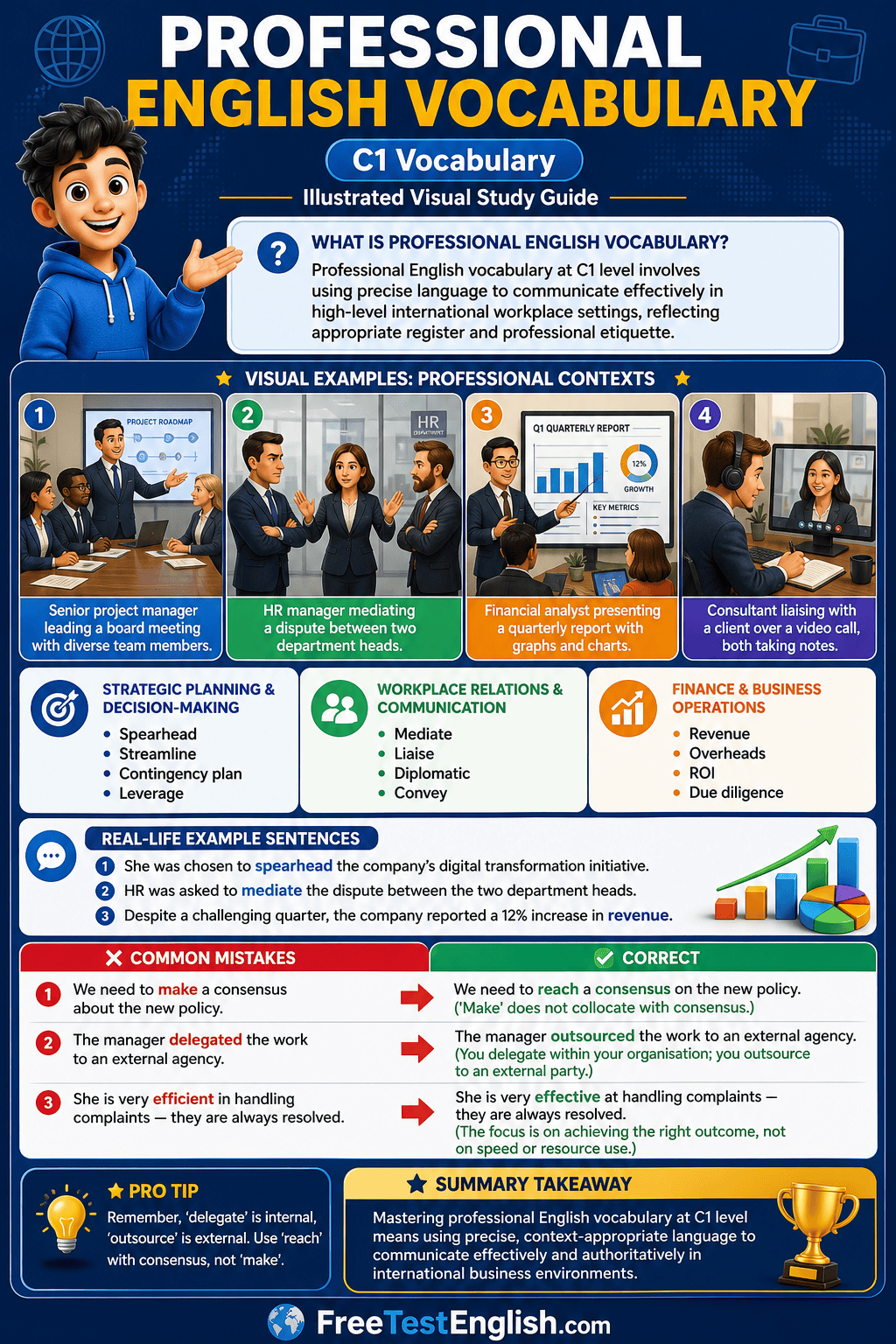
Professional English Vocabulary
Mastering professional English vocabulary is essential for anyone operating at a high level in an international workplace. Whether you are navigating complex negotiations, delivering a high-stakes presentation, or managing cross-functional teams, the words and expressions you choose signal your credibility, authority, and cultural awareness. At C1 level, it is not enough simply to communicate — you must communicate with precision, choosing language that reflects the appropriate register, subtlety, and professional etiquette expected in senior or specialist environments.
Scenario: Imagine you are a senior project manager at a multinational consultancy. This week alone, you have chaired a board-level strategy meeting, drafted a proposal for a new client, and mediated a disagreement between two department heads. Each of these situations demands a distinct set of vocabulary — from formal discourse markers and diplomatic hedging language to precise financial and organisational terminology. This lesson equips you with exactly that.
Key Vocabulary & Meaning Breakdown
1. Strategic Planning & Decision-Making
These terms are central to boardroom discussions, strategic reviews, and executive communications. They allow speakers to articulate complex organisational processes with clarity and confidence.
| Word / Phrase | Part of Speech & Meaning | Example Sentence | Collocations / Notes |
|---|---|---|---|
| to spearhead | verb — to lead or initiate a significant project or movement | She was chosen to spearhead the company's digital transformation initiative. | spearhead a campaign / initiative / effort / drive |
| to streamline | verb — to make a process, organisation, or system more efficient by removing unnecessary elements | The board agreed to streamline the procurement process to reduce overhead costs. | streamline operations / processes / workflows / procedures |
| contingency plan | noun phrase — a pre-arranged strategy to manage an unforeseeable event or emergency | Given the market volatility, the CFO insisted on a robust contingency plan before signing off on the project. | draw up / activate / rely on a contingency plan |
| to leverage | verb — to use something, such as a resource or relationship, to maximum advantage | We must leverage our existing client relationships to break into the Asian market. | leverage resources / data / expertise / networks |
| scalable | adjective — capable of being expanded or adapted to accommodate growth without compromising performance | The investors were impressed that the business model was both cost-effective and scalable. | scalable solution / model / infrastructure / approach |
| to benchmark | verb — to evaluate or compare something by measuring it against a standard or best practice | The team benchmarked their performance against the top five competitors in the sector. | benchmark against / performance benchmarking / industry benchmark |
| to mitigate | verb — to reduce the severity, seriousness, or impact of something, especially a risk | Several measures were introduced to mitigate the financial risks associated with the merger. | mitigate risk / damage / impact / effects |
| to prioritise | verb — to treat something as more important than other things; to rank tasks or goals by urgency or significance | In the current climate, the leadership team must prioritise staff retention above rapid expansion. | prioritise tasks / objectives / resources / stakeholders |
2. Workplace Relations, Communication & Diplomacy
Effective professionals are not only technically competent — they are also skilled communicators who can navigate sensitive interpersonal dynamics, deliver difficult messages diplomatically, and build consensus across diverse groups.
| Word / Phrase | Part of Speech & Meaning | Example Sentence | Collocations / Notes |
|---|---|---|---|
| to mediate | verb — to intervene in a dispute in order to facilitate an agreement between conflicting parties | HR was asked to mediate the dispute between the two department heads. | mediate a dispute / conflict / negotiation / settlement |
| to liaise | verb — to communicate and cooperate regularly with another person or organisation | You will need to liaise closely with the legal team throughout the contract review process. | liaise with / liaise between / liaise on a matter |
| diplomatic | adjective — dealing with sensitive situations tactfully, without causing offence | Her response to the client's complaint was firm yet entirely diplomatic. | diplomatic approach / tone / handling / response |
| to convey | verb — to communicate an idea, feeling, or information, often with precision and care | The memo was carefully worded to convey the urgency of the situation without causing alarm. | convey a message / meaning / concern / impression |
| rapport | noun — a close, harmonious relationship in which parties understand and communicate well with each other | Building rapport with clients early in the project can significantly improve long-term retention. | build / establish / develop / maintain rapport |
| to delegate | verb — to entrust a task or responsibility to another person, typically someone of lower seniority | An effective manager knows when to delegate and when to remain directly involved. | delegate authority / responsibility / tasks / power |
| consensus | noun — general agreement reached by a group, especially one reached through discussion and compromise | After two hours of deliberation, the committee finally reached a consensus on the proposed restructuring. | reach / build / achieve consensus; by consensus; broad consensus |
| constructive feedback | noun phrase — criticism offered in a helpful, solution-focused way that aims to improve performance | The appraisal process was redesigned to ensure employees received timely, constructive feedback. | provide / offer / give constructive feedback; act on feedback |
3. Finance, Performance & Business Operations
From interpreting quarterly reports to discussing operational efficiency, this cluster of vocabulary is indispensable in corporate, entrepreneurial, and financial environments.
| Word / Phrase | Part of Speech & Meaning | Example Sentence | Collocations / Notes |
|---|---|---|---|
| revenue | noun — the total income generated by a business from its normal operations, before costs are deducted | Despite a challenging quarter, the company reported a 12% increase in revenue. | generate / boost / increase / lose revenue; annual revenue |
| overheads | noun (plural) — the ongoing, fixed costs of running a business that are not directly tied to production | The new office space significantly reduced our monthly overheads. | cut / reduce / cover / manage overheads |
| ROI (return on investment) | noun phrase — a measure of the financial benefit gained relative to the cost of an investment | The marketing director struggled to demonstrate a clear ROI for the social media campaign. | measure / calculate / maximise / demonstrate ROI; strong / poor ROI |
| due diligence | noun phrase — the thorough investigation and verification of a business or individual before entering an agreement | The acquisition was delayed while the legal team completed their due diligence. | carry out / conduct / perform due diligence |
| turnover | noun — (1) the total revenue of a business; (2) the rate at which employees leave and are replaced | High staff turnover in the first year of the restructure was a serious concern for HR. | annual turnover; staff / employee turnover; high / low turnover |
| bottom line | noun phrase — the net profit or loss of a company; figuratively, the most important point of a matter | Ultimately, the bottom line is that we cannot afford to expand without additional funding. | affect / improve / protect the bottom line; focus on the bottom line |
| to allocate | verb — to distribute or assign resources, responsibilities, or funds for a specific purpose | The board agreed to allocate an additional budget of £50,000 to the R&D department. | allocate funds / resources / time / budget / responsibilities |
| procurement | noun — the process of obtaining goods, services, or raw materials for business use, typically through a formal process | The new procurement policy requires three competitive quotes for any purchase exceeding £10,000. | procurement process / department / strategy / policy |
Collocations & Useful Expressions
At C1 level, knowing a word in isolation is not sufficient — you must understand how professional vocabulary collocates, that is, which words naturally appear together. The following pairings are widely used in professional English contexts.
to spearhead + a drive / initiative / campaign
She was appointed to spearhead the firm's sustainability drive ahead of the annual report.
to reach + consensus
After extensive consultation, the partners finally reached consensus on the revised terms.
to mitigate + risk / damage / impact
Introducing a phased rollout will significantly mitigate the risk of system failure.
to leverage + expertise / data / relationships
The consultancy was hired specifically to leverage their expertise in emerging markets.
to carry out + due diligence
No acquisition proceeds without carrying out thorough due diligence on the target company.
to build + rapport / consensus / momentum
It is vital to build rapport with stakeholders before presenting a proposal of this scale.
to delegate + authority / responsibility
Senior leaders must learn to delegate responsibility without micromanaging outcomes.
to streamline + operations / procedures / the process
The interim CEO moved quickly to streamline operations and reduce unnecessary expenditure.
to allocate + budget / resources / time
We have allocated a significant portion of this quarter's budget to staff development.
constructive + feedback / criticism / dialogue
The workshop was designed to facilitate constructive dialogue between senior managers and their teams.
Important Differences & Confusing Words
Revenue vs Turnover vs Profit
These three financial terms are frequently confused, even by proficient English speakers. Understanding the distinction is critical in professional contexts.
- Revenue refers to the total income a business generates from its activities before any deductions. It is sometimes called "top-line income."
The company's annual revenue reached £4.2 million. - Turnover in British English is broadly synonymous with revenue — the total sales or income of a business. However, turnover can also refer to the rate at which staff leave and are replaced, which creates potential ambiguity. Context usually clarifies the meaning.
The firm reported a turnover of £6 million last year. (financial)
Staff turnover remains a challenge in the retail sector. (human resources) - Profit is what remains after all costs, expenses, and taxes have been deducted from revenue. It is the "bottom line" figure.
Despite strong revenue, the business posted a loss rather than a profit due to rising operational costs.
To Delegate vs To Outsource
- To delegate means to assign a task to a person within your organisation or team, typically someone more junior.
The director delegated the client briefing to her senior associate. - To outsource means to contract work to an external company or individual outside your organisation.
Many firms now outsource their payroll and IT support functions to third-party providers.
To Mediate vs To Negotiate vs To Arbitrate
- To mediate — a neutral third party helps two sides reach a voluntary agreement.
A professional mediator was brought in to resolve the contractual dispute. - To negotiate — the parties directly discuss terms with each other in order to reach an agreement.
Both companies negotiated the terms of the partnership over several weeks. - To arbitrate — a neutral party hears both sides and makes a binding decision, as in a formal legal process.
The dispute was referred to arbitration after negotiations broke down entirely.
Effective vs Efficient
Both words are common in professional English but carry importantly different meanings.
- Effective means achieving the intended result or goal — doing the right thing.
The new onboarding programme proved highly effective in reducing early attrition. - Efficient means achieving results with minimum waste of time, money, or effort — doing things in the right way.
The automated reporting system is far more efficient than the previous manual process.
A process can be efficient (fast and low-cost) without being effective (achieving the desired outcome), and vice versa. In professional English, this distinction frequently arises in performance reviews and operational discussions.
Common Mistakes
❌ We need to make a consensus about the new policy.
✅ reach a consensus — We need to reach a consensus on the new policy. ("Make" does not collocate with consensus.)
❌ The manager delegated the work to an external agency.
✅ outsourced — The manager outsourced the work to an external agency. (You delegate within your organisation; you outsource to an external party.)
❌ She is very efficient in handling complaints — they are always resolved.
✅ effective — She is very effective at handling complaints — they are always resolved. (The focus is on achieving the right outcome, not on speed or resource use.)
❌ We must mitigate the risk by doing more research before we can proceed.
✅ mitigate is correct here but note: do not confuse with "eliminate." You mitigate (reduce) a risk — you cannot always eliminate it entirely.
✅ We must mitigate the risk by conducting thorough research before proceeding.
❌ The company has a very high income and turnover.
✅ revenue or turnover (not both together) — The company has a very high turnover. (In British English, "turnover" and "revenue" are near-synonyms in a financial context. Using both together is redundant.)
❌ We need to leverage on our existing client base.
✅ leverage (without "on") — We need to leverage our existing client base. ("Leverage" as a verb does not require the preposition "on.")
❌ The project manager spearheaded to launch the new product line.
✅ spearheaded the launch of — The project manager spearheaded the launch of the new product line. ("Spearhead" takes a noun object, not an infinitive.)
❌ Please liaise me about any updates on the contract.
✅ liaise with me — Please liaise with me regarding any updates on the contract. ("Liaise" requires the preposition "with," not a direct object.)
Professional English Vocabulary: Quick Summary & Review
In this lesson, you have explored a broad and sophisticated range of professional English vocabulary across three key areas: strategic planning and decision-making, workplace relations and diplomacy, and finance and business operations.
- Use strategic vocabulary such as spearhead, leverage, benchmark, and contingency plan to articulate complex organisational thinking with authority.
- Deploy diplomatic and interpersonal language — mediate, liaise, convey, and build rapport — to navigate sensitive workplace situations with tact and professionalism.
- Apply financial and operational terms such as revenue, overheads, ROI, due diligence, and procurement accurately in business communications and reports.
- Pay close attention to common confusing pairs: effective vs efficient, delegate vs outsource, mediate vs arbitrate, and revenue vs profit.
- Master the collocations — reach consensus, carry out due diligence, mitigate risk, streamline operations — to sound truly fluent and natural in professional contexts.
At C1 level, the goal is not just comprehension but mastery: choosing the right word, in the right register, with the right collocation, at the right moment. Consistent exposure to authentic professional texts — reports, proposals, board minutes, and business journalism — will sharpen your command of this vocabulary considerably.
Now practise professional English vocabulary in the exercises below.
📄 Download the Professional English Vocabulary PDF
Download this Professional English Vocabulary grammar lesson as a free printable PDF.
It includes grammar rules, examples, and explanations so you can study offline anytime.