

Exercise 1
Choose the correct advanced adjective to complete each sentence.
Example: The professor gave a _______ analysis of the political situation. (astute / ambiguous / amiable)
Answer: The professor gave an astute analysis of the political situation.
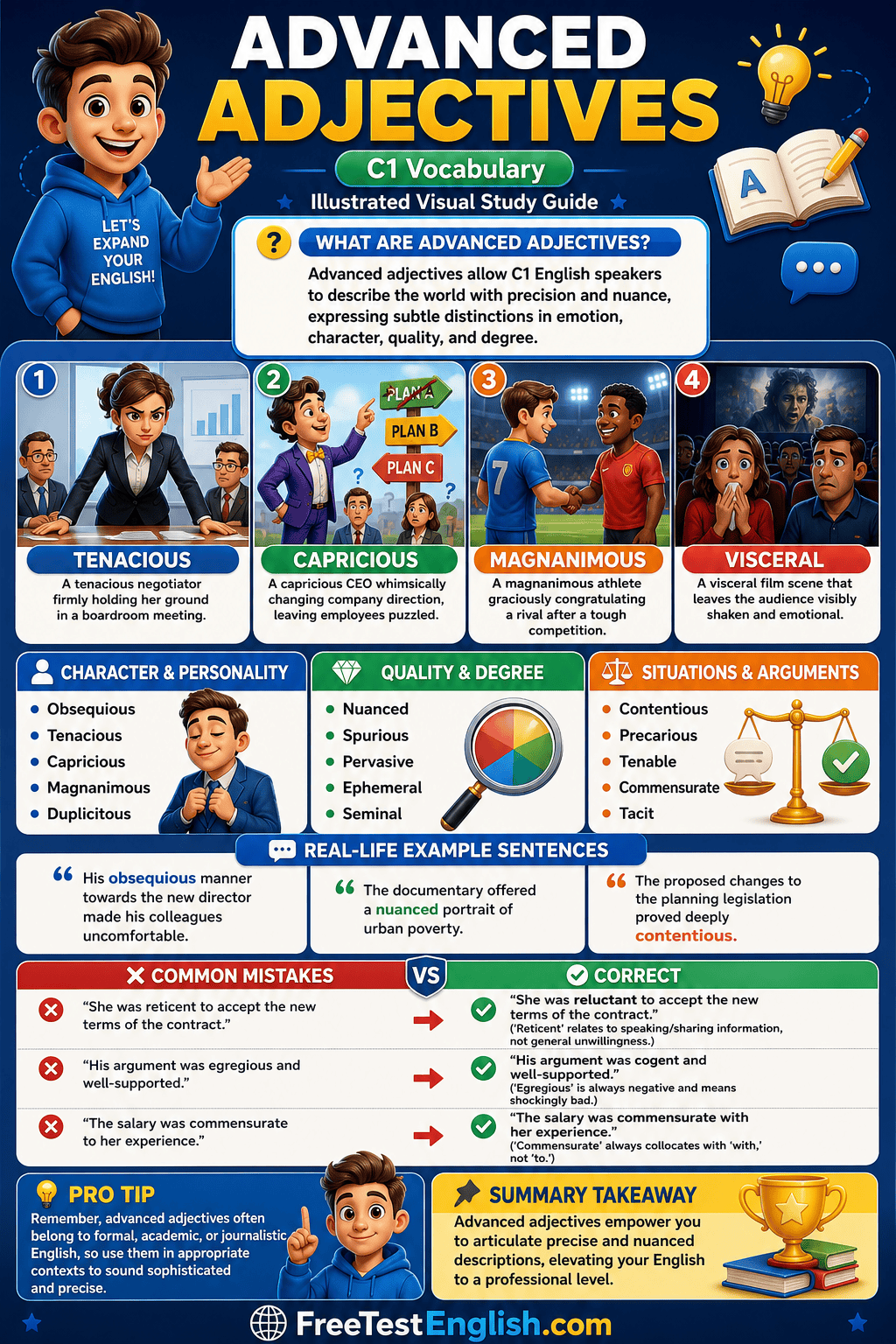
Advanced Adjectives: Describing the World with Precision and Nuance
At C1 level, your vocabulary is already broad and functional — but the most sophisticated English speakers distinguish themselves through precision. Rather than saying something is "very interesting" or "very bad," they reach for adjectives that carry richer, more exact meaning. Advanced adjectives allow you to express subtle distinctions in emotion, character, quality, and degree — the kind of language you encounter in quality journalism, literary fiction, academic writing, and professional discourse.
Consider this scenario: A senior editor at a publishing house is reviewing manuscripts submitted for a prestigious literary prize. In her notes, she writes: "The first novel has a compelling narrative, but the protagonist feels implausible. The second is more nuanced, though somewhat meandering in its final act. The third is utterly visceral — uncompromising and deeply affecting."
Every adjective in that passage does precise, irreplaceable work. By the end of this lesson, you will be able to use advanced adjectives like these with the same confidence and accuracy.
Key Vocabulary & Meaning Breakdown
1. Adjectives Describing Character, Behaviour, and Personality
These adjectives go far beyond "kind," "rude," or "shy." They capture specific shades of personality that are essential in professional and literary contexts.
| Word / Phrase | Part of Speech & Meaning | Example Sentence | Collocations / Notes |
|---|---|---|---|
| obsequious | adjective — excessively eager to please or serve others, often in a way that seems insincere or servile | His obsequious behaviour towards the new director made his colleagues deeply uncomfortable. | obsequious manner / tone / smile; strongly negative connotation; register: formal/literary |
| tenacious | adjective — holding firmly to a purpose, belief, or course of action; persistent and determined despite difficulty | She was a tenacious negotiator who never conceded ground without securing something in return. | tenacious grip / defender / campaigner / spirit; positive connotation; formal and journalistic register |
| capricious | adjective — given to sudden and unpredictable changes of mood or behaviour; impulsive and inconsistent | The capricious CEO changed the company's strategic direction on a whim, unsettling investors. | capricious nature / mood / decision / leadership; negative connotation; often used of weather or authority figures |
| magnanimous | adjective — generous in spirit, especially towards a rival or someone less powerful; noble and forgiving | In defeat, she was magnanimous, congratulating her opponent with genuine warmth. | magnanimous gesture / spirit / winner / response; strongly positive; formal register |
| duplicitous | adjective — deceitful, engaging in deliberately misleading behaviour; two-faced | The inquiry revealed a duplicitous campaign of misinformation orchestrated at the highest level. | duplicitous behaviour / tactics / character; strongly negative; formal and journalistic |
| reticent | adjective — unwilling to speak openly about something; reserved or restrained in expression | He was characteristically reticent about his personal life, deflecting every question with a polite smile. | reticent about / on the subject of; not the same as "reluctant" (see Confusing Words section) |
| pedantic | adjective — excessively concerned with minor details or rules, especially in academic or intellectual matters | His feedback was so pedantic that it focused on comma placement rather than the argument itself. | pedantic approach / correction / tone; mildly negative; often used in academic contexts |
2. Adjectives Describing Quality, Complexity, and Degree
These adjectives are vital in academic essays, critical writing, and professional analysis. They allow you to qualify, intensify, or temper your claims with sophistication.
| Word / Phrase | Part of Speech & Meaning | Example Sentence | Collocations / Notes |
|---|---|---|---|
| nuanced | adjective — characterised by subtle distinctions or fine gradations; not simplistic or black-and-white | The documentary offered a nuanced portrait of urban poverty that resisted easy conclusions. | nuanced analysis / view / argument / portrayal; highly valued in academic writing |
| spurious | adjective — not genuine or true; based on false reasoning or deceptive appearances | The defence counsel dismissed the prosecution's evidence as spurious and circumstantial. | spurious claim / argument / connection / logic; formal; often used in legal, academic, and journalistic contexts |
| pervasive | adjective — spreading widely throughout an area, environment, or community; omnipresent | A sense of distrust had become so pervasive that even routine decisions required committee approval. | pervasive influence / culture / problem / bias; often describes negative phenomena |
| ephemeral | adjective — lasting for only a very short time; transient and fleeting | Social media fame is notoriously ephemeral — today's viral sensation is tomorrow's forgotten post. | ephemeral nature / beauty / trend / moment; used in philosophy, art, and media criticism |
| seminal | adjective — strongly influencing later developments; original and highly important in a field | Kuhn's seminal work on paradigm shifts transformed how historians of science approach their discipline. | seminal work / text / moment / figure; always positive; academic register |
| egregious | adjective — outstandingly bad or shocking; flagrant and conspicuous in a negative sense | The report documented an egregious misuse of public funds that spanned nearly a decade. | egregious error / violation / example / behaviour; always negative; formal and legal register |
| visceral | adjective — relating to deep, instinctive feelings rather than reasoned thought; raw and powerfully emotional | The film's opening sequence provoked a visceral reaction — audiences were genuinely shaken. | visceral reaction / impact / response / experience; common in literary and film criticism |
3. Adjectives Describing Situations, Arguments, and Ideas
These are the adjectives that elevate academic and professional writing. They help you evaluate, critique, and contextualise with authority.
| Word / Phrase | Part of Speech & Meaning | Example Sentence | Collocations / Notes |
|---|---|---|---|
| contentious | adjective — causing or likely to cause disagreement or controversy; provoking strong opposing views | The proposed changes to the planning legislation proved deeply contentious, uniting unlikely allies in opposition. | contentious issue / debate / point / policy; neutral connotation; very common in journalism and academic discourse |
| precarious | adjective — not securely held or in position; dangerously uncertain or unstable | The start-up's financial position was increasingly precarious, with runway running out and investors wavering. | precarious situation / position / balance / existence; commonly used in economics and social commentary |
| tenable | adjective — (of a position or argument) capable of being defended or maintained against criticism or attack | Given the new evidence, the original hypothesis was no longer tenable. | a tenable position / argument / theory; often used in the negative: no longer tenable / hardly tenable |
| commensurate | adjective — corresponding in size, degree, or extent; proportionate | She expected a salary commensurate with her level of experience and the demands of the role. | commensurate with (always followed by "with"); formal; common in professional and legal contexts |
| perfunctory | adjective — carried out with minimal effort or care; routine and superficial | The safety inspection was perfunctory at best — the inspector spent fewer than ten minutes on site. | perfunctory glance / nod / check / apology; negative connotation; formal register |
| implacable | adjective — unable to be appeased or pacified; relentlessly opposed and unwilling to compromise | She faced implacable opposition from the board, who refused to consider any version of her proposal. | implacable enemy / opposition / hostility / critic; strongly negative when describing opposition; formal |
| tacit | adjective — understood or implied without being stated openly; unspoken but acknowledged | There was a tacit understanding amongst the team that overtime would not be claimed that quarter. | tacit agreement / understanding / approval / consent; formal; widely used in legal and professional discourse |
Collocations & Useful Expressions
Advanced adjectives are most powerful when paired with the right nouns and structures. The following collocations reflect authentic, high-register English usage.
tacit + agreement / understanding / consent / approval
The colleagues reached a tacit agreement that the matter would not be raised again.
pervasive + influence / bias / culture / sense of
A pervasive sense of unease hung over the proceedings from the very beginning.
seminal + work / study / text / moment / figure
This is considered a seminal text in postcolonial literary theory.
untenable + position / situation / argument
The minister's position had become wholly untenable in light of the leaked correspondence.
commensurate with + experience / qualifications / risk / effort
Rewards must be commensurate with the level of responsibility involved.
visceral + reaction / response / impact / hatred / fear
The speech provoked a visceral reaction from an audience exhausted by years of empty promises.
deeply + contentious / problematic / nuanced / unsettling
The ethical implications are deeply contentious and unlikely to be resolved easily.
increasingly + precarious / untenable / pervasive
The position of small independent retailers is becoming increasingly precarious.
entirely / wholly + spurious / unwarranted / unfounded
The accusations were entirely spurious and were dismissed by the tribunal.
characteristically + reticent / tenacious / magnanimous
He was characteristically reticent when journalists pressed him for details.
Important Differences & Confusing Words
Reticent vs. Reluctant
These two adjectives are frequently confused, even by advanced learners. They overlap in meaning but are not interchangeable.
Reticent specifically means unwilling to speak or reveal information. It relates to communication and expression.
She was reticent about her upbringing, rarely mentioning her childhood even to close friends.
Reluctant means unwilling to do something more generally — it is not limited to speech.
He was reluctant to accept the promotion, worried about the increased pressure it would bring.
❌ Using "reticent" when you mean general unwillingness is increasingly common but remains non-standard in careful formal writing.
✅ Reserve reticent for contexts involving speaking or revealing information.
Ephemeral vs. Transient vs. Fleeting
All three describe something brief or short-lived, but they carry different registers and nuances.
Ephemeral — most literary and philosophical; often implies beauty or significance in its brevity.
The ephemeral nature of cherry blossom is precisely what gives it cultural meaning in Japan.
Transient — more formal and neutral; often used in social sciences, economics, and policy.
The economic benefits proved transient, fading within two years of the investment.
Fleeting — the most common and least formal of the three; suitable across registers.
She caught only a fleeting glimpse of him through the crowd before he disappeared.
Contentious vs. Controversial
Both describe topics that provoke disagreement, but there is a subtle difference in emphasis.
Contentious often implies active, ongoing conflict or dispute — it suggests people are fighting over the issue.
Land rights remain a contentious issue in many post-colonial states.
Controversial is broader and more widely used; it simply means an issue has attracted significant public disagreement or debate, without necessarily implying active conflict.
The casting decision was controversial, generating thousands of comments online.
Egregious vs. Flagrant
Both mean conspicuously bad, but they have different emphases.
Egregious stresses the extreme degree of badness — something is shockingly, outrageously bad.
It was an egregious breach of medical ethics that resulted in the doctor being struck off.
Flagrant stresses the brazenness — the offence is done openly, with apparent disregard for what is right.
The decision was a flagrant violation of the terms agreed upon in the contract.
Common Mistakes
❌ She was reticent to accept the new terms of the contract.
✅ She was reluctant to accept the new terms of the contract. ("Reticent" relates to speaking/sharing information, not general unwillingness.)
❌ His argument was egregious and well-supported.
✅ His argument was cogent and well-supported. ("Egregious" is always negative and means shockingly bad — it cannot describe a good argument.)
❌ The salary was commensurate to her experience.
✅ The salary was commensurate with her experience. ("Commensurate" always collocates with "with," not "to.")
❌ The new policy was very pervasive in its benefits across the organisation.
✅ The new policy had widespread benefits across the organisation. ("Pervasive" tends to describe phenomena that spread negatively or passively — use "widespread" for positive, deliberate reach.)
❌ It was a seminal mistake that cost the company millions.
✅ It was a catastrophic mistake that cost the company millions. ("Seminal" means foundationally important in a positive or neutral intellectual sense — it does not mean simply "significant" or "major.")
❌ He gave a tacit refusal, saying clearly that he wouldn't attend.
✅ He gave an outright refusal, saying clearly that he wouldn't attend. ("Tacit" means unspoken and implied — it is contradicted by saying something clearly and directly.)
❌ The board was very magnanimous and refused to consider any compromise.
✅ The board was implacable and refused to consider any compromise. ("Magnanimous" means generously forgiving — the opposite of refusing compromise.)
Advanced Adjectives: Quick Summary & Review
Advanced adjectives are among the most powerful tools available to a C1 speaker. They allow you to express not just what something is, but how, to what degree, and with what underlying quality — the kind of precision that defines sophisticated, professional English.
- Use character adjectives such as obsequious, tenacious, capricious, magnanimous, and duplicitous to describe people with sharp, exact insight rather than relying on vague terms like "very ambitious" or "quite dishonest."
- Deploy quality and degree adjectives such as nuanced, spurious, pervasive, ephemeral, seminal, egregious, and visceral to elevate your analysis, criticism, and academic writing.
- Master situational and argumentative adjectives such as contentious, precarious, tenable, commensurate, perfunctory, implacable, and tacit to engage confidently with professional and intellectual discourse.
- Pay careful attention to register: many of these adjectives belong primarily to formal, academic, or journalistic English and may sound out of place in casual conversation.
- Learn key collocations — knowing that "commensurate" takes "with," that "tacit" collocates with "agreement" and "understanding," and that "pervasive" typically describes negative phenomena will help you use these words accurately and naturally.
- Avoid common pitfalls: do not confuse reticent with reluctant, do not use seminal to mean simply "significant," and do not apply egregious to anything positive.
Now practise Advanced Adjectives vocabulary in the exercises below.
📄 Download the Advanced Adjectives PDF
Download this Advanced Adjectives grammar lesson as a free printable PDF.
It includes grammar rules, examples, and explanations so you can study offline anytime.