
Read the passage carefully before attempting Exercise 1 (Multiple Choice) and Exercise 2 (Fill in the blanks dropdown) below.
There is a particular kind of silence that follows a significant failure — not the peaceful silence of an empty room, but a heavy, pressing one that seems to sit on the chest and refuse to move. Most people who have experienced genuine professional or personal collapse know this sensation intimately. What they are less likely to anticipate, however, is that this silence often precedes something rather remarkable: a fundamental reorientation of identity, purpose, and capability that conventional success rarely, if ever, produces.
The cultural narrative surrounding failure has shifted considerably over the past two decades. Where once it was treated as something shameful — to be concealed, minimised, or quietly forgotten — failure has gradually been reframed in psychological literature, business culture, and even mainstream media as an essential catalyst for growth. Silicon Valley entrepreneurs speak openly of their bankruptcies. Celebrated novelists discuss the rejection letters that wallpapered their early careers. Olympic athletes describe the defeats that ultimately forced them to refine their technique. This reframing is not merely fashionable optimism; it is, in many respects, grounded in what researchers have come to understand about how the human brain actually processes adversity.
Neuroscientific research conducted over the past three decades has demonstrated that the brain responds to significant failure much as it responds to physical injury — with inflammation, disruption, and, crucially, repair. Not only does the brain rewire neural pathways following periods of intense cognitive and emotional distress, but it frequently constructs more sophisticated and resilient networks in doing so. This phenomenon, broadly referred to as post-traumatic growth, suggests that the discomfort of failure is not incidental to development — it may, in fact, be indispensable to it. Were we to be shielded from all meaningful setback, we should arguably emerge less capable, not more.
That said, it would be dangerously simplistic to conclude that failure is inherently beneficial, or that suffering automatically yields wisdom. The determining factors are considerably more nuanced. Research by the psychologist Carol Dweck, whose work on fixed and growth mindsets has become widely influential, indicates that what matters is not the failure itself but the interpretive framework through which it is processed. Individuals who perceive their abilities as fundamentally static are far more likely to experience setbacks as confirmation of inadequacy, whereas those who regard intelligence and skill as developable qualities tend to treat failure as diagnostic information — painful, certainly, but ultimately instructive. The same event, filtered through different assumptions, produces dramatically different outcomes.
There is also a structural dimension to consider. Failure does not affect all people equally, and it would be naïve to overlook the extent to which socioeconomic circumstances, access to support networks, and institutional safety nets determine whether a person can afford, in the most literal sense, to fail and recover. For a tenured academic or a well-capitalised entrepreneur, failure may represent a setback from which recovery is not only possible but expected. For someone without financial reserves or professional connections, an equivalent failure could be catastrophic and permanent. Celebrating failure as universally productive risks glossing over these profound inequalities.
What remains compelling, nonetheless, is the evidence that people who have navigated genuine adversity — provided they have done so with adequate support and a degree of reflective capacity — frequently report a clarity of values and a sense of purpose that those whose paths have been smooth rarely articulate quite so precisely. They know what matters to them, having learned it the hard way. They tend to be less frightened of uncertainty, having already survived what they feared most. And they are, perhaps most significantly, more capable of sitting with that particular heavy silence and recognising it, in time, not as an ending, but as an unusually uncomfortable form of beginning.

Exercise 1
Read the passage carefully and choose the correct answer for each question based on the text. Each question has only one correct answer.
Example: According to the passage, what is one reason why failure is considered valuable?
Answer: Failure is considered valuable because it provides opportunities for self-reflection and personal growth.
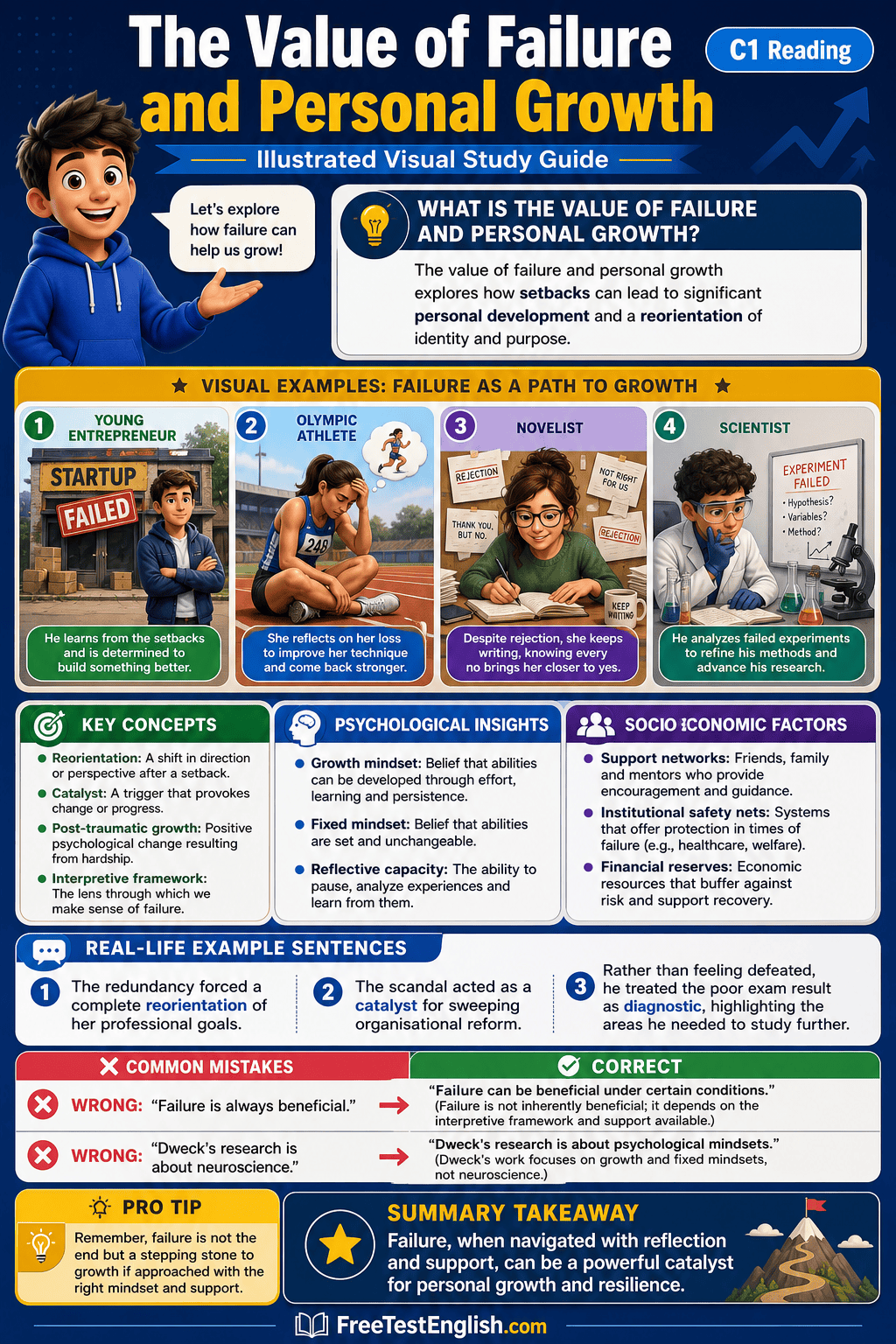
The Value of Failure and Personal Growth
Before you read, think about these two questions: Have you ever experienced a failure that ultimately changed your life for the better? And why do some people seem to thrive after setbacks while others are overwhelmed by them? Keep these questions in mind as you read the passage below.
Reading Passage: The Necessary Education
There is a particular kind of silence that follows a significant failure — not the peaceful silence of an empty room, but a heavy, pressing one that seems to sit on the chest and refuse to move. Most people who have experienced genuine professional or personal collapse know this sensation intimately. What they are less likely to anticipate, however, is that this silence often precedes something rather remarkable: a fundamental reorientation of identity, purpose, and capability that conventional success rarely, if ever, produces.
The cultural narrative surrounding failure has shifted considerably over the past two decades. Where once it was treated as something shameful — to be concealed, minimised, or quietly forgotten — failure has gradually been reframed in psychological literature, business culture, and even mainstream media as an essential catalyst for growth. Silicon Valley entrepreneurs speak openly of their bankruptcies. Celebrated novelists discuss the rejection letters that wallpapered their early careers. Olympic athletes describe the defeats that ultimately forced them to refine their technique. This reframing is not merely fashionable optimism; it is, in many respects, grounded in what researchers have come to understand about how the human brain actually processes adversity.
Neuroscientific research conducted over the past three decades has demonstrated that the brain responds to significant failure much as it responds to physical injury — with inflammation, disruption, and, crucially, repair. Not only does the brain rewire neural pathways following periods of intense cognitive and emotional distress, but it frequently constructs more sophisticated and resilient networks in doing so. This phenomenon, broadly referred to as post-traumatic growth, suggests that the discomfort of failure is not incidental to development — it may, in fact, be indispensable to it. Were we to be shielded from all meaningful setback, we should arguably emerge less capable, not more.
That said, it would be dangerously simplistic to conclude that failure is inherently beneficial, or that suffering automatically yields wisdom. The determining factors are considerably more nuanced. Research by the psychologist Carol Dweck, whose work on fixed and growth mindsets has become widely influential, indicates that what matters is not the failure itself but the interpretive framework through which it is processed. Individuals who perceive their abilities as fundamentally static are far more likely to experience setbacks as confirmation of inadequacy, whereas those who regard intelligence and skill as developable qualities tend to treat failure as diagnostic information — painful, certainly, but ultimately instructive. The same event, filtered through different assumptions, produces dramatically different outcomes.
There is also a structural dimension to consider. Failure does not affect all people equally, and it would be naïve to overlook the extent to which socioeconomic circumstances, access to support networks, and institutional safety nets determine whether a person can afford, in the most literal sense, to fail and recover. For a tenured academic or a well-capitalised entrepreneur, failure may represent a setback from which recovery is not only possible but expected. For someone without financial reserves or professional connections, an equivalent failure could be catastrophic and permanent. Celebrating failure as universally productive risks glossing over these profound inequalities.
What remains compelling, nonetheless, is the evidence that people who have navigated genuine adversity — provided they have done so with adequate support and a degree of reflective capacity — frequently report a clarity of values and a sense of purpose that those whose paths have been smooth rarely articulate quite so precisely. They know what matters to them, having learned it the hard way. They tend to be less frightened of uncertainty, having already survived what they feared most. And they are, perhaps most significantly, more capable of sitting with that particular heavy silence and recognising it, in time, not as an ending, but as an unusually uncomfortable form of beginning.
Key Vocabulary in Context
| Word / Phrase | Part of Speech | Definition | Example Sentence |
|---|---|---|---|
| reorientation | noun | A significant shift in the direction, focus, or understanding of something | The redundancy forced a complete reorientation of her professional goals. |
| catalyst | noun | Something that triggers or accelerates a process or change, without necessarily being the main cause | The scandal acted as a catalyst for sweeping organisational reform. |
| post-traumatic growth | noun phrase | Positive psychological change that can emerge following a struggle with highly challenging life circumstances | Several studies have documented post-traumatic growth among patients recovering from serious illness. |
| interpretive framework | noun phrase | The set of assumptions or beliefs through which a person understands and makes sense of events | Her interpretive framework, shaped by years of coaching, helped her see criticism as useful rather than threatening. |
| diagnostic | adjective | Providing useful information that identifies a problem or reveals where improvement is needed | Rather than feeling defeated, he treated the poor exam result as diagnostic, highlighting the areas he needed to study further. |
| glossing over | verb phrase (phrasal verb) | Treating something difficult or unpleasant in a superficial way, avoiding its full significance | The report was criticised for glossing over the social costs of the new policy. |
| resilient | adjective | Able to recover quickly and effectively from difficult experiences or conditions | Children who grow up in supportive environments tend to be more emotionally resilient as adults. |
| reflective capacity | noun phrase | The ability to think carefully and critically about one's own experiences and responses | Mentoring programmes aim to develop the reflective capacity of young professionals early in their careers. |
Reading Strategies & Comprehension Tips
Skimming for the Main Argument
Before reading in detail, skim the first and last sentences of each paragraph. This passage is structured as a nuanced argument rather than a straightforward report, so identifying the topic sentence of each paragraph will help you map the overall line of reasoning — from the personal experience of failure, through its cultural and neurological dimensions, to the important critical caveat in paragraph five.
Scanning for Evidence and Examples
The passage uses a mix of scientific research (e.g., Dweck's work on mindsets, neuroscientific findings), real-world examples (entrepreneurs, novelists, athletes), and analytical argument. When answering questions about evidence, scan for specific names and fields mentioned rather than trying to recall them from memory.
Inference and Tone
Pay close attention to the author's hedging language — phrases such as may in fact be, arguably, frequently report, and rarely articulate quite so precisely. These signal that the author is making careful, qualified claims rather than absolute statements. Questions about the author's attitude or degree of certainty will require you to interpret this nuanced, measured tone accurately.
Understanding Complex Conditionals
The passage contains several advanced conditional structures (e.g., Were we to be shielded from all meaningful setback...). Recognise that this is an inverted conditional equivalent to If we were shielded... — a formal stylistic choice that does not change the underlying meaning.
Common Reading Pitfalls & Traps
- Oversimplifying the author's position: The passage does not simply argue that failure is always good. Paragraph five presents a significant counterpoint about inequality and access to support. Students who read too quickly may miss this qualification and incorrectly conclude that the author is uncritically celebrating failure.
- Confusing Dweck's research with the neuroscientific findings: The passage references two separate bodies of research — one neurological (paragraph three) and one psychological (paragraph four). Be careful not to attribute Dweck's work to neuroscience, or to conflate the two distinct arguments they are used to support.
- Misreading hedged language as certainty: Phrases like may be indispensable or could be catastrophic indicate possibility or conditionality, not confirmed fact. Answer questions about what the author claims or suggests with appropriate precision — avoid absolute interpretations where the text uses modal verbs.
- Misunderstanding the opening metaphor: The heavy, pressing silence described in the first paragraph is figurative language conveying the emotional weight of failure — it is not a literal description of an event. Students who interpret it too literally may struggle with questions about the writer's purpose in the introduction.
Quick Summary
Now read the passage carefully and complete Exercise 1 (Multiple Choice) and Exercise 2 (Fill-in-the-gap dropdown) below.
📄 Download the The Value of Failure and Personal Growth PDF
Download this The Value of Failure and Personal Growth grammar lesson as a free printable PDF.
It includes grammar rules, examples, and explanations so you can study offline anytime.