
Read the passage carefully before attempting Exercise 1 (Multiple Choice) and Exercise 2 (Fill in the blanks dropdown) below.
Every morning, before most people have even made a conscious decision, they have already been exposed to dozens of commercial messages. A smartphone notification from a retail app, a sponsored post on a social media feed, a branded coffee cup on a colleague’s desk — each of these micro-encounters is no accident. They are the product of an industry that has spent over a century refining its understanding of human psychology, and whose influence on everyday behaviour is far deeper than most of us would care to admit.
The conventional view of advertising is that it simply informs consumers about products they might find useful. On this reading, a well-placed advertisement merely bridges the gap between supply and demand, helping manufacturers reach buyers and enabling buyers to make informed choices. Were this the whole story, the moral and societal implications of advertising would be relatively straightforward. The reality, however, is considerably more complex. Decades of research in behavioural economics have demonstrated that human decision-making is far less rational than we assume. Not only do consumers routinely overestimate their own resistance to commercial persuasion, but they also consistently underestimate the extent to which their preferences have been shaped long before they set foot in a shop.
One of the most well-documented mechanisms through which advertising operates is known as the mere exposure effect — the psychological tendency to develop a preference for things simply because they are familiar. Advertisers exploit this phenomenon with extraordinary precision: by ensuring that a brand logo, a jingle, or a slogan appears repeatedly across multiple platforms, they are not necessarily telling consumers what to think, but conditioning them to feel comfortable with a particular product. This distinction — between persuasion and conditioning — is crucial, and it is one that critics of the advertising industry argue is deliberately obscured. Having built emotional associations over months or even years, a brand can activate these associations at the precise moment a consumer is poised to make a purchase.
The digital revolution has amplified these dynamics to a degree that would have been unimaginable to Madison Avenue executives of the 1960s. Algorithms now aggregate vast quantities of behavioural data — browsing history, location, purchasing patterns, even the speed at which a user scrolls past certain content — to construct detailed psychological profiles of individual consumers. Advertisements are then targeted with a granularity that traditional mass media could never achieve. A person who spent three minutes reading a review of hiking boots on a Tuesday evening may find themselves pursued across the internet by advertisements for outdoor clothing for the following fortnight. Whether this constitutes a service or a form of surveillance capitalism is a debate that regulators across the world are only beginning to take seriously.
What is particularly striking is the degree to which many consumers remain convinced of their own autonomy. Surveys consistently show that while people acknowledge advertising’s influence on others, they tend to believe themselves largely immune — a phenomenon researchers have termed the third-person effect. This self-flattering illusion of resistance may, paradoxically, make individuals more susceptible to influence rather than less, since those who believe they are not being manipulated are unlikely to adopt critical defences against it.
None of this is to suggest that advertising is inherently malicious, or that consumers are simply passive victims of corporate engineering. There is a legitimate case to be made that advertising funds much of the content the public enjoys for free, from streaming services to journalism, and that without it, access to information would be considerably more restricted. Nevertheless, as the tools available to advertisers grow ever more sophisticated, the question of where persuasion ends and manipulation begins demands not only academic scrutiny but meaningful regulatory intervention. The shopping basket, it turns out, is rarely as freely chosen as we imagine.

Exercise 1
Read the passage carefully and choose the correct answer for each question based on the text. Each question has only one correct answer.
Example: According to the passage, what is one of the primary goals of advertising?
Answer: To influence consumer behaviour and increase product demand.
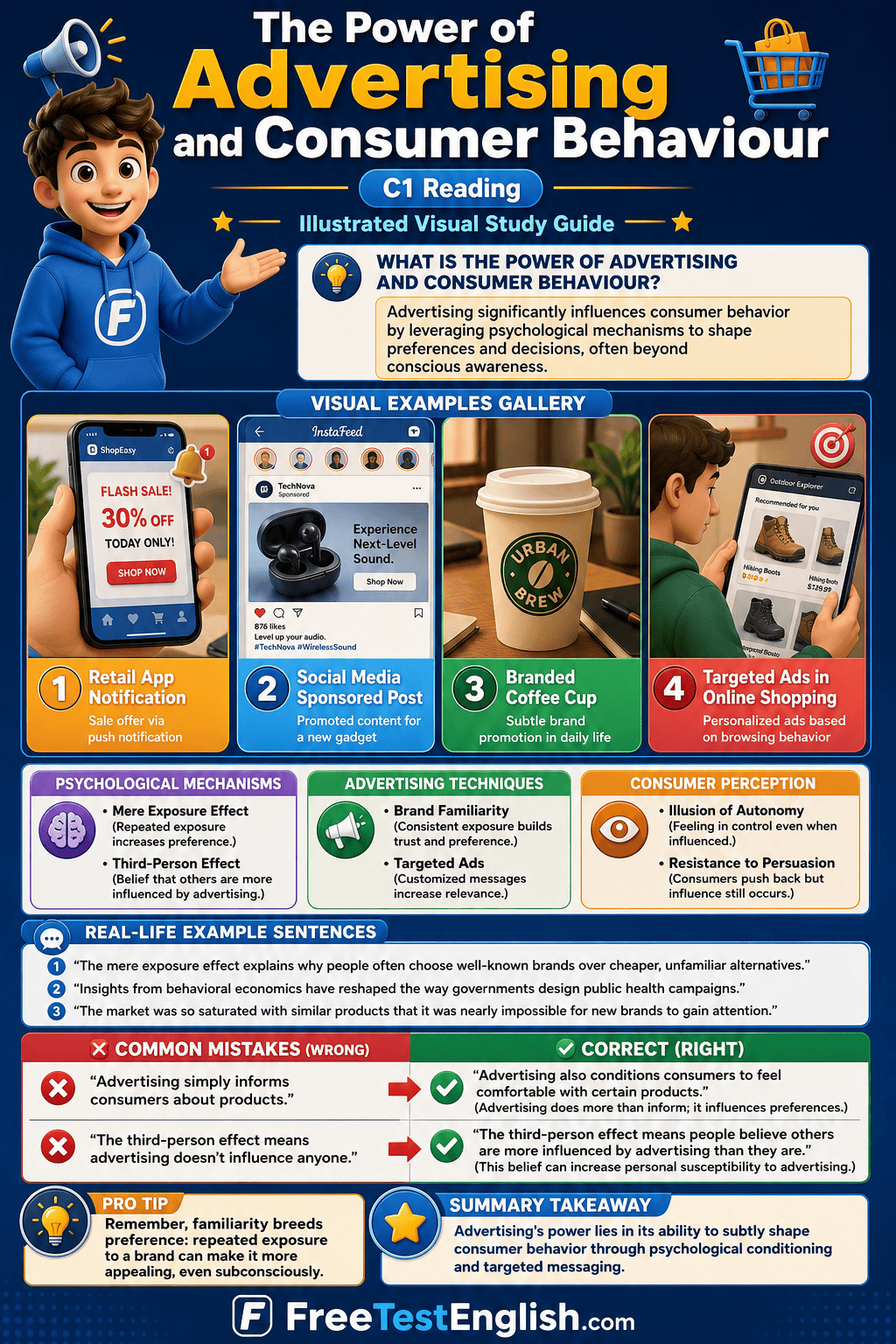
The Power of Advertising and Consumer Behaviour
Before you read, consider these two questions: To what extent do you think advertising genuinely influences your purchasing decisions? And: Is it possible for consumers to be truly rational when making choices in a marketplace saturated with commercial messages? Keep these questions in mind as you read the article below.
Reading Passage: The Invisible Hand in Your Shopping Basket
Every morning, before most people have even made a conscious decision, they have already been exposed to dozens of commercial messages. A smartphone notification from a retail app, a sponsored post on a social media feed, a branded coffee cup on a colleague's desk — each of these micro-encounters is no accident. They are the product of an industry that has spent over a century refining its understanding of human psychology, and whose influence on everyday behaviour is far deeper than most of us would care to admit.
The conventional view of advertising is that it simply informs consumers about products they might find useful. On this reading, a well-placed advertisement merely bridges the gap between supply and demand, helping manufacturers reach buyers and enabling buyers to make informed choices. Were this the whole story, the moral and societal implications of advertising would be relatively straightforward. The reality, however, is considerably more complex. Decades of research in behavioural economics have demonstrated that human decision-making is far less rational than we assume. Not only do consumers routinely overestimate their own resistance to commercial persuasion, but they also consistently underestimate the extent to which their preferences have been shaped long before they set foot in a shop.
One of the most well-documented mechanisms through which advertising operates is known as the mere exposure effect — the psychological tendency to develop a preference for things simply because they are familiar. Advertisers exploit this phenomenon with extraordinary precision: by ensuring that a brand logo, a jingle, or a slogan appears repeatedly across multiple platforms, they are not necessarily telling consumers what to think, but conditioning them to feel comfortable with a particular product. This distinction — between persuasion and conditioning — is crucial, and it is one that critics of the advertising industry argue is deliberately obscured. Having built emotional associations over months or even years, a brand can activate these associations at the precise moment a consumer is poised to make a purchase.
The digital revolution has amplified these dynamics to a degree that would have been unimaginable to Madison Avenue executives of the 1960s. Algorithms now aggregate vast quantities of behavioural data — browsing history, location, purchasing patterns, even the speed at which a user scrolls past certain content — to construct detailed psychological profiles of individual consumers. Advertisements are then targeted with a granularity that traditional mass media could never achieve. A person who spent three minutes reading a review of hiking boots on a Tuesday evening may find themselves pursued across the internet by advertisements for outdoor clothing for the following fortnight. Whether this constitutes a service or a form of surveillance capitalism is a debate that regulators across the world are only beginning to take seriously.
What is particularly striking is the degree to which many consumers remain convinced of their own autonomy. Surveys consistently show that while people acknowledge advertising's influence on others, they tend to believe themselves largely immune — a phenomenon researchers have termed the third-person effect. This self-flattering illusion of resistance may, paradoxically, make individuals more susceptible to influence rather than less, since those who believe they are not being manipulated are unlikely to adopt critical defences against it.
None of this is to suggest that advertising is inherently malicious, or that consumers are simply passive victims of corporate engineering. There is a legitimate case to be made that advertising funds much of the content the public enjoys for free, from streaming services to journalism, and that without it, access to information would be considerably more restricted. Nevertheless, as the tools available to advertisers grow ever more sophisticated, the question of where persuasion ends and manipulation begins demands not only academic scrutiny but meaningful regulatory intervention. The shopping basket, it turns out, is rarely as freely chosen as we imagine.
Key Vocabulary in Context
| Word / Phrase | Part of Speech | Definition | Example Sentence |
|---|---|---|---|
| saturated | adjective | Completely filled with something to the point where no more can be absorbed or added | The market was so saturated with similar products that it was nearly impossible for new brands to gain attention. |
| behavioural economics | noun phrase | A field of study that examines how psychological factors affect economic decision-making | Insights from behavioural economics have reshaped the way governments design public health campaigns. |
| mere exposure effect | noun phrase | The psychological tendency to prefer something simply because it has become familiar through repeated encounters | The mere exposure effect explains why people often choose well-known brands over cheaper, unfamiliar alternatives. |
| granularity | noun | The level of detail or precision with which something is analysed or targeted | The granularity of modern data collection allows advertisers to tailor messages to individual consumers. |
| surveillance capitalism | noun phrase | An economic system in which personal data is collected and sold commercially, often without full awareness or consent from users | Critics argue that surveillance capitalism poses a fundamental threat to individual privacy and democratic freedom. |
| the third-person effect | noun phrase | The tendency for people to believe that media messages have a greater influence on others than on themselves | The third-person effect means that warning labels on advertising are often dismissed by the very people they are designed to protect. |
| susceptible | adjective | Easily influenced, affected, or harmed by something | Young children are particularly susceptible to advertising because they lack the critical skills to evaluate commercial messages. |
| regulatory intervention | noun phrase | Action taken by official bodies or governments to control or restrict an activity through rules and legislation | Many consumer groups are calling for stronger regulatory intervention in the online advertising sector. |
Reading Strategies & Comprehension Tips
Skimming for the Main Argument
This passage presents a clear central argument that develops across six paragraphs. When you skim, read the first and last sentence of each paragraph. You will quickly notice that the writer moves from establishing advertising's ubiquity, to questioning its rationality claims, to examining specific psychological mechanisms, and finally to raising ethical concerns. Tracking this progression helps you understand how the argument builds.
Scanning for Evidence and Examples
The writer uses specific concepts and named phenomena as evidence (e.g., the mere exposure effect, the third-person effect, surveillance capitalism). When answering detail-focused questions, scan for these technical terms — they are anchor points around which specific claims are made and are likely to be tested.
Inferring the Writer's Attitude
The writer's tone is measured and analytical rather than overtly polemical. Pay attention to qualifying phrases such as "far less rational than we assume", "deliberately obscured", and "rarely as freely chosen as we imagine". These signal implicit criticism without direct accusation, and exam questions may ask you to distinguish between what the writer states explicitly and what is merely implied.
Understanding Complex Conditionals and Inversion
The passage contains several advanced grammatical structures. For example, "Were this the whole story..." is an inverted conditional equivalent to "If this were the whole story...". Recognising these structures is essential for accurate comprehension and will help you avoid misreading the logical relationships between ideas.
Common Reading Pitfalls & Traps
Confusing the Conventional View with the Writer's Own Position
Paragraph two introduces the idea that advertising "simply informs consumers" — but this is presented as a conventional view that the writer then challenges, not as the writer's own position. Students who skim carelessly may attribute this argument to the writer themselves, leading to incorrect answers on attitude and opinion questions.
Misreading the Third-Person Effect
The concept of the third-person effect describes people's belief that others are more influenced by advertising than they themselves are. A common error is to interpret this as a statement that advertising does not actually influence anyone, or that the effect only applies to a minority of people. The writer's point is the opposite: this belief in personal immunity may actively increase vulnerability.
Oversimplifying the Writer's Conclusion
The final paragraph explicitly acknowledges a positive case for advertising — that it funds freely available content. Students may be tempted to read this as a reversal of the writer's critical argument. In fact, it represents a concession that strengthens rather than undermines the overall position: even granting advertising's benefits, the writer argues that stronger regulation is still warranted.
False Cognates and Misleading Vocabulary
The word aggregate in paragraph four is used as a verb meaning "to collect and combine data from multiple sources." Students familiar with it only as a noun (a collection of things) may misread its function in the sentence. Similarly, poised means "on the verge of" or "in a position ready to do something" — not "balanced" or "calm," which are its more common meanings in other contexts.
Quick Summary
This article examines the psychological mechanisms that make advertising far more powerful than most consumers acknowledge. Moving from the concept of the mere exposure effect to the implications of digital surveillance and the third-person effect, the writer argues that the illusion of consumer autonomy is itself a product of sophisticated commercial engineering — and that this demands serious regulatory attention.
Now read the passage carefully and complete Exercise 1 (Multiple Choice) and Exercise 2 (Fill-in-the-gap dropdown) below.
📄 Download the The Power of Advertising and Consumer Behaviour PDF
Download this The Power of Advertising and Consumer Behaviour grammar lesson as a free printable PDF.
It includes grammar rules, examples, and explanations so you can study offline anytime.