
Read the passage carefully before attempting Exercise 1 (Multiple Choice) and Exercise 2 (Fill in the blanks dropdown) below.
In ancient Athens, the agora — a bustling public square where citizens gathered to debate, trade, and exchange ideas — was considered the heartbeat of democratic life. Philosophers, merchants, and politicians mingled freely, exposing one another to a cacophony of competing viewpoints. Fast-forward roughly two and a half millennia, and one might argue that this exchange has been replicated on an unprecedented scale by social media platforms. Yet the crucial difference is one that rarely receives the scrutiny it deserves: the Athenian agora was governed by the unpredictability of human encounter, whereas the modern digital equivalent is governed by code — specifically, by engagement-maximising algorithms that determine not just what you see, but what you are nudged to believe.
The mechanics of algorithmic curation are not particularly mysterious. Platforms such as Facebook, X (formerly Twitter), and YouTube are engineered to maximise the time users spend on them, since longer engagement translates into greater advertising revenue. To achieve this, their systems learn which content provokes the strongest emotional reactions — and it is a well-documented finding in behavioural psychology that outrage, fear, and moral indignation tend to be far more engaging than nuanced, measured analysis. Content that elicits these responses is therefore amplified, irrespective of its accuracy or its broader societal consequences. The result is that users are gradually immersed in environments where extreme viewpoints feel mainstream, and where the moderate centre appears either invisible or intellectually weak. Not only does this distort individual perception, but it actively erodes the shared factual basis upon which democratic deliberation depends.
This phenomenon has been given various names — filter bubbles, echo chambers, epistemic silos — but labelling it does little to diminish its potency. Research conducted by MIT’s Media Lab found that false news stories spread roughly six times faster on Twitter than accurate ones, a disparity attributed partly to the novelty and emotional charge of misinformation. During the 2016 US presidential election, the Brexit referendum, and numerous subsequent political events around the world, coordinated disinformation campaigns exploited these algorithmic vulnerabilities with remarkable efficiency. What made such campaigns particularly insidious was their subtlety: rather than fabricating stories wholesale, they often exaggerated genuine grievances, seeding suspicion and deepening existing social divisions.
Defenders of social media’s role in public discourse — and there are legitimate ones — point out that platforms have also given a voice to marginalised communities that were historically excluded from mainstream media. Movements such as #MeToo and Black Lives Matter gained traction precisely because social media allowed ordinary individuals to bypass editorial gatekeepers and speak directly to global audiences. Had these platforms not existed in their current form, the speed and scale of those social reckonings would almost certainly have been far more limited. To dismiss social media’s democratising potential entirely would, therefore, be intellectually dishonest.
The real challenge lies not in choosing between these two narratives but in grappling with their uncomfortable coexistence. Proposing meaningful regulation is fraught with difficulty: governments that attempt to police online content risk accusations of censorship, while those that do nothing tacitly endorse the amplification of harmful material. Some researchers have advocated for structural reforms — making algorithmic logic transparent, mandating the curation of diverse perspectives, or replacing engagement-based ranking with systems that prioritise credibility. Whether any of these solutions could be implemented without unintended consequences remains, at best, an open question.
What seems increasingly clear is that the passive consumption of social media content is no longer a politically neutral act. Every scroll, every share, and every reaction feeds a system that is, in turn, shaping the broader information ecosystem in which all of us — politician and citizen alike — are compelled to navigate. The agora, it turns out, has not simply moved online. It has been rebuilt entirely, on someone else’s terms.

Exercise 1
Read the passage about the influence of social media on public opinion carefully, then choose the correct answer for each question based on the information given in the text.
Example: According to the passage, which factor most significantly amplifies the spread of misinformation on social media platforms?
Answer: Algorithmic content curation that prioritises engagement over accuracy most significantly amplifies the spread of misinformation on social media platforms.
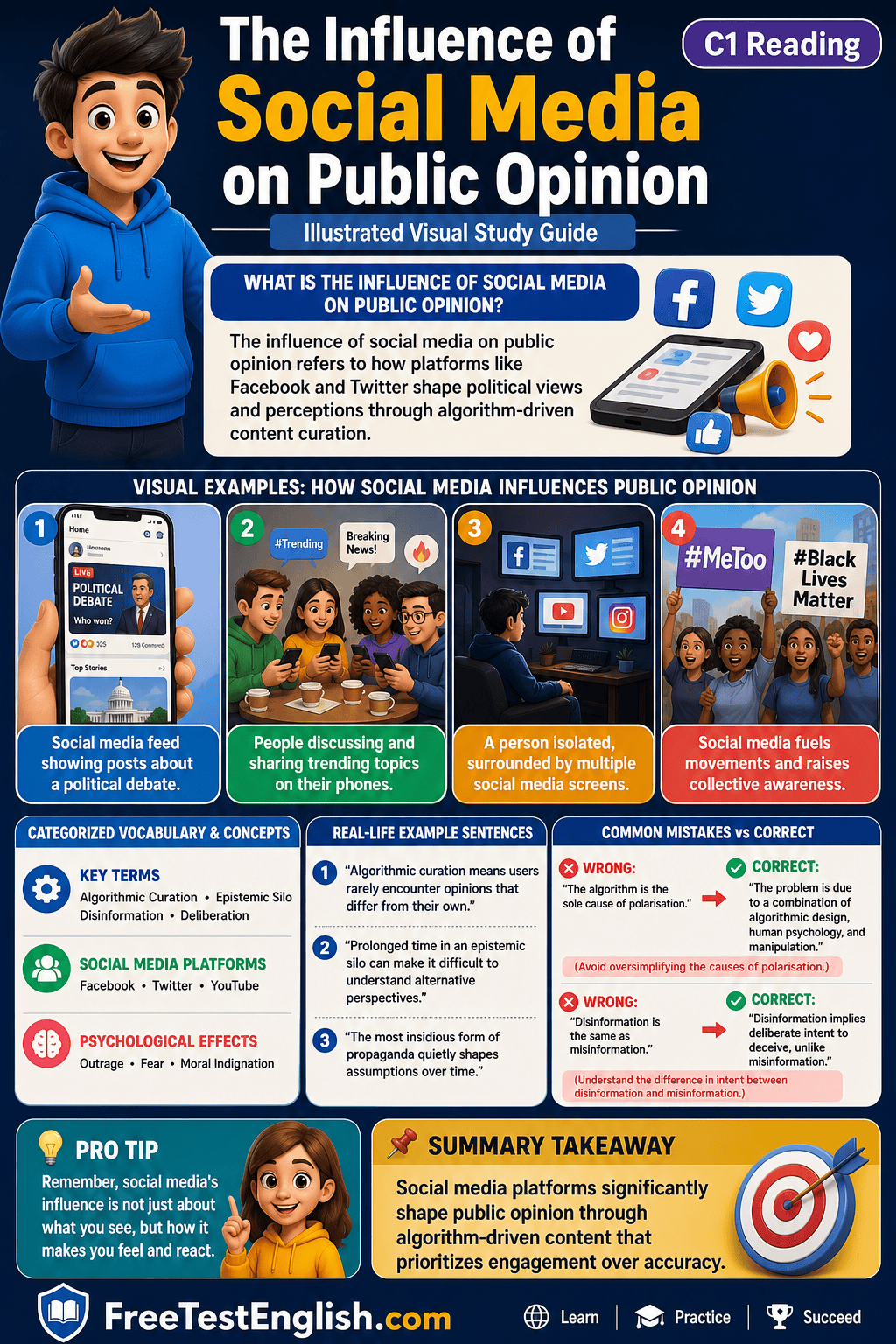
The Influence of Social Media on Public Opinion
Before you read, consider these two questions: To what extent do you think social media platforms shape the way people form their political opinions? And: Is it possible to remain truly objective when the information you encounter online has been filtered by an algorithm designed to keep you engaged? Keep these questions in mind as you work through the passage below.
Reading Passage: The Algorithm and the Agora
In ancient Athens, the agora — a bustling public square where citizens gathered to debate, trade, and exchange ideas — was considered the heartbeat of democratic life. Philosophers, merchants, and politicians mingled freely, exposing one another to a cacophony of competing viewpoints. Fast-forward roughly two and a half millennia, and one might argue that this exchange has been replicated on an unprecedented scale by social media platforms. Yet the crucial difference is one that rarely receives the scrutiny it deserves: the Athenian agora was governed by the unpredictability of human encounter, whereas the modern digital equivalent is governed by code — specifically, by engagement-maximising algorithms that determine not just what you see, but what you are nudged to believe.
The mechanics of algorithmic curation are not particularly mysterious. Platforms such as Facebook, X (formerly Twitter), and YouTube are engineered to maximise the time users spend on them, since longer engagement translates into greater advertising revenue. To achieve this, their systems learn which content provokes the strongest emotional reactions — and it is a well-documented finding in behavioural psychology that outrage, fear, and moral indignation tend to be far more engaging than nuanced, measured analysis. Content that elicits these responses is therefore amplified, irrespective of its accuracy or its broader societal consequences. The result is that users are gradually immersed in environments where extreme viewpoints feel mainstream, and where the moderate centre appears either invisible or intellectually weak. Not only does this distort individual perception, but it actively erodes the shared factual basis upon which democratic deliberation depends.
This phenomenon has been given various names — filter bubbles, echo chambers, epistemic silos — but labelling it does little to diminish its potency. Research conducted by MIT's Media Lab found that false news stories spread roughly six times faster on Twitter than accurate ones, a disparity attributed partly to the novelty and emotional charge of misinformation. During the 2016 US presidential election, the Brexit referendum, and numerous subsequent political events around the world, coordinated disinformation campaigns exploited these algorithmic vulnerabilities with remarkable efficiency. What made such campaigns particularly insidious was their subtlety: rather than fabricating stories wholesale, they often exaggerated genuine grievances, seeding suspicion and deepening existing social divisions.
Defenders of social media's role in public discourse — and there are legitimate ones — point out that platforms have also given a voice to marginalised communities that were historically excluded from mainstream media. Movements such as #MeToo and Black Lives Matter gained traction precisely because social media allowed ordinary individuals to bypass editorial gatekeepers and speak directly to global audiences. Had these platforms not existed in their current form, the speed and scale of those social reckonings would almost certainly have been far more limited. To dismiss social media's democratising potential entirely would, therefore, be intellectually dishonest.
The real challenge lies not in choosing between these two narratives but in grappling with their uncomfortable coexistence. Proposing meaningful regulation is fraught with difficulty: governments that attempt to police online content risk accusations of censorship, while those that do nothing tacitly endorse the amplification of harmful material. Some researchers have advocated for structural reforms — making algorithmic logic transparent, mandating the curation of diverse perspectives, or replacing engagement-based ranking with systems that prioritise credibility. Whether any of these solutions could be implemented without unintended consequences remains, at best, an open question.
What seems increasingly clear is that the passive consumption of social media content is no longer a politically neutral act. Every scroll, every share, and every reaction feeds a system that is, in turn, shaping the broader information ecosystem in which all of us — politician and citizen alike — are compelled to navigate. The agora, it turns out, has not simply moved online. It has been rebuilt entirely, on someone else's terms.
Key Vocabulary in Context
| Word / Phrase | Part of Speech | Definition | Example Sentence |
|---|---|---|---|
| algorithmic curation | noun phrase | The automatic selection and filtering of content by a computer system, based on patterns in user behaviour, designed to personalise what each person sees online. | Many users are unaware that algorithmic curation means they rarely encounter opinions that significantly differ from their own. |
| epistemic silo | noun phrase | An isolated information environment in which a person is only exposed to knowledge and beliefs that confirm their existing worldview, preventing genuine understanding of alternative perspectives. | Prolonged time in an epistemic silo can make it genuinely difficult to comprehend why others hold different political views. |
| insidious | adjective | Developing gradually and harmfully in a way that is not immediately obvious or noticeable; treacherous. | The most insidious form of propaganda does not announce itself but quietly shapes assumptions over time. |
| disinformation | noun | False or misleading information that is deliberately spread with the intention of deceiving people, often for political or financial gain. | Distinguishing between honest error and deliberate disinformation has become one of the defining challenges for modern journalism. |
| deliberation | noun | Long, careful consideration or discussion, particularly when making decisions or forming judgements on important matters. | Genuine democratic deliberation requires access to a shared and reliable body of factual information. |
| erodes | verb | Gradually destroys or weakens something over time, as if wearing it away. | Repeated exposure to sensationalised news slowly erodes a person's trust in institutions. |
| tacitly | adverb | In a way that is understood or implied without being directly stated; silently or without explicit acknowledgement. | By refusing to act, the committee tacitly accepted responsibility for the damage that followed. |
| reckonings | noun (plural) | Moments of consequence or public confrontation with a difficult truth, often involving accountability for past wrongdoing. | The corporate scandals of that decade triggered painful reckonings within the financial industry. |
Reading Strategies & Comprehension Tips
Skimming for the Central Argument
This passage is structured as an analytical opinion piece rather than a purely informational text. When skimming, focus on the opening and closing sentences of each paragraph, as the writer uses these positions to signal key arguments and to signal shifts in perspective. Notice how the passage moves from problem identification to counterargument to unresolved tension — this three-part structure is characteristic of sophisticated academic writing.
Scanning for Evidence and Examples
The writer integrates specific evidence to support claims. Scan for proper nouns (MIT Media Lab, Facebook, #MeToo, the 2016 US election) to locate the evidentiary passages. When a question asks you to identify what a claim is supported by, these named references are your signposts.
Inferring the Writer's Attitude
The writer does not adopt a straightforwardly negative position towards social media. Pay close attention to concessive language — phrases such as "Defenders of social media's role... point out that..." and "To dismiss... entirely would be intellectually dishonest." These signal that the writer is deliberately presenting a balanced, nuanced position rather than a polemical one. Questions about tone or attitude will likely test whether you recognise this complexity.
Understanding Figurative Language
The extended metaphor of the Athenian agora, introduced in the first paragraph and returned to in the conclusion, is central to the writer's argument. Make sure you understand what the agora represents and what its modern equivalent is claimed to be — and, crucially, why the writer believes the comparison ultimately breaks down.
Common Reading Pitfalls & Traps
Mistaking a Concession for the Writer's Main View
Paragraph four presents genuine arguments in favour of social media. Students sometimes misidentify this as the writer's primary position. It is, in fact, a counterargument that the writer acknowledges before moving on. The overall thesis is one of cautious concern, not endorsement.
Confusing Disinformation with Misinformation
The passage uses the word disinformation specifically, which implies deliberate intent to deceive. This is distinct from misinformation, which refers to false information spread without necessarily malicious intent. Comprehension questions may test this distinction, so read carefully when intent is implied.
Over-simplifying the Algorithm's Role
The writer does not claim that algorithms are the sole cause of polarisation. The passage attributes the problem to a combination of algorithmic design, human psychology, and coordinated manipulation. Avoid selecting answers that present a single, simplistic cause-and-effect relationship.
The Meaning of "Irrespective of"
In paragraph two, the phrase "amplified, irrespective of its accuracy" means the content is amplified regardless of whether it is true or not — it is a concessive phrase, not a causal one. Students sometimes misread this as suggesting accuracy is a factor in amplification, which is the opposite of the intended meaning.
Quick Summary
Now read the passage carefully and complete Exercise 1 (Multiple Choice) and Exercise 2 (Fill-in-the-gap dropdown) below.
📄 Download the The Influence of Social Media on Public Opinion PDF
Download this The Influence of Social Media on Public Opinion grammar lesson as a free printable PDF.
It includes grammar rules, examples, and explanations so you can study offline anytime.