
Read the passage carefully before attempting Exercise 1 (Multiple Choice) and Exercise 2 (Fill in the blanks dropdown) below.
Barely a decade ago, the idea that millions of people would routinely conduct meetings in their pyjamas, manage international teams from kitchen tables, or clock off by simply closing a laptop would have seemed faintly absurd. Yet the transformation that has reshaped the modern workplace has been so rapid, and so profound, that we are only now beginning to reckon with its full implications. Not only has the physical boundary between work and home been eroded, but the psychological boundary between professional identity and personal life has grown increasingly blurred — and for many workers, that blurring carries a considerable cost.
The shift towards remote and hybrid working, accelerated dramatically by the global disruptions of the early 2020s, was initially celebrated as an overdue liberation. Employees reported greater autonomy, reduced commuting time, and an improved sense of work-life balance. Companies, for their part, discovered that productivity did not collapse when workers were trusted to manage their own time. For a while, it seemed as though the old model — the rigid nine-to-five, the open-plan office, the performative busyness of being seen to work — was heading for permanent obsolescence. Had the pandemic achieved what decades of flexible working campaigns had failed to do?
The reality, however, has proven considerably more complicated. Research conducted across multiple industries has revealed a phenomenon that psychologists have taken to calling “always-on culture” — the expectation, whether explicitly stated or merely implied, that employees should remain accessible beyond contracted hours. Enabled by smartphones and collaborative platforms such as Slack or Teams, this creeping availability has made it harder for workers to mentally disengage from their professional responsibilities. What was once the privilege of senior executives — being contacted at any hour — has now, somewhat perversely, become the burden of employees at all levels.
Compounding this issue is the parallel rise of the gig economy, which has fundamentally redefined what employment itself means. Millions of workers worldwide now operate as independent contractors — driving, delivering, designing, coding — without the security of fixed salaries, paid leave, or legal protections traditionally associated with employment. Proponents argue that this model offers unparalleled freedom, allowing individuals to construct working lives tailored to their circumstances. Critics, however, contend that such freedom is largely illusory: the algorithmic management systems underpinning platforms like Uber or Deliveroo exercise a degree of control over workers that many traditional employers would have found excessive, yet without the corresponding obligations.
What is perhaps most striking about these developments is the extent to which they have exposed the assumptions embedded in our conception of work itself. For much of the twentieth century, paid employment was understood not merely as a means of income, but as a source of structure, identity, and social connection. Whether or not that model was ever as stable as we imagined it to be, there is growing recognition that the erosion of its foundations demands a considered response — from policymakers, from corporations, and from workers themselves. Some European countries have already begun experimenting with four-day working weeks and legally enforceable rights to disconnect; early evidence suggests the outcomes are broadly positive, though the long-term picture remains to be seen.
Rarely has a generation been asked to renegotiate the terms of working life so quickly, or with so little guidance. The danger lies not in change itself — adaptive and imaginative, humanity has always found ways to reorganise labour — but in allowing technological momentum to outpace our collective capacity to think carefully about what we actually want work to be. The office may no longer have walls, but the questions it raises are as pressing as ever.

Exercise 1
Read the passage about the changing nature of work carefully, then answer each question by selecting the correct option based on the information in the text.
Example: According to the passage, what has been one major driver of change in modern workplaces?
Answer: The rapid advancement of digital technology has been one major driver of change in modern workplaces.
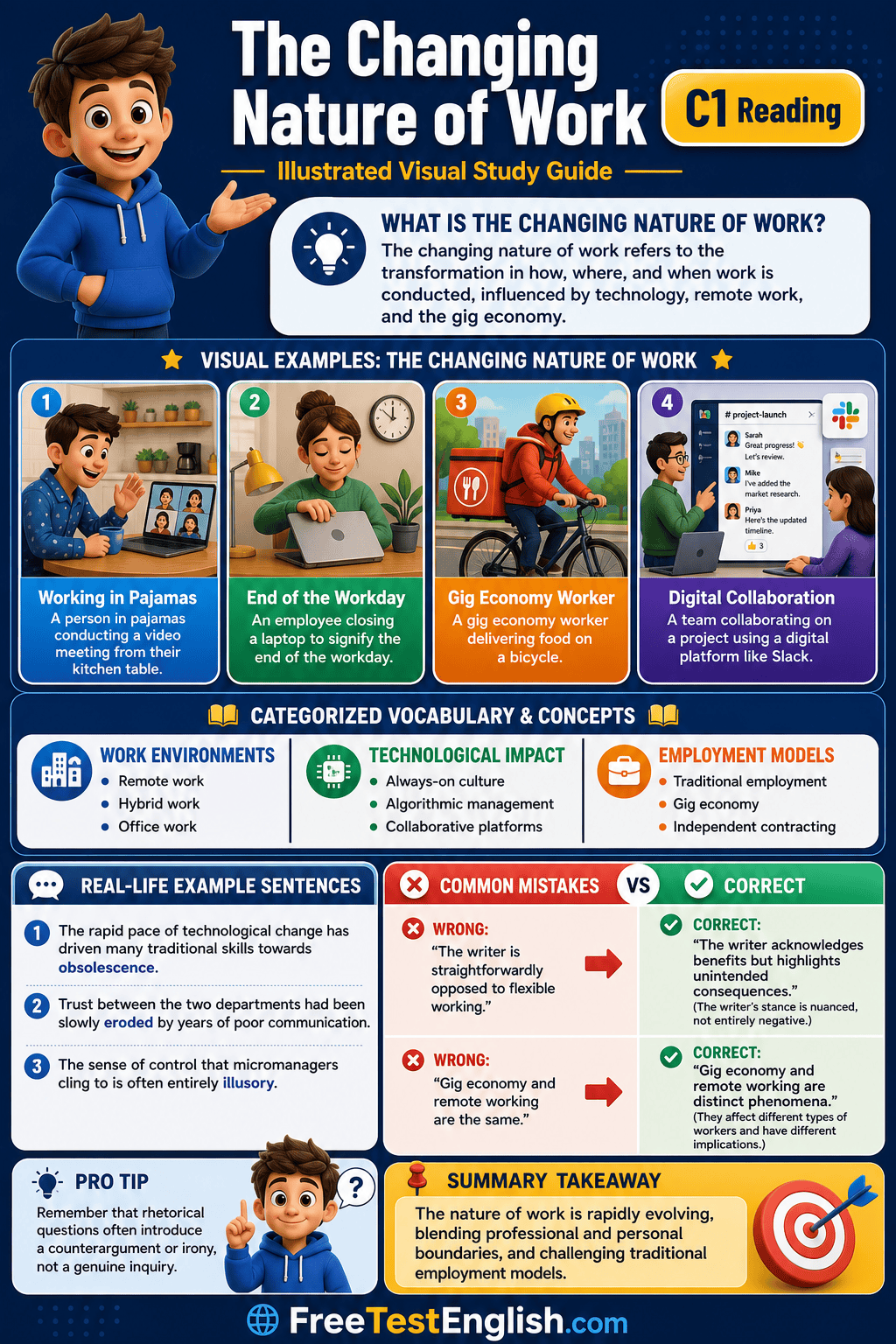
The Changing Nature of Work
Think about the last time you completed a full working day without being interrupted by a notification, a message, or the quiet anxiety that you should be doing something else entirely. For many people, that kind of focused, uninterrupted work has become something of a rarity. Before you read, consider these two questions: How has technology changed not just where we work, but who we are as workers? And is the increasing flexibility of modern work genuinely liberating, or does it simply relocate the pressures of the office into the home?
Reading Passage: The Office That Never Closes
Barely a decade ago, the idea that millions of people would routinely conduct meetings in their pyjamas, manage international teams from kitchen tables, or clock off by simply closing a laptop would have seemed faintly absurd. Yet the transformation that has reshaped the modern workplace has been so rapid, and so profound, that we are only now beginning to reckon with its full implications. Not only has the physical boundary between work and home been eroded, but the psychological boundary between professional identity and personal life has grown increasingly blurred — and for many workers, that blurring carries a considerable cost.
The shift towards remote and hybrid working, accelerated dramatically by the global disruptions of the early 2020s, was initially celebrated as an overdue liberation. Employees reported greater autonomy, reduced commuting time, and an improved sense of work-life balance. Companies, for their part, discovered that productivity did not collapse when workers were trusted to manage their own time. For a while, it seemed as though the old model — the rigid nine-to-five, the open-plan office, the performative busyness of being seen to work — was heading for permanent obsolescence. Had the pandemic achieved what decades of flexible working campaigns had failed to do?
The reality, however, has proven considerably more complicated. Research conducted across multiple industries has revealed a phenomenon that psychologists have taken to calling "always-on culture" — the expectation, whether explicitly stated or merely implied, that employees should remain accessible beyond contracted hours. Enabled by smartphones and collaborative platforms such as Slack or Teams, this creeping availability has made it harder for workers to mentally disengage from their professional responsibilities. What was once the privilege of senior executives — being contacted at any hour — has now, somewhat perversely, become the burden of employees at all levels.
Compounding this issue is the parallel rise of the gig economy, which has fundamentally redefined what employment itself means. Millions of workers worldwide now operate as independent contractors — driving, delivering, designing, coding — without the security of fixed salaries, paid leave, or legal protections traditionally associated with employment. Proponents argue that this model offers unparalleled freedom, allowing individuals to construct working lives tailored to their circumstances. Critics, however, contend that such freedom is largely illusory: the algorithmic management systems underpinning platforms like Uber or Deliveroo exercise a degree of control over workers that many traditional employers would have found excessive, yet without the corresponding obligations.
What is perhaps most striking about these developments is the extent to which they have exposed the assumptions embedded in our conception of work itself. For much of the twentieth century, paid employment was understood not merely as a means of income, but as a source of structure, identity, and social connection. Whether or not that model was ever as stable as we imagined it to be, there is growing recognition that the erosion of its foundations demands a considered response — from policymakers, from corporations, and from workers themselves. Some European countries have already begun experimenting with four-day working weeks and legally enforceable rights to disconnect; early evidence suggests the outcomes are broadly positive, though the long-term picture remains to be seen.
Rarely has a generation been asked to renegotiate the terms of working life so quickly, or with so little guidance. The danger lies not in change itself — adaptive and imaginative, humanity has always found ways to reorganise labour — but in allowing technological momentum to outpace our collective capacity to think carefully about what we actually want work to be. The office may no longer have walls, but the questions it raises are as pressing as ever.
Key Vocabulary in Context
| Word / Phrase | Part of Speech | Definition | Example Sentence |
|---|---|---|---|
| obsolescence | noun | The process of becoming outdated or no longer useful or relevant | The rapid pace of technological change has driven many traditional skills towards obsolescence. |
| eroded | verb (past participle) | Gradually worn away or diminished over time | Trust between the two departments had been slowly eroded by years of poor communication. |
| perversely | adverb | In a way that is contrary to what would be expected or considered reasonable | Perversely, the extra support provided to students sometimes reduced their motivation to work independently. |
| illusory | adjective | Appearing to be real or possible but actually false or unachievable | The sense of control that micromanagers cling to is often entirely illusory. |
| algorithmic management | noun phrase | The use of automated, data-driven systems to monitor, evaluate, and direct workers' behaviour | Algorithmic management in warehouses has raised serious concerns about worker wellbeing and privacy. |
| compounding | verb (present participle) | Making a problem or difficulty worse by adding to it | Poor sleep compounded his difficulty in concentrating during long meetings. |
| embedded | adjective | Deeply fixed in something or forming an integral part of it | Certain assumptions about gender roles remain deeply embedded in the culture of many organisations. |
| enforceable | adjective | Capable of being made to happen through legal or official power | Without legally enforceable standards, companies face little pressure to improve working conditions. |
Reading Strategies & Comprehension Tips
Skimming for Main Ideas
- Read the first and last sentence of each paragraph quickly to identify the central argument. Notice how each paragraph introduces a complication, counterpoint, or development — this text is structured as a progressive argument, not simply a list of facts.
- Identify the writer's overall stance: is the tone neutral, cautiously optimistic, or critical? Look for evaluative language such as "considerably more complicated" or "largely illusory" to guide your interpretation.
Scanning for Specific Information
- When locating specific details (e.g. which countries are experimenting with the four-day week, or which platforms are cited), scan for proper nouns and numerals rather than re-reading every word.
- Pay close attention to hedging language: phrases like "early evidence suggests" or "remains to be seen" indicate that the writer is presenting tentative rather than confirmed conclusions.
Inference & Implicit Meaning
- The writer does not state outright that gig economy workers are exploited, but implies this through word choices such as "illusory," "burden," and "without the corresponding obligations." Practise identifying what is suggested rather than explicitly stated.
- Consider the rhetorical questions in the text (e.g. "Had the pandemic achieved what decades of flexible working campaigns had failed to do?"). These are not genuine questions expecting an answer — they signal irony and introduce the counterargument that follows.
Common Reading Pitfalls & Traps
Misreading the Writer's Attitude Towards Flexibility
A common mistake is to assume the writer is straightforwardly opposed to flexible or remote working. In fact, the argument is more nuanced: the writer acknowledges the genuine benefits initially reported, but draws attention to the unintended consequences that followed. Avoid selecting answers that describe the writer's view as entirely negative or entirely positive.
Confusing the Gig Economy with Remote Working
The passage discusses two distinct phenomena: remote and hybrid working (primarily affecting traditional employees) and the gig economy (affecting independent contractors). These are related but separate issues, and comprehension questions may test whether you can distinguish between them accurately.
Misinterpreting Inversion and Complex Syntax
Sentences beginning with inverted structures such as "Rarely has a generation been asked..." or "Not only has the physical boundary... been eroded..." are used for emphasis, not to convey passive resignation. Recognising that inversion signals the writer's strong assertion will help you avoid misreading the tone as tentative or uncertain.
Taking Rhetorical Questions at Face Value
The question "Had the pandemic achieved what decades of flexible working campaigns had failed to do?" might appear to be a genuine claim the writer is making. It is not — it is a rhetorical device that sets up the contrasting evidence in the following paragraph. Always read what comes after a rhetorical question to understand its true function.
Quick Summary
Now read the passage carefully and complete Exercise 1 (Multiple Choice) and Exercise 2 (Fill-in-the-gap dropdown) below.
📄 Download the The Changing Nature of Work PDF
Download this The Changing Nature of Work grammar lesson as a free printable PDF.
It includes grammar rules, examples, and explanations so you can study offline anytime.