
Read the passage carefully before attempting Exercise 1 (Multiple Choice) and Exercise 2 (Fill in the blanks dropdown) below.
Imagine arriving in Lisbon with no fixed itinerary, no one waiting for you at a restaurant, and no compromises to make. For millions of travellers worldwide, this isn’t an anxiety-inducing nightmare — it’s the whole point. Solo travel, once considered an eccentric or even reckless choice, has gradually become one of the most popular ways to explore the world. According to several travel industry reports, bookings made by solo travellers have increased significantly since the mid-2010s, and the trend shows no sign of slowing down.
People are drawn to solo travel for a surprisingly wide range of reasons. Freedom is, without question, the most commonly cited motivation. When travelling alone, a person can change plans on a whim, spend an entire afternoon in a single museum, or take an unplanned bus to a coastal village simply because it sounds appealing. There are no schedules to negotiate and no compromises to reach. For individuals who lead highly structured professional lives, this kind of complete autonomy can feel genuinely liberating. However, freedom isn’t the only driver. Many solo travellers report that being alone in an unfamiliar environment pushes them to become more self-reliant. Having to navigate a foreign transport system, find accommodation in a language you barely speak, or eat dinner alone in a crowded restaurant builds a quiet confidence that tends to stay with a person long after the trip has ended.
That said, solo travel is not without its difficulties. Safety is a legitimate concern, particularly for women travelling in unfamiliar regions, and the financial reality can be sobering: single supplements charged by hotels and cruise companies mean that travelling alone often costs considerably more per person than travelling with a companion. Loneliness, too, can surface unexpectedly — not necessarily in isolated places, but often in busy, vibrant cities where everyone else appears to be surrounded by friends or family. Nevertheless, many experienced solo travellers argue that these are precisely the moments which force genuine connections with strangers, leading to conversations and friendships that simply would not have happened otherwise.
Interestingly, the profile of the typical solo traveller has shifted considerably. Whereas solo travel was once associated almost exclusively with young backpackers seeking adventure on a budget, it is now equally common among people in their forties, fifties, and beyond — many of whom travel in considerable comfort. Online communities dedicated to solo travel have flourished, providing advice, companionship, and reassurance to those who might otherwise hesitate. If you had asked most travel agents twenty years ago whether solo travel would become mainstream, they would almost certainly have said no. Today, the industry is actively catering to it.
Ultimately, solo travel means something different to each person who chooses it. For some, it is a deliberate act of self-discovery; for others, simply the most practical solution when no one else is available or willing to go. What most solo travellers seem to agree on, however, is this: the experience changes you — and rarely for the worse.

Exercise 1
Read the passage about why people choose to travel alone carefully, then answer each question by selecting the correct option based on the information in the text.
Example: According to the text, why do some people prefer to travel without companions?
Answer: They prefer to travel without companions because it gives them complete freedom to plan their own schedule.
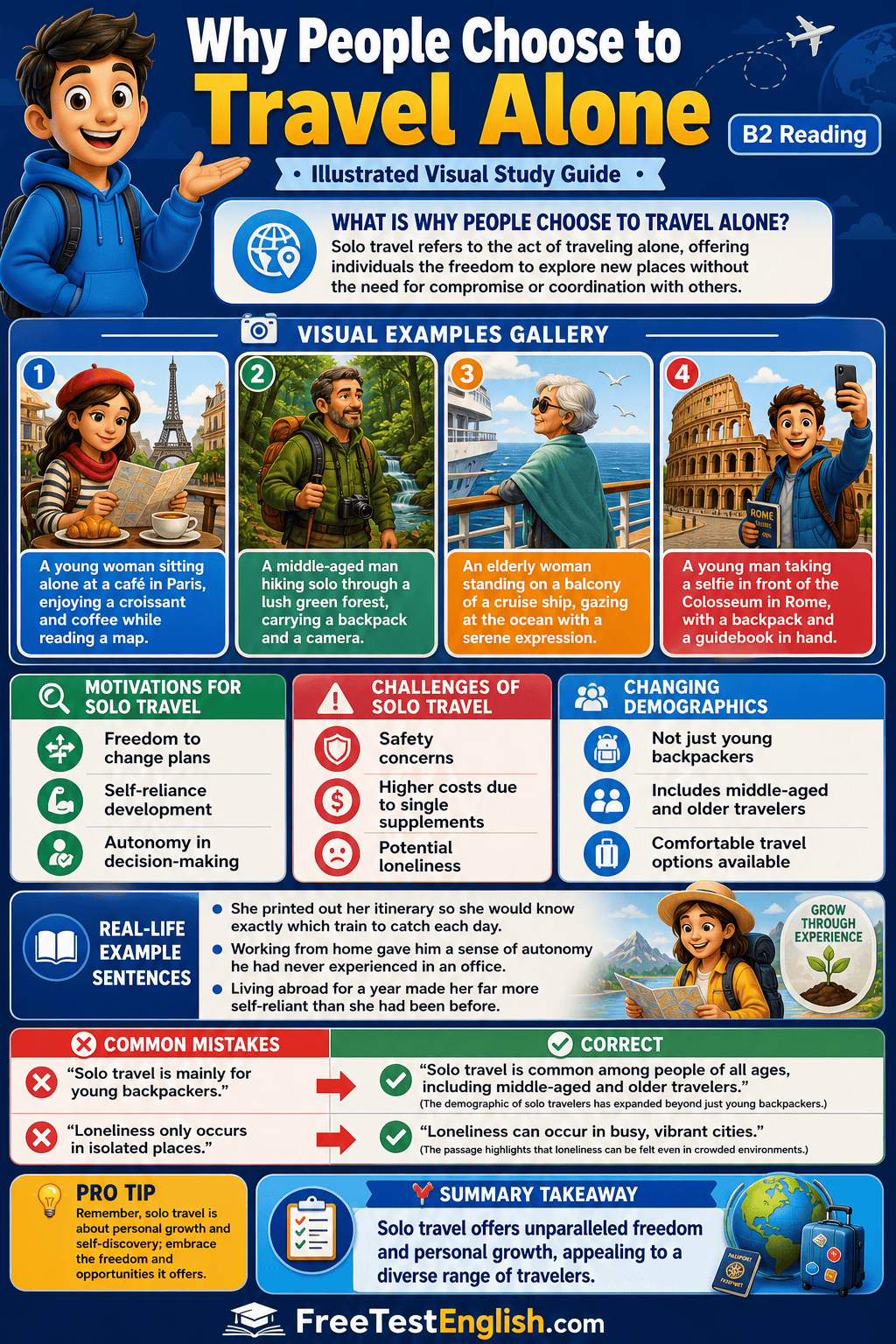
Why People Choose to Travel Alone
Have you ever considered packing a bag and heading somewhere new without anyone else by your side? Solo travel has grown dramatically in popularity over the past decade, attracting everyone from recent graduates to retired professionals. Before you read, think about these two questions: What do you think would be the biggest challenge of travelling alone? And what might someone gain from the experience that they couldn't get travelling with others?
Reading Passage: Going It Alone — The Rise of the Solo Traveller
Imagine arriving in Lisbon with no fixed itinerary, no one waiting for you at a restaurant, and no compromises to make. For millions of travellers worldwide, this isn't an anxiety-inducing nightmare — it's the whole point. Solo travel, once considered an eccentric or even reckless choice, has gradually become one of the most popular ways to explore the world. According to several travel industry reports, bookings made by solo travellers have increased significantly since the mid-2010s, and the trend shows no sign of slowing down.
People are drawn to solo travel for a surprisingly wide range of reasons. Freedom is, without question, the most commonly cited motivation. When travelling alone, a person can change plans on a whim, spend an entire afternoon in a single museum, or take an unplanned bus to a coastal village simply because it sounds appealing. There are no schedules to negotiate and no compromises to reach. For individuals who lead highly structured professional lives, this kind of complete autonomy can feel genuinely liberating. However, freedom isn't the only driver. Many solo travellers report that being alone in an unfamiliar environment pushes them to become more self-reliant. Having to navigate a foreign transport system, find accommodation in a language you barely speak, or eat dinner alone in a crowded restaurant builds a quiet confidence that tends to stay with a person long after the trip has ended.
That said, solo travel is not without its difficulties. Safety is a legitimate concern, particularly for women travelling in unfamiliar regions, and the financial reality can be sobering: single supplements charged by hotels and cruise companies mean that travelling alone often costs considerably more per person than travelling with a companion. Loneliness, too, can surface unexpectedly — not necessarily in isolated places, but often in busy, vibrant cities where everyone else appears to be surrounded by friends or family. Nevertheless, many experienced solo travellers argue that these are precisely the moments which force genuine connections with strangers, leading to conversations and friendships that simply would not have happened otherwise.
Interestingly, the profile of the typical solo traveller has shifted considerably. Whereas solo travel was once associated almost exclusively with young backpackers seeking adventure on a budget, it is now equally common among people in their forties, fifties, and beyond — many of whom travel in considerable comfort. Online communities dedicated to solo travel have flourished, providing advice, companionship, and reassurance to those who might otherwise hesitate. If you had asked most travel agents twenty years ago whether solo travel would become mainstream, they would almost certainly have said no. Today, the industry is actively catering to it.
Ultimately, solo travel means something different to each person who chooses it. For some, it is a deliberate act of self-discovery; for others, simply the most practical solution when no one else is available or willing to go. What most solo travellers seem to agree on, however, is this: the experience changes you — and rarely for the worse.
Key Vocabulary in Context
| Word / Phrase | Part of Speech | Definition | Example Sentence |
|---|---|---|---|
| itinerary | noun | a detailed plan or route for a journey, including places to visit and times | She printed out her itinerary so she would know exactly which train to catch each day. |
| autonomy | noun | the freedom to make your own decisions without being controlled by others | Working from home gave him a sense of autonomy he had never experienced in an office. |
| self-reliant | adjective | able to do things and make decisions independently, without help from others | Living abroad for a year made her far more self-reliant than she had been before. |
| single supplement | noun phrase | an extra charge that hotels or tour companies add when only one person is using a room or service designed for two | The single supplement added nearly €80 to her hotel bill, making the trip more expensive than expected. |
| on a whim | prepositional phrase | as a sudden, unplanned idea or impulse, without thinking it through in advance | They decided on a whim to drive to the coast, even though they had planned a quiet evening at home. |
| legitimate | adjective | reasonable, valid, and accepted as having a sound basis | His concern about the project's budget was entirely legitimate and worth discussing seriously. |
| flourish | verb | to grow or develop successfully and in a healthy way | Small independent coffee shops have flourished in the city centre over the past few years. |
| mainstream | adjective | considered normal, accepted, or popular by most people in society | Electric cars were once seen as unusual, but they have now become increasingly mainstream. |
Reading Strategies & Comprehension Tips
Skimming for the Main Idea
Read the first and last sentences of each paragraph quickly before reading in detail. This passage has a clear structure: it introduces the trend, explains the motivations, addresses the drawbacks, describes changing demographics, and then concludes. Identifying this structure first will help you understand how the writer's argument develops.
Scanning for Specific Details
If a question asks about a specific fact — such as when solo travel bookings increased or who pays single supplements — scan for key nouns and numbers rather than reading every word. Look for phrases like since the mid-2010s or hotels and cruise companies as anchor points.
Understanding the Writer's Attitude
Pay close attention to qualifying language. The writer uses phrases such as "many solo travellers report" and "most solo travellers seem to agree" — this suggests the writer is presenting commonly held views rather than personal experience. Notice how the tone is balanced: the passage acknowledges real problems without dismissing the benefits.
Making Inferences
Not everything is stated directly. For example, the passage says solo travel was once considered "eccentric or even reckless." This implies that public attitudes have changed significantly — the writer doesn't say this outright but expects you to draw that conclusion from the contrast with how solo travel is viewed today.
Common Reading Pitfalls & Traps
Pitfall 1: Assuming the Writer Is a Solo Traveller
The passage is written in an informative, balanced style. The writer reports what others say and experience — they never claim to be a solo traveller themselves. Be careful not to confuse reported opinions with the writer's personal views.
Pitfall 2: Misreading "Nevertheless" and "That Said"
These discourse markers signal a contrast or concession. When the writer says "That said, solo travel is not without its difficulties," this does not mean the writer is arguing against solo travel — it means they are presenting a balanced view. Watch out for contrast markers in multiple-choice questions, as they often indicate where the argument shifts direction.
Pitfall 3: Overgeneralising Who Solo Travellers Are
The passage specifically states that the profile of solo travellers has changed. It would be incorrect to answer a question by saying solo travel is mainly for young backpackers — the text makes clear that this was true in the past but is no longer the case.
Pitfall 4: Confusing "Loneliness" with "Being Alone"
The passage makes a subtle but important distinction: it says loneliness can appear in busy, vibrant cities — not in isolated places. This is counterintuitive and easy to misread quickly. Slow down when you encounter ideas that seem surprising or unexpected.
Quick Summary
Now read the passage carefully and complete Exercise 1 (Multiple Choice) and Exercise 2 (Fill-in-the-gap dropdown) below.
📄 Download the Why People Choose to Travel Alone PDF
Download this Why People Choose to Travel Alone grammar lesson as a free printable PDF.
It includes grammar rules, examples, and explanations so you can study offline anytime.