
Read the passage carefully before attempting Exercise 1 (Multiple Choice) and Exercise 2 (Fill in the blanks dropdown) below.
Walk through the narrow cobblestone streets of Kotor, Montenegro, on a summer morning, and you will find yourself weaving between tour groups, souvenir stalls, and long queues outside every café. Locals hurrying to work squeeze past visitors who stop without warning to photograph ancient walls. This daily friction is a familiar story in dozens of towns and cities across Europe, and it raises a question that community leaders, environmentalists, and economists have been debating for years: is tourism doing more harm than good?
There is no doubt that tourism has transformed the economies of many regions that previously had little to offer in terms of industry or employment. In coastal towns across Croatia, Greece, and Portugal, hospitality has created thousands of jobs and generated revenue that funds public services, road improvements, and cultural preservation. Local artisans who might otherwise have struggled to sell handmade goods now have a global market walking directly to their doorsteps. Furthermore, increased tourism often encourages governments to invest in infrastructure — better transport links, cleaner streets, and improved healthcare facilities — that benefits residents and visitors alike.
Nevertheless, the picture is considerably more complicated. In cities such as Barcelona and Amsterdam, residents have grown increasingly frustrated with what has been called “overtourism” — a situation in which the sheer volume of visitors overwhelms a place and gradually erodes the quality of life for those who call it home. Rents rise sharply as landlords convert apartments into short-term holiday lets, pushing long-term residents out of neighbourhoods their families have occupied for generations. Traditional local businesses, which cannot compete with tourist-facing cafés and gift shops charging inflated prices, are forced to close. In some cases, the very cultural authenticity that attracted tourists in the first place begins to disappear, replaced by a commercialised version of local identity designed purely to appeal to outsiders.
Having recognised these patterns, some communities are beginning to push back. Authorities in Dubrovnik have introduced strict visitor limits, whereas Amsterdam has banned the construction of new hotels in the city centre. Venice has experimented with an entry fee for day-trippers, a controversial measure that supporters argue is essential for protecting the city’s fragile environment and heritage. What these approaches share is the idea that sustainable tourism — carefully managed and genuinely beneficial to local people — requires deliberate intervention rather than simply allowing market forces to take over.
The debate is unlikely to be resolved easily, partly because tourism is rarely straightforward. A policy that works brilliantly for one community might prove disastrous for another. What seems clear, however, is that the days of treating tourism as an unconditional economic blessing are over. Local voices must be heard, and the needs of residents must be placed at the centre of any plan for the future. After all, a destination without a thriving community is little more than a theme park — and theme parks, eventually, lose their appeal.

Exercise 1
Read the passage about tourism and its impact on local communities carefully, then choose the correct answer for each question based on the information in the text.
Example: According to the passage, what is one economic benefit of tourism for local communities?
Answer: Tourism creates jobs and generates income for local businesses and residents.
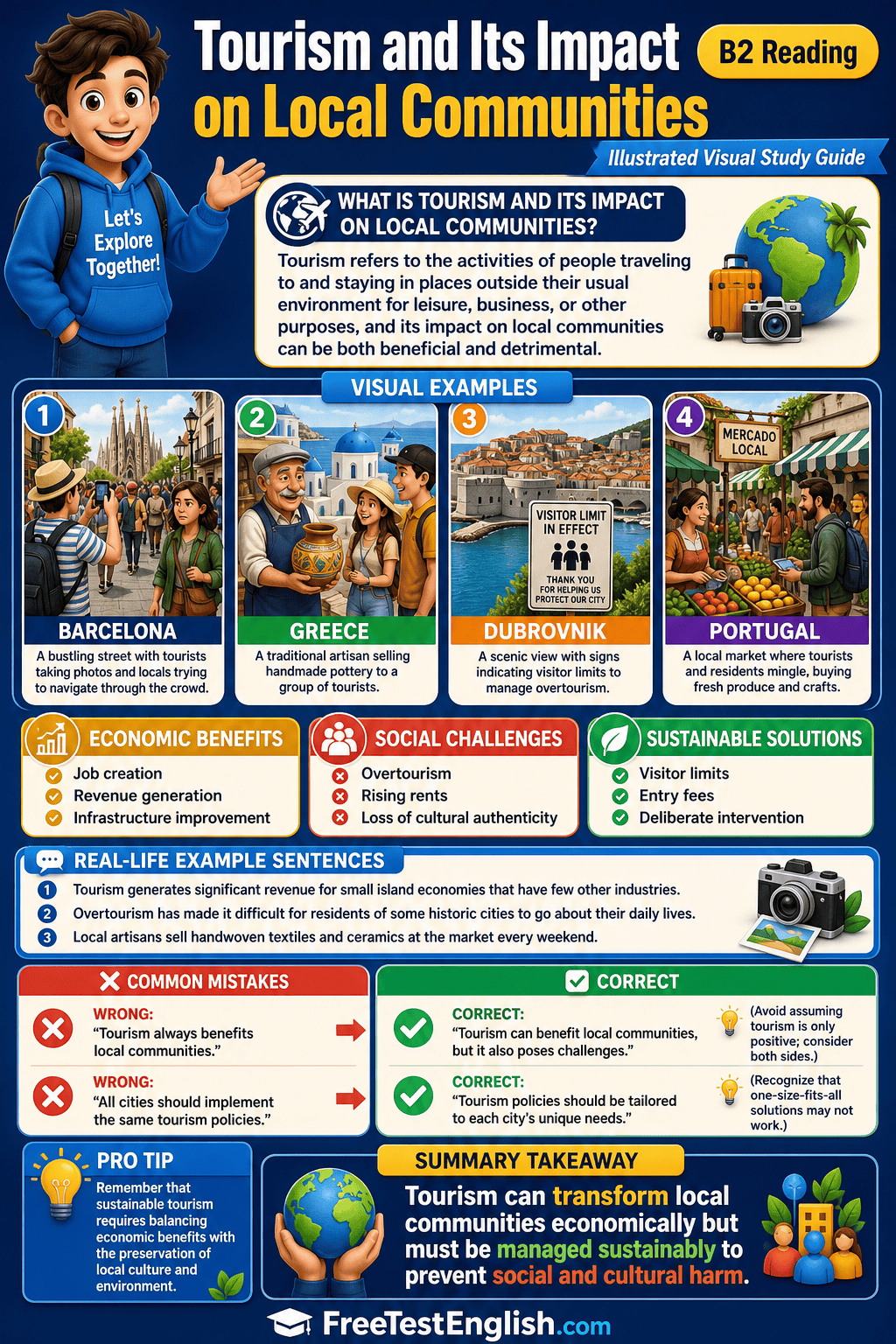
Tourism and Its Impact on Local Communities
Every year, millions of tourists flood into popular destinations around the world, drawn by stunning landscapes, rich cultural heritage, and the promise of unforgettable experiences. But what actually happens to the people who live in these places once tourism takes hold? Before you read, consider these two questions: In what ways might tourism benefit a small local community? And can you think of any problems that mass tourism might cause for local residents?
Reading Passage: When the Tourists Never Leave
Walk through the narrow cobblestone streets of Kotor, Montenegro, on a summer morning, and you will find yourself weaving between tour groups, souvenir stalls, and long queues outside every café. Locals hurrying to work squeeze past visitors who stop without warning to photograph ancient walls. This daily friction is a familiar story in dozens of towns and cities across Europe, and it raises a question that community leaders, environmentalists, and economists have been debating for years: is tourism doing more harm than good?
There is no doubt that tourism has transformed the economies of many regions that previously had little to offer in terms of industry or employment. In coastal towns across Croatia, Greece, and Portugal, hospitality has created thousands of jobs and generated revenue that funds public services, road improvements, and cultural preservation. Local artisans who might otherwise have struggled to sell handmade goods now have a global market walking directly to their doorsteps. Furthermore, increased tourism often encourages governments to invest in infrastructure — better transport links, cleaner streets, and improved healthcare facilities — that benefits residents and visitors alike.
Nevertheless, the picture is considerably more complicated. In cities such as Barcelona and Amsterdam, residents have grown increasingly frustrated with what has been called "overtourism" — a situation in which the sheer volume of visitors overwhelms a place and gradually erodes the quality of life for those who call it home. Rents rise sharply as landlords convert apartments into short-term holiday lets, pushing long-term residents out of neighbourhoods their families have occupied for generations. Traditional local businesses, which cannot compete with tourist-facing cafés and gift shops charging inflated prices, are forced to close. In some cases, the very cultural authenticity that attracted tourists in the first place begins to disappear, replaced by a commercialised version of local identity designed purely to appeal to outsiders.
Having recognised these patterns, some communities are beginning to push back. Authorities in Dubrovnik have introduced strict visitor limits, whereas Amsterdam has banned the construction of new hotels in the city centre. Venice has experimented with an entry fee for day-trippers, a controversial measure that supporters argue is essential for protecting the city's fragile environment and heritage. What these approaches share is the idea that sustainable tourism — carefully managed and genuinely beneficial to local people — requires deliberate intervention rather than simply allowing market forces to take over.
The debate is unlikely to be resolved easily, partly because tourism is rarely straightforward. A policy that works brilliantly for one community might prove disastrous for another. What seems clear, however, is that the days of treating tourism as an unconditional economic blessing are over. Local voices must be heard, and the needs of residents must be placed at the centre of any plan for the future. After all, a destination without a thriving community is little more than a theme park — and theme parks, eventually, lose their appeal.
Key Vocabulary in Context
| Word / Phrase | Part of Speech | Definition | Example Sentence |
|---|---|---|---|
| friction | noun | Tension or conflict between people or groups with different interests or needs | There is growing friction between local residents and the tourist industry over the use of public spaces. |
| revenue | noun | Money that a government, business, or organisation receives, especially from taxes or sales | Tourism generates significant revenue for small island economies that have few other industries. |
| artisan | noun | A person who makes high-quality goods by hand using traditional skills | Local artisans sell handwoven textiles and ceramics at the market every weekend. |
| overtourism | noun | A situation in which too many tourists visit a place, causing damage to the environment or a reduced quality of life for residents | Overtourism has made it difficult for residents of some historic cities to go about their daily lives. |
| erode | verb | To gradually destroy or weaken something over a period of time | Constant development along the coastline has eroded both the natural environment and the community's sense of identity. |
| commercialised | adjective | Changed in a way that is more focused on making money than on quality, culture, or authenticity | Critics argue that the festival has become too commercialised and no longer reflects genuine local traditions. |
| sustainable | adjective | Able to continue over a long period without causing harm to the environment or society | The government is promoting sustainable tourism by encouraging visitors to travel outside peak seasons. |
| deliberate intervention | noun phrase | A planned and intentional action taken to change or influence a situation | Without deliberate intervention from local authorities, rising rents will continue to drive residents away from the city centre. |
Reading Strategies & Comprehension Tips
Skimming for the Main Idea
- Read the title and the first sentence of each paragraph quickly. Notice that each paragraph develops a different aspect of the topic: the problem is introduced, economic benefits are explored, negative social effects are explained, and finally, solutions are discussed. This structure will help you predict what information to look for.
- The final paragraph contains the writer's overall conclusion. Skimming this first can help you understand the writer's position before reading in detail.
Scanning for Specific Details
- The passage mentions several specific cities and countries. When answering questions about particular examples — such as which city introduced entry fees for day-trippers — scan for proper nouns (place names written with capital letters) rather than re-reading the whole text.
- Numbers, statistics, and named policies are useful anchors when scanning. Look for words like banned, limits, or fee to locate relevant sections quickly.
Understanding Implied Meaning
- The writer does not always state opinions directly. For example, the final sentence — "a destination without a thriving community is little more than a theme park — and theme parks, eventually, lose their appeal" — is a metaphor. Ask yourself: what is the writer warning could happen if tourism is not managed responsibly?
- Look carefully at evaluative adjectives and adverbs such as considerably more complicated, increasingly frustrated, and controversial. These signal the writer's attitude and help you identify tone.
Understanding Cause and Effect
- Several cause-and-effect relationships are described in paragraph three. Look for linking language such as as, pushing (used as a participle clause), and forced to. Mapping these relationships — for example, rising rents → residents displaced — will help you answer inference questions accurately.
Common Reading Pitfalls & Traps
Trap 1: Confusing the writer's view with the views of others
The passage presents multiple perspectives: those of economists, residents, and local authorities. Be careful not to assume that every point made in the text reflects the writer's own opinion. For example, the argument that tourism creates jobs and improves infrastructure is presented as a genuine benefit — but the writer then immediately complicates this view with the word nevertheless. Watch for contrast markers to identify shifts in perspective.
Trap 2: Overgeneralising from specific examples
The passage cites Barcelona, Amsterdam, Dubrovnik, and Venice as examples, but it also states that "a policy that works brilliantly for one community might prove disastrous for another." A common mistake is to assume that the text is making a universal claim. The writer is deliberately cautious, so answers suggesting absolute rules are likely to be incorrect.
Trap 3: Misreading the tone as entirely negative
The passage is balanced. Although the problems of overtourism receive considerable attention, the writer also acknowledges real economic and social benefits. Exam questions may ask whether the writer is wholly critical of tourism — and the answer is no. Look for phrases such as "there is no doubt" and "benefits residents and visitors alike" to remind yourself of the balanced approach.
Trap 4: Missing the meaning of "short-term holiday lets"
This phrase refers to apartments rented out to tourists for short stays — for example, through platforms such as Airbnb. Some learners may not be familiar with this expression. Use context clues: the sentence explains that landlords convert apartments for this purpose, which leads to residents being pushed out. From this, you can infer that "short-term holiday lets" are temporary tourist rentals rather than permanent homes.
Quick Summary
Now read the passage carefully and complete Exercise 1 (Multiple Choice) and Exercise 2 (Fill-in-the-gap dropdown) below.
📄 Download the Tourism and Its Impact on Local Communities PDF
Download this Tourism and Its Impact on Local Communities grammar lesson as a free printable PDF.
It includes grammar rules, examples, and explanations so you can study offline anytime.