
Read the passage carefully before attempting Exercise 1 (Multiple Choice) and Exercise 2 (Fill in the blanks dropdown) below.
Every year, millions of people enrol in language courses, download vocabulary apps, or sign up for evening classes — all in pursuit of fluency in a second language. The motivations vary widely: some people are driven by career ambitions, others by a desire to connect with their cultural heritage, and many simply by the thrill of being understood in a foreign country. Whatever the reason, the evidence suggests that the rewards of becoming bilingual stretch far beyond the practical ability to hold a conversation.
Cognitively speaking, learning a second language has been shown to have a remarkable impact on the brain. Researchers at several European universities have found that people who regularly switch between two languages tend to develop stronger problem-solving skills and greater mental flexibility. This is thought to occur because the brain is constantly managing two linguistic systems, which builds a kind of mental resilience. Furthermore, some studies have suggested that bilingualism may delay the onset of conditions such as dementia by several years, though scientists are careful to point out that this is not a guaranteed outcome. Nevertheless, the neurological benefits alone make a compelling case for language learning at any age.
Professionally, being able to speak a second language can open doors that would otherwise remain firmly shut. In fields such as international business, diplomacy, healthcare, and journalism, candidates who are proficient in more than one language are frequently prioritised over equally qualified monolingual applicants. A report published by the British Council noted that employers increasingly view multilingualism not merely as a bonus, but as a core professional skill. Companies operating across borders simply cannot afford to rely entirely on translation tools, which, despite their growing sophistication, still lack the cultural nuance that a human speaker naturally provides.
Of course, learning a language is rarely straightforward. Progress can feel painfully slow, and the fear of making mistakes in front of native speakers puts many people off. However, those who push through the initial discomfort often describe a turning point — a moment when the language begins to feel less like a foreign code and more like a natural extension of who they are. At that stage, something profound tends to happen: learners don’t just gain vocabulary, they gain a new perspective on the world, shaped by the culture embedded in the language itself.
In a world that is more interconnected than ever before, the ability to communicate across linguistic boundaries is arguably one of the most valuable investments a person can make in themselves. Whether you start at five or fifty-five, the journey towards a second language is rarely wasted.

Exercise 1
Read the passage about the value of learning a second language carefully, then choose the correct answer for each question based on the information in the text.
Example: According to the passage, what is one cognitive benefit of learning a second language?
Answer: Learning a second language improves memory and problem-solving skills.
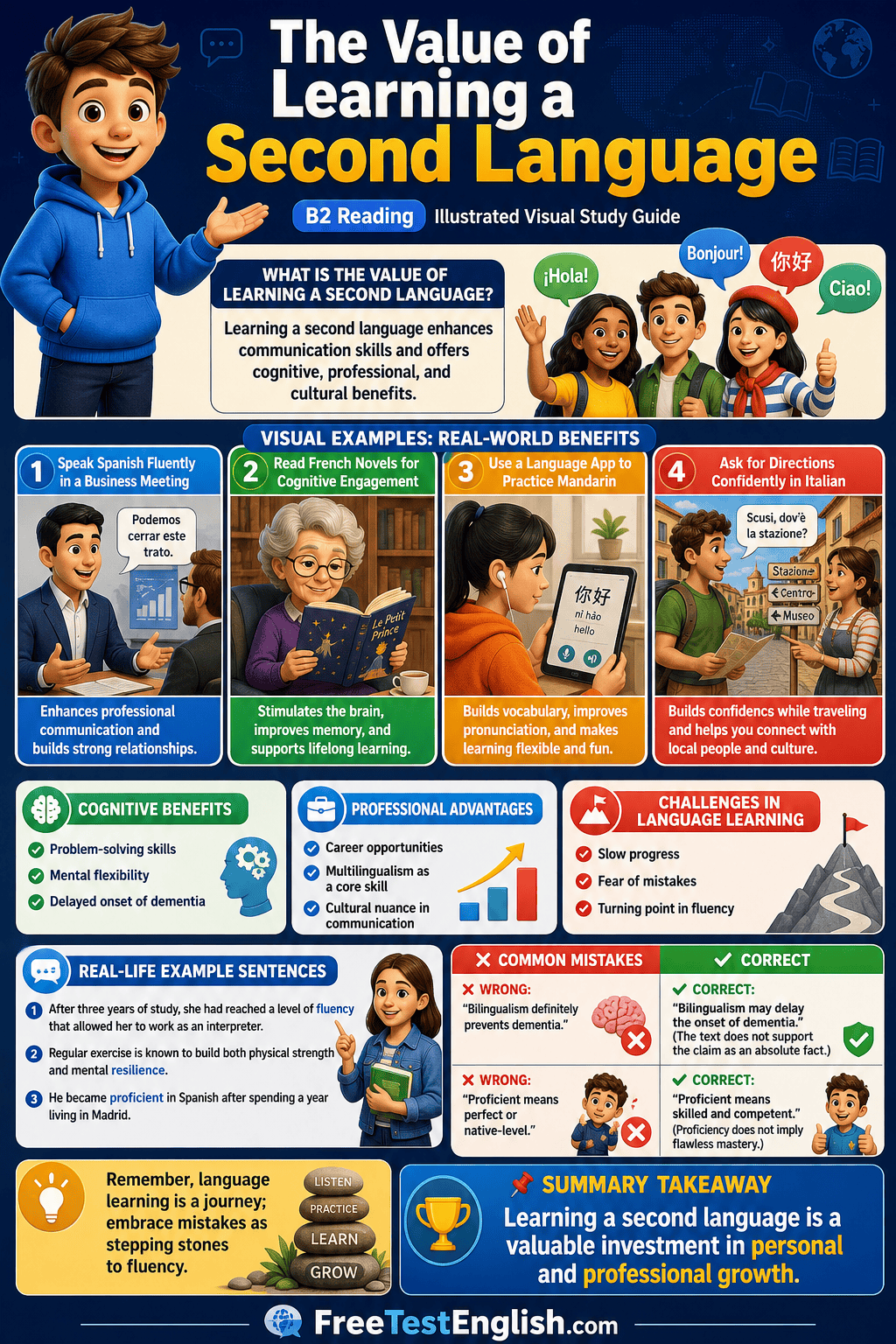
The Value of Learning a Second Language
Think about the last time you struggled to communicate with someone because you didn't share a common language. Perhaps you were travelling abroad, or maybe you were trying to help a foreign colleague at work. Now imagine how different that situation would have been if you'd had even a basic command of their language. Before you read, consider these two questions: Do you think the benefits of learning a second language go beyond simply being able to communicate? And at what point in life do you think it is most valuable to start learning a new language?
Reading Passage: More Than Just Words
Every year, millions of people enrol in language courses, download vocabulary apps, or sign up for evening classes — all in pursuit of fluency in a second language. The motivations vary widely: some people are driven by career ambitions, others by a desire to connect with their cultural heritage, and many simply by the thrill of being understood in a foreign country. Whatever the reason, the evidence suggests that the rewards of becoming bilingual stretch far beyond the practical ability to hold a conversation.
Cognitively speaking, learning a second language has been shown to have a remarkable impact on the brain. Researchers at several European universities have found that people who regularly switch between two languages tend to develop stronger problem-solving skills and greater mental flexibility. This is thought to occur because the brain is constantly managing two linguistic systems, which builds a kind of mental resilience. Furthermore, some studies have suggested that bilingualism may delay the onset of conditions such as dementia by several years, though scientists are careful to point out that this is not a guaranteed outcome. Nevertheless, the neurological benefits alone make a compelling case for language learning at any age.
Professionally, being able to speak a second language can open doors that would otherwise remain firmly shut. In fields such as international business, diplomacy, healthcare, and journalism, candidates who are proficient in more than one language are frequently prioritised over equally qualified monolingual applicants. A report published by the British Council noted that employers increasingly view multilingualism not merely as a bonus, but as a core professional skill. Companies operating across borders simply cannot afford to rely entirely on translation tools, which, despite their growing sophistication, still lack the cultural nuance that a human speaker naturally provides.
Of course, learning a language is rarely straightforward. Progress can feel painfully slow, and the fear of making mistakes in front of native speakers puts many people off. However, those who push through the initial discomfort often describe a turning point — a moment when the language begins to feel less like a foreign code and more like a natural extension of who they are. At that stage, something profound tends to happen: learners don't just gain vocabulary, they gain a new perspective on the world, shaped by the culture embedded in the language itself.
In a world that is more interconnected than ever before, the ability to communicate across linguistic boundaries is arguably one of the most valuable investments a person can make in themselves. Whether you start at five or fifty-five, the journey towards a second language is rarely wasted.
Key Vocabulary in Context
| Word / Phrase | Part of Speech | Definition | Example Sentence |
|---|---|---|---|
| fluency | noun | The ability to speak or write a language easily, accurately, and at a natural speed | After three years of study, she had reached a level of fluency that allowed her to work as an interpreter. |
| resilience | noun | The capacity to recover quickly from difficulties, or to adapt well under pressure | Regular exercise is known to build both physical strength and mental resilience. |
| onset | noun | The beginning or early stages of something, often something unpleasant | Early treatment can slow the onset of the disease significantly. |
| proficient | adjective | Competent and skilled at doing something, especially after practice or training | He became proficient in Spanish after spending a year living in Madrid. |
| multilingualism | noun | The ability to speak or use more than two languages | Multilingualism is increasingly valued in international workplaces and global organisations. |
| nuance | noun | A subtle difference in meaning, tone, or expression that is not immediately obvious | Automated translation tools often miss the cultural nuance that changes the meaning of a phrase entirely. |
| embedded | adjective | Firmly fixed or deeply integrated within something larger | Certain values and customs are deeply embedded in the language and cannot be easily translated. |
| monolingual | adjective | Able to speak or use only one language | In some regions, monolingual speakers face significant disadvantages in the job market. |
Reading Strategies & Comprehension Tips
Skimming for the Main Idea
Read the first sentence of each paragraph quickly without stopping at unfamiliar words. This will give you a clear map of the passage: the introduction establishes the topic, paragraphs two and three focus on cognitive and professional benefits respectively, paragraph four addresses challenges, and the final paragraph offers a concluding perspective. Identifying this structure before you read in detail will help you locate answers much more efficiently.
Scanning for Specific Details
When a question asks about a specific fact — such as which organisations or studies are mentioned — scan for proper nouns, numbers, and capitalised words. For example, the phrase British Council stands out visually and leads you directly to the information about employer attitudes.
Inferring the Writer's Attitude
The writer does not simply list facts — they also express opinions through careful word choices. Notice phrases like "arguably one of the most valuable investments" and "the journey is rarely wasted." These suggest the writer is broadly in favour of language learning, while still acknowledging that results are not always guaranteed. Look for hedging language (e.g., may, tend to, is thought to) to understand where the writer is being cautious rather than definitive.
Understanding Cause and Effect
Pay close attention to linking phrases that signal cause-and-effect relationships, such as as a result, this is thought to occur because, consequently, and which builds. These connectors are often tested in comprehension questions and help you understand why the writer makes certain claims.
Common Reading Pitfalls & Traps
Overgeneralising Scientific Claims
The passage states that bilingualism may delay the onset of dementia, and immediately qualifies this by saying scientists warn it is not a guaranteed outcome. A common mistake is to read this as an absolute fact. In exam questions, be careful not to choose answers that say bilingualism definitely prevents dementia — the text does not support that strong a claim.
Confusing Professional and Cognitive Benefits
Paragraphs two and three are closely related in theme but deal with different areas of benefit — the brain and the workplace. Students sometimes mix up details from these two sections. Keep the focus of each paragraph in mind when answering detail questions.
Misreading the Writer's Tone on Difficulties
Paragraph four acknowledges that language learning is hard and that many people feel discouraged. However, this is not the writer's final message — it is followed by a contrasting point introduced by however. Do not interpret the mention of challenges as the writer arguing against language learning. The overall tone remains clearly positive and encouraging.
False Friends: "Proficient" vs "Perfect"
The word proficient means skilled and competent — not perfect or native-level. In the context of job applications, the passage says employers value proficiency, not necessarily flawless mastery. Questions testing vocabulary in context may try to confuse these ideas.
Quick Summary
Now read the passage carefully and complete Exercise 1 (Multiple Choice) and Exercise 2 (Fill-in-the-gap dropdown) below.
📄 Download the The Value of Learning a Second Language PDF
Download this The Value of Learning a Second Language grammar lesson as a free printable PDF.
It includes grammar rules, examples, and explanations so you can study offline anytime.