
Read the passage carefully before attempting Exercise 1 (Multiple Choice) and Exercise 2 (Fill in the blanks dropdown) below.
Walk through any city centre, scroll through social media for five minutes, or simply watch television in the evening — you will be exposed to hundreds of advertising messages without even noticing most of them. It has been estimated that the average person encounters between 4,000 and 10,000 advertisements every single day. Yet despite this constant bombardment, many consumers insist that advertising has little real influence on their purchasing decisions. The evidence, however, tells a very different story.
Modern advertising has moved far beyond simple product promotion. Rather than merely listing the features of a product, advertisers now craft carefully constructed narratives designed to tap into emotions, aspirations, and insecurities. A perfume advertisement, for instance, rarely describes how the fragrance smells. Instead, it sells an idea — glamour, confidence, or romance. This technique, known as emotional branding, has proven extraordinarily effective because it bypasses rational thinking and connects with how consumers want to feel about themselves. Consequently, people are not just buying a product; they are buying into an identity.
The rise of digital advertising has made these strategies considerably more sophisticated. Algorithms analyse browsing history, purchasing patterns, and even the amount of time a user spends looking at a particular post, enabling companies to deliver highly targeted advertisements to individuals who are most likely to respond. A person who has been searching online for hiking boots, for example, will almost certainly begin seeing advertisements for outdoor clothing, camping equipment, and adventure holidays within hours. Critics argue that this level of personalisation crosses a boundary, turning private consumer behaviour into commercial data without meaningful consent. Supporters, on the other hand, claim that targeted advertising simply makes the shopping experience more relevant and convenient.
There is also the question of vulnerable groups. Children, who lack the critical awareness needed to distinguish advertising from neutral content, are particularly susceptible to its influence. Regulations governing advertising aimed at children vary significantly between countries; whereas some nations have introduced strict limitations on advertising junk food to minors, others have done very little. Similarly, research suggests that people experiencing financial hardship may be disproportionately targeted by advertisements for loans, gambling, and fast food — industries that can exploit rather than serve their customers.
Nevertheless, it would be unfair to portray advertising as entirely manipulative. Advertising does inform consumers about products they might genuinely find useful, and it funds much of the free content people enjoy online and on television. The key issue is not advertising itself, but transparency. If consumers understood more clearly how advertising techniques work — and how their data is being used — they would be better placed to make truly independent choices. As media literacy becomes an increasingly vital skill in the digital age, learning to read an advertisement critically may be just as important as reading a newspaper article.

Exercise 1
Read the passage about the influence of advertising on consumer choices carefully, then answer each question by selecting the correct option based on the information in the text.
Example: According to the text, what is one main goal of advertising?
Answer: To persuade consumers to buy a product or service.
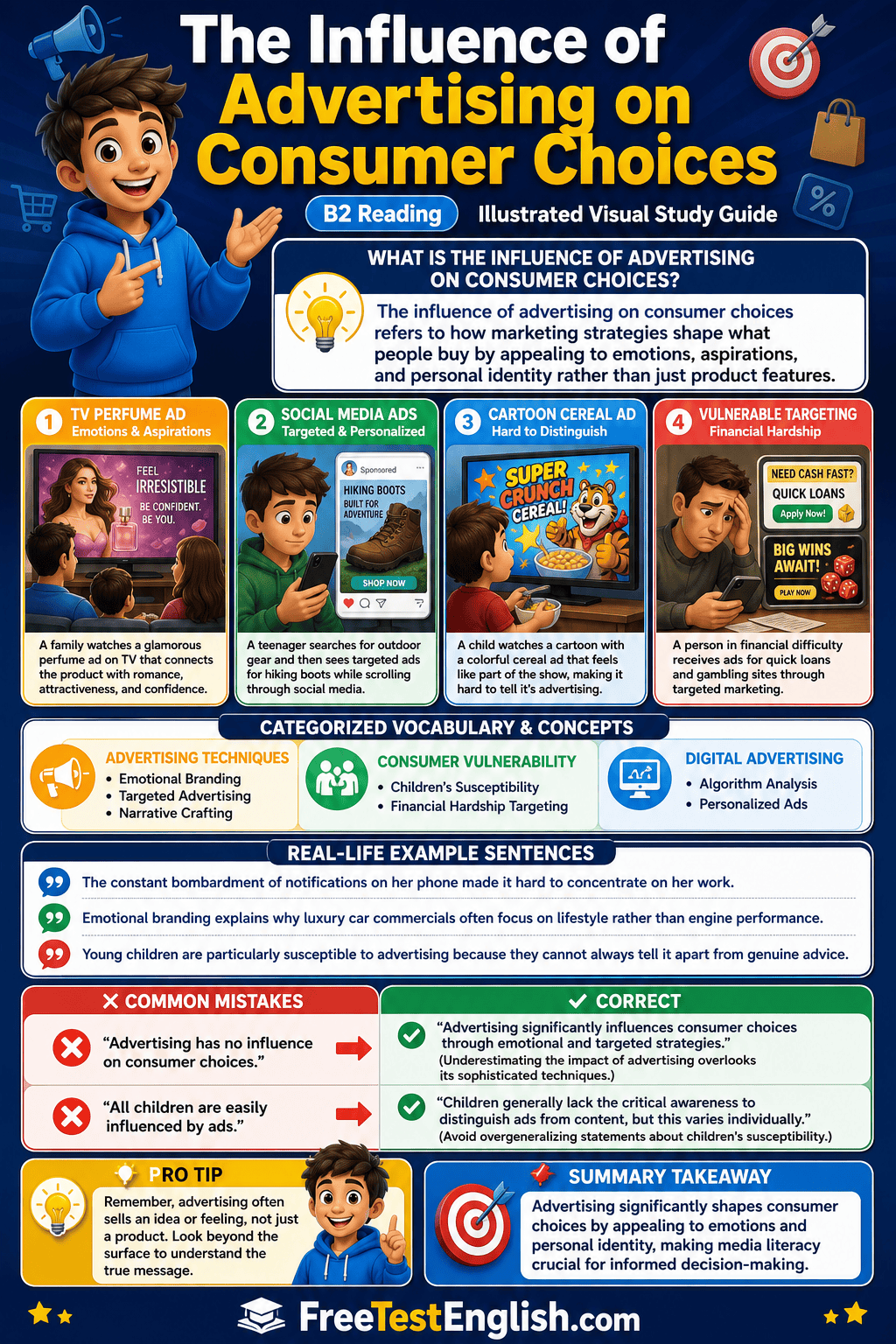
The Influence of Advertising on Consumer Choices
Before you read, think about these questions: Have you ever bought something simply because of an advertisement, even though you hadn't planned to? And do you think most people are aware of how much advertising actually shapes what they buy? Keep these questions in mind as you read the article below.
Reading Passage: Selling You a Story
Walk through any city centre, scroll through social media for five minutes, or simply watch television in the evening — you will be exposed to hundreds of advertising messages without even noticing most of them. It has been estimated that the average person encounters between 4,000 and 10,000 advertisements every single day. Yet despite this constant bombardment, many consumers insist that advertising has little real influence on their purchasing decisions. The evidence, however, tells a very different story.
Modern advertising has moved far beyond simple product promotion. Rather than merely listing the features of a product, advertisers now craft carefully constructed narratives designed to tap into emotions, aspirations, and insecurities. A perfume advertisement, for instance, rarely describes how the fragrance smells. Instead, it sells an idea — glamour, confidence, or romance. This technique, known as emotional branding, has proven extraordinarily effective because it bypasses rational thinking and connects with how consumers want to feel about themselves. Consequently, people are not just buying a product; they are buying into an identity.
The rise of digital advertising has made these strategies considerably more sophisticated. Algorithms analyse browsing history, purchasing patterns, and even the amount of time a user spends looking at a particular post, enabling companies to deliver highly targeted advertisements to individuals who are most likely to respond. A person who has been searching online for hiking boots, for example, will almost certainly begin seeing advertisements for outdoor clothing, camping equipment, and adventure holidays within hours. Critics argue that this level of personalisation crosses a boundary, turning private consumer behaviour into commercial data without meaningful consent. Supporters, on the other hand, claim that targeted advertising simply makes the shopping experience more relevant and convenient.
There is also the question of vulnerable groups. Children, who lack the critical awareness needed to distinguish advertising from neutral content, are particularly susceptible to its influence. Regulations governing advertising aimed at children vary significantly between countries; whereas some nations have introduced strict limitations on advertising junk food to minors, others have done very little. Similarly, research suggests that people experiencing financial hardship may be disproportionately targeted by advertisements for loans, gambling, and fast food — industries that can exploit rather than serve their customers.
Nevertheless, it would be unfair to portray advertising as entirely manipulative. Advertising does inform consumers about products they might genuinely find useful, and it funds much of the free content people enjoy online and on television. The key issue is not advertising itself, but transparency. If consumers understood more clearly how advertising techniques work — and how their data is being used — they would be better placed to make truly independent choices. As media literacy becomes an increasingly vital skill in the digital age, learning to read an advertisement critically may be just as important as reading a newspaper article.
Key Vocabulary in Context
| Word / Phrase | Part of Speech | Definition | Example Sentence |
|---|---|---|---|
| bombardment | noun | An overwhelming number of things coming at someone continuously, often causing difficulty or confusion | The constant bombardment of notifications on her phone made it hard to concentrate on her work. |
| aspirations | noun (plural) | Strong hopes or ambitions for achieving something better in life | The marketing campaign deliberately targeted young people's aspirations for success and independence. |
| emotional branding | noun phrase | A marketing strategy that connects a product to a particular feeling or personal identity rather than focusing on its practical features | Emotional branding explains why luxury car commercials often focus on lifestyle rather than engine performance. |
| sophisticated | adjective | Highly developed, complex, and using advanced methods | Today's advertising algorithms are far more sophisticated than the simple banner ads of the early internet. |
| susceptible | adjective | Easily influenced, affected, or harmed by something | Young children are particularly susceptible to advertising because they cannot always tell it apart from genuine advice. |
| disproportionately | adverb | To a degree that is larger or smaller than is fair or expected in relation to something else | Low-income households are disproportionately affected by aggressive lending advertisements. |
| transparency | noun | The quality of being open, clear, and honest about how something works or is done | Consumer groups are calling for greater transparency from tech companies about how user data is collected. |
| media literacy | noun phrase | The ability to critically understand, analyse, and evaluate media content and messages | Schools are increasingly including media literacy in the curriculum to help students navigate the digital world. |
Reading Strategies & Comprehension Tips
Skimming for the Main Idea
Read the first and last sentences of each paragraph quickly to get a general sense of what the article is about before reading in detail. Notice that this article moves from a general claim (advertising has little influence — which is then challenged) to specific examples, and finally to a balanced conclusion. Recognising this argumentative structure will help you follow the writer's logic.
Scanning for Specific Details
If a question asks about a specific fact — such as a statistic, a named technique, or a particular group of people — scan the text for keywords rather than rereading everything. For example, numbers like "4,000 to 10,000" or proper terms like "emotional branding" act as anchors that will lead you directly to the relevant part of the text.
Understanding the Writer's Attitude
Pay close attention to phrases like "the evidence, however, tells a very different story" and "it would be unfair to portray advertising as entirely manipulative." These signal that the writer is presenting a nuanced, balanced view rather than a one-sided argument. Be careful not to assume the writer is simply "pro-advertising" or "anti-advertising."
Inferring Implied Meaning
Some ideas are not stated directly. For instance, when the writer says that algorithms track "even the amount of time a user spends looking at a particular post," the implication is that companies can measure interest and hesitation even without a click or purchase. Think about what the examples suggest beyond what is explicitly written.
Common Reading Pitfalls & Traps
Distractor: Confusing the Writer's View with Quoted Opinions
The article mentions both critics and supporters of targeted advertising. Be careful not to confuse these reported perspectives with the writer's own position. The writer is summarising two sides of a debate, not personally endorsing either one at that point in the text.
Distractor: Overgeneralising Statements About Children
The article says children lack the critical awareness needed to recognise advertising — but this refers to a general developmental stage, not every individual child in every situation. Exam questions sometimes rephrase this as an absolute statement, so read carefully.
False Friend Alert: "Sophisticated"
For some learners, sophisticated may suggest something purely positive, such as elegant or stylish. In this context, it means highly complex and advanced in method, which carries a more neutral — and slightly cautionary — tone. Misreading this word could affect your understanding of the writer's attitude toward digital advertising.
Trap: Assuming the Conclusion is Negative About Advertising
The final paragraph begins with "Nevertheless, it would be unfair to portray advertising as entirely manipulative." Students often miss this concession and assume the whole article condemns advertising. The conclusion is actually a call for consumer education, not a rejection of advertising itself.
Quick Summary
Now read the passage carefully and complete Exercise 1 (Multiple Choice) and Exercise 2 (Fill-in-the-gap dropdown) below.
📄 Download the The Influence of Advertising on Consumer Choices PDF
Download this The Influence of Advertising on Consumer Choices grammar lesson as a free printable PDF.
It includes grammar rules, examples, and explanations so you can study offline anytime.