
Read the passage carefully before attempting Exercise 1 (Multiple Choice) and Exercise 2 (Fill in the blanks dropdown) below.
Not long ago, staying in touch with someone who lived abroad meant writing letters, making expensive international phone calls, or simply losing contact altogether. Today, a quick voice note, a shared meme, or a brief comment on someone’s post can maintain a relationship across continents at virtually no cost. In this sense, social media has been nothing short of revolutionary. Platforms such as Instagram, WhatsApp, and TikTok have made communication faster, more visual, and accessible to billions of people who would otherwise have had far fewer options for staying connected.
However, the shift has not been entirely positive. Many linguists and communication researchers argue that while we are exchanging more messages than ever before, the quality of those exchanges has declined. Written communication on social media tends to favour brevity — short captions, emoji reactions, and quick replies that leave little room for nuance or depth. A person who might have crafted a thoughtful letter to a friend is now more likely to send a string of GIFs. Critics suggest that this compression of language could be eroding our ability to express complex emotions or engage in sustained, meaningful dialogue. Whether or not this is an exaggeration, it raises a genuine question about what we sacrifice in the name of convenience.
There is also the matter of tone and misunderstanding. Face-to-face communication relies heavily on body language, facial expressions, and vocal tone — cues that are largely absent online. As a result, irony can be mistaken for sincerity, a blunt message can come across as hostile, and humour often falls flat. Some platforms have attempted to address this by introducing features such as reaction buttons and voice messaging, which add a layer of emotional context. Nevertheless, digital communication still lacks the richness of in-person interaction, and misunderstandings remain surprisingly common.
On the other hand, social media has given a voice to communities and individuals who were previously excluded from public conversation. Activists, artists, and ordinary people who lack access to traditional media can now share their perspectives with a global audience. New forms of expression — from short-form video to threaded debates — have emerged, representing a genuine evolution in how ideas are communicated rather than simply a degradation of older forms.
The truth is that social media has not replaced communication so much as it has expanded and complicated it. We communicate more frequently and across greater distances, but we do so in ways that are still being shaped and understood. Learning to navigate this landscape thoughtfully — knowing when a phone call serves better than a text, or when depth matters more than speed — may well be one of the most important social skills of our time.

Exercise 1
Read the passage about how social media changes the way we communicate carefully, then choose the correct answer for each question based on the text.
Example: According to the text, which platform is mentioned as a place where people share short written messages?
Answer: Twitter is mentioned as a platform where people share short written messages.
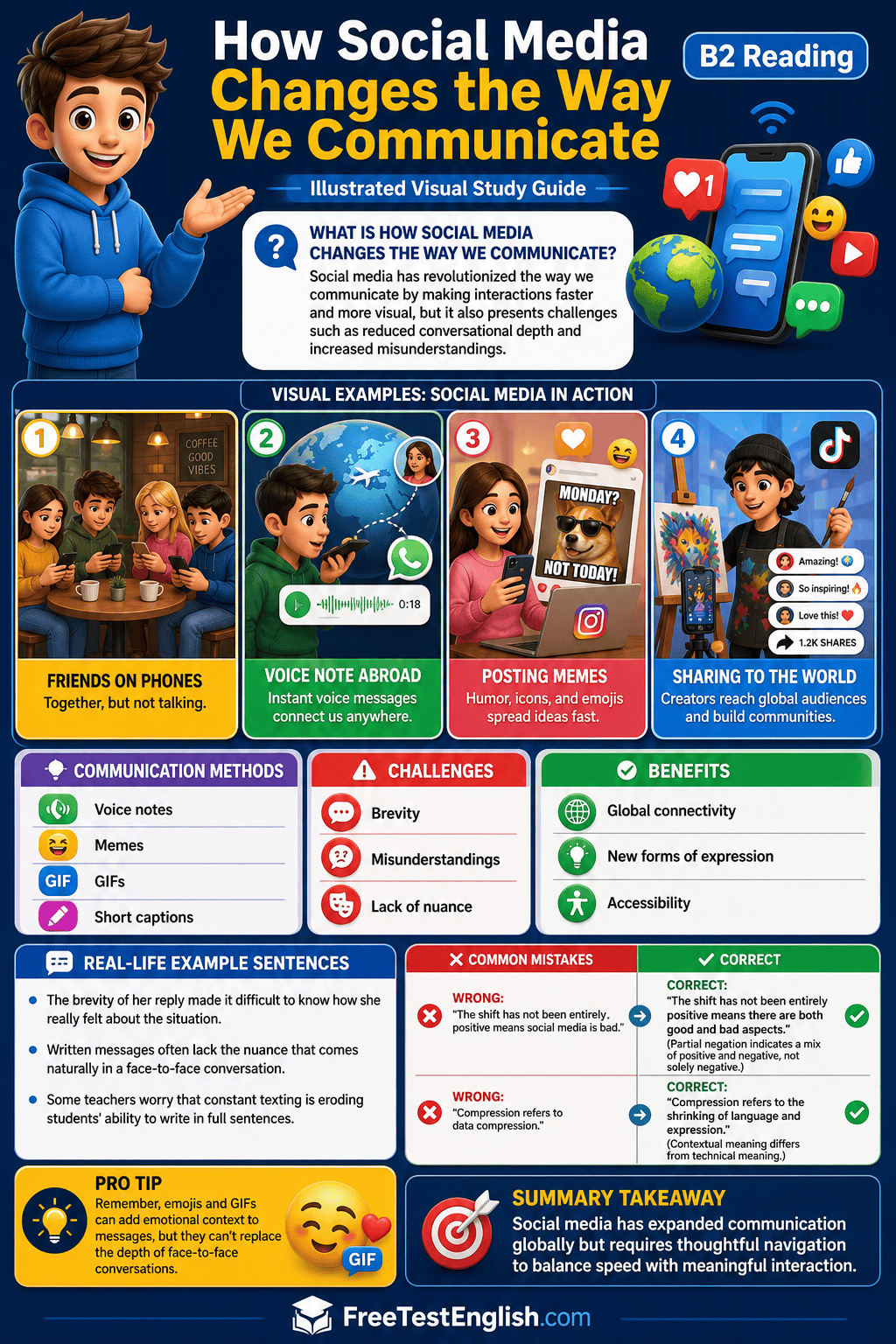
How Social Media Changes the Way We Communicate
Think about the last time you had a long, uninterrupted conversation with a friend — no phones on the table, no notifications buzzing in the background. For many people, that kind of exchange is becoming increasingly rare. Social media platforms have fundamentally reshaped how we connect, share information, and even how we express ourselves. Before you read, consider these two questions: How has social media changed your own communication habits? And do you think these changes have made us better or worse at connecting with others?
Reading Passage: Talking Differently — The Social Media Effect
Not long ago, staying in touch with someone who lived abroad meant writing letters, making expensive international phone calls, or simply losing contact altogether. Today, a quick voice note, a shared meme, or a brief comment on someone's post can maintain a relationship across continents at virtually no cost. In this sense, social media has been nothing short of revolutionary. Platforms such as Instagram, WhatsApp, and TikTok have made communication faster, more visual, and accessible to billions of people who would otherwise have had far fewer options for staying connected.
However, the shift has not been entirely positive. Many linguists and communication researchers argue that while we are exchanging more messages than ever before, the quality of those exchanges has declined. Written communication on social media tends to favour brevity — short captions, emoji reactions, and quick replies that leave little room for nuance or depth. A person who might have crafted a thoughtful letter to a friend is now more likely to send a string of GIFs. Critics suggest that this compression of language could be eroding our ability to express complex emotions or engage in sustained, meaningful dialogue. Whether or not this is an exaggeration, it raises a genuine question about what we sacrifice in the name of convenience.
There is also the matter of tone and misunderstanding. Face-to-face communication relies heavily on body language, facial expressions, and vocal tone — cues that are largely absent online. As a result, irony can be mistaken for sincerity, a blunt message can come across as hostile, and humour often falls flat. Some platforms have attempted to address this by introducing features such as reaction buttons and voice messaging, which add a layer of emotional context. Nevertheless, digital communication still lacks the richness of in-person interaction, and misunderstandings remain surprisingly common.
On the other hand, social media has given a voice to communities and individuals who were previously excluded from public conversation. Activists, artists, and ordinary people who lack access to traditional media can now share their perspectives with a global audience. New forms of expression — from short-form video to threaded debates — have emerged, representing a genuine evolution in how ideas are communicated rather than simply a degradation of older forms.
The truth is that social media has not replaced communication so much as it has expanded and complicated it. We communicate more frequently and across greater distances, but we do so in ways that are still being shaped and understood. Learning to navigate this landscape thoughtfully — knowing when a phone call serves better than a text, or when depth matters more than speed — may well be one of the most important social skills of our time.
Key Vocabulary in Context
| Word / Phrase | Part of Speech | Definition | Example Sentence |
|---|---|---|---|
| brevity | noun | the quality of being short and to the point, especially in speech or writing | The brevity of her reply made it difficult to know how she really felt about the situation. |
| nuance | noun | a subtle difference in meaning, expression, or tone that is not immediately obvious | Written messages often lack the nuance that comes naturally in a face-to-face conversation. |
| eroding | verb (present participle) | gradually weakening or destroying something over time | Some teachers worry that constant texting is eroding students' ability to write in full sentences. |
| compression | noun | the process of reducing something so that it takes up less space or time; here, making language shorter and simpler | The compression of complex ideas into short captions can lead to misunderstanding. |
| blunt | adjective | direct and honest in a way that may seem rude or unkind; lacking softness in tone | His blunt message was meant to be helpful, but many people found it harsh. |
| evolution | noun | a gradual process of development or change into a more complex or different form | The rise of podcasting represents an evolution in how journalism reaches its audience. |
| sustained | adjective | continuing for a long period without weakening or losing focus | It is becoming harder to have a sustained conversation without someone checking their phone. |
| navigate | verb | to find a way through a complex situation or environment with care and skill | Young people need to learn how to navigate social media without letting it affect their wellbeing. |
Reading Strategies & Comprehension Tips
Skimming for the Main Idea
Read the first and last sentences of each paragraph quickly before reading the full text. This will give you a strong sense of the article's overall argument — that social media has both expanded and complicated human communication — before you focus on the details.
Scanning for Specific Information
If a question asks about a specific platform, researcher, or example, scan the text for names, numbers, or topic-related keywords rather than re-reading everything. For instance, platform names like Instagram or WhatsApp are easy anchor points to find quickly.
Understanding the Writer's Attitude
Pay attention to how the writer introduces contrasting ideas. Phrases like "however", "on the other hand", and "nevertheless" signal a shift in viewpoint. The writer is not simply criticising or praising social media — they are presenting a balanced argument. Look for where the writer seems to sympathise with a particular side.
Inferring Implied Meaning
Some ideas in the passage are suggested rather than stated directly. For example, the opening image of an "uninterrupted conversation with no phones on the table" implies that this has become unusual — the writer never says so explicitly, but the implication is clear. Practise reading between the lines.
Common Reading Pitfalls & Traps
Confusing "the writer's opinion" with "the view of critics"
The passage reports what "critics suggest" about language being eroded, but this is not necessarily the writer's own view. Be careful to distinguish between opinions the writer is reporting and the writer's own conclusions. In exam questions, this distinction is often tested.
Misreading "not entirely positive" as "entirely negative"
The phrase "the shift has not been entirely positive" means there are both good and bad aspects — it does not mean the writer thinks social media is bad overall. Watch out for this kind of partial negation, which is a common source of misinterpretation at B2 level.
Overlooking concession words
Words like "despite", "nevertheless", and "however" are crucial for understanding the direction of an argument. If you skip over them, you may misidentify the writer's main point. Always slow down when you encounter these discourse markers.
False cognates and deceptive vocabulary
The word "compression" is used metaphorically in this passage — it does not refer to a technical process (as in data compression in computing), but to the shrinking of language and expression. Always use the surrounding context to confirm the intended meaning of a word.
Quick Summary
This passage explores how social media has transformed human communication, highlighting both its remarkable advantages — such as connecting people across great distances — and its potential drawbacks, including shallower language, increased misunderstandings, and the loss of conversational depth. The writer presents a balanced perspective, ultimately suggesting that adapting thoughtfully to these changes is essential in modern life.
Now read the passage carefully and complete Exercise 1 (Multiple Choice) and Exercise 2 (Fill-in-the-gap dropdown) below.
📄 Download the How Social Media Changes the Way We Communicate PDF
Download this How Social Media Changes the Way We Communicate grammar lesson as a free printable PDF.
It includes grammar rules, examples, and explanations so you can study offline anytime.