
Read the passage carefully before attempting Exercise 1 (Multiple Choice) and Exercise 2 (Fill in the blanks dropdown) below.
Three years ago, Priya Sharma was sitting in a glass-walled office in central Mumbai, staring at a spreadsheet she had no interest in completing. She had a stable salary, a clear career path, and — by most people’s standards — a successful life. Yet something was missing. Having worked in financial consulting for nearly a decade, she had grown increasingly restless, though she could not quite articulate why. It was only when her colleague, a quietly ambitious woman named Zara, handed in her resignation to become a ceramics artist that Priya began to question everything she had taken for granted.
“I wasn’t jealous of Zara’s courage,” Priya recalls. “I was terrified by the realisation that I had never once asked myself what I actually wanted.” That evening, she signed up for a six-month volunteer programme in rural Sri Lanka, working with an environmental NGO that was restoring degraded coastal wetlands. It was a decision that seemed impulsive to her colleagues, who warned her that she would be throwing away years of hard-earned professional credibility. Her parents, who had sacrificed a great deal to fund her education, were understandably anxious. Nevertheless, she bought the plane ticket.
The work in Sri Lanka was physically demanding and frequently frustrating. Priya had no background in ecology, so she spent the first month feeling overwhelmed and, at times, genuinely useless. However, it was precisely this discomfort that proved to be the turning point. Stripped of the status and the routine that had defined her identity for years, she was forced to learn, to collaborate, and to listen in ways she never had before. The local team, many of whom had been working in conservation for decades without recognition or financial reward, demonstrated a level of commitment that Priya found both humbling and profoundly inspiring.
By the time she returned to Mumbai, Priya had no intention of going back to consulting. She had already been offered a position coordinating environmental education programmes across South Asia — a role that paid considerably less but, as she puts it, “felt like it was actually connected to something real.” She acknowledges that not everyone can afford to make such a dramatic change, and she is careful not to present her story as a universal blueprint. If she had had greater financial obligations or family responsibilities, the decision might have been impossible. Nevertheless, she believes that most people live with far more unexplored potential than they realise.
Whether or not Priya’s story resonates with you, it raises questions worth sitting with: How much of the life we lead is genuinely chosen, and how much has simply accumulated around us without our full awareness?

Exercise 1
Read the passage about a life-changing experience carefully, then choose the correct answer for each question based on the information in the text.
Example: Why did the author consider the experience life-changing?
Answer: Because it completely transformed the way the author saw the world and themselves.
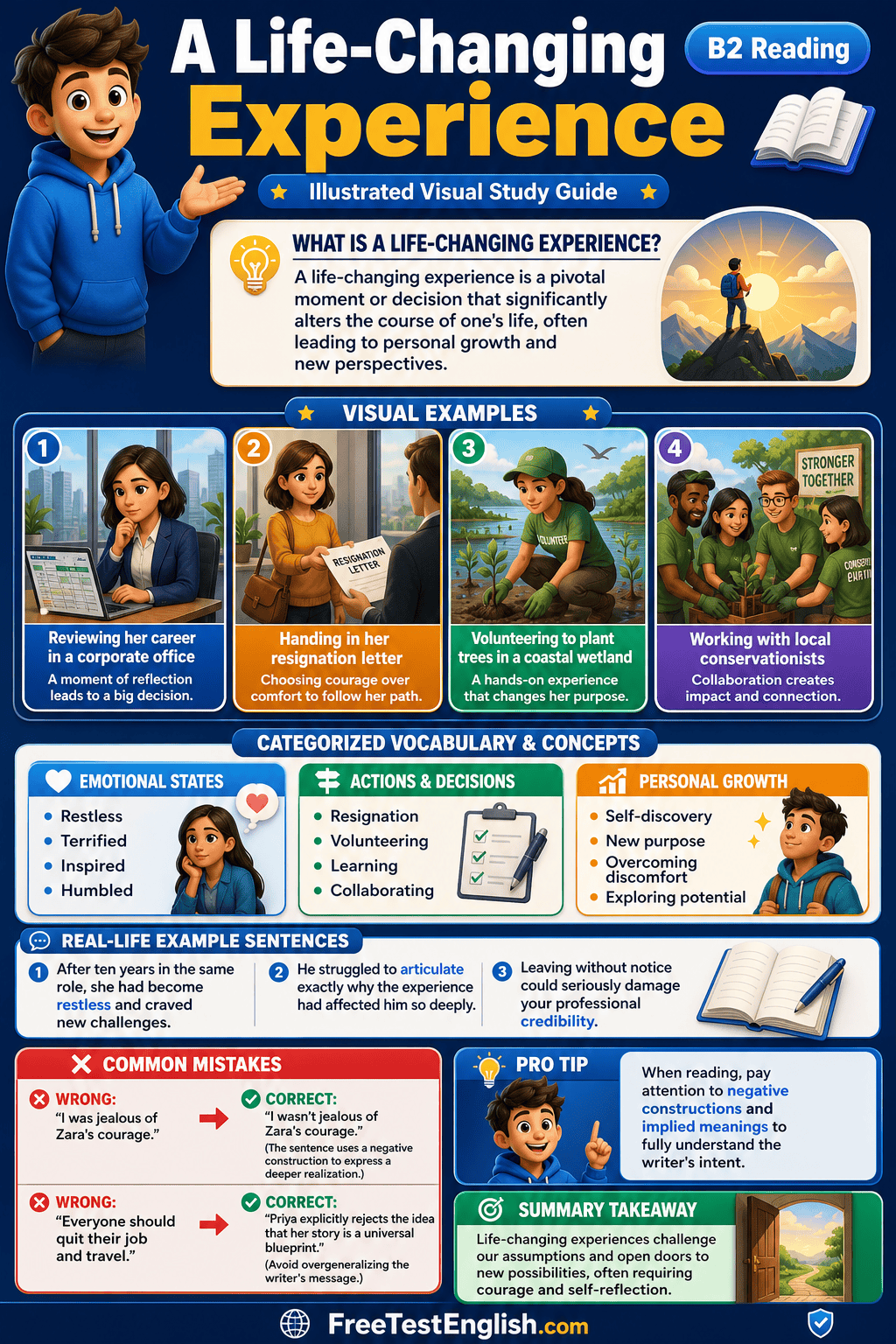
A Life-Changing Experience: When the World Shifts Beneath Your Feet
Have you ever made a decision that completely altered the direction of your life? Sometimes a single moment — a conversation, an opportunity, or even a crisis — is enough to change everything. Before you read, think about these two questions: What kinds of experiences do you think change people the most? And do you believe people can truly reinvent themselves, or are we shaped by habits and circumstances we cannot escape?
Reading Passage: The Year I Stopped Playing It Safe
Three years ago, Priya Sharma was sitting in a glass-walled office in central Mumbai, staring at a spreadsheet she had no interest in completing. She had a stable salary, a clear career path, and — by most people's standards — a successful life. Yet something was missing. Having worked in financial consulting for nearly a decade, she had grown increasingly restless, though she could not quite articulate why. It was only when her colleague, a quietly ambitious woman named Zara, handed in her resignation to become a ceramics artist that Priya began to question everything she had taken for granted.
"I wasn't jealous of Zara's courage," Priya recalls. "I was terrified by the realisation that I had never once asked myself what I actually wanted." That evening, she signed up for a six-month volunteer programme in rural Sri Lanka, working with an environmental NGO that was restoring degraded coastal wetlands. It was a decision that seemed impulsive to her colleagues, who warned her that she would be throwing away years of hard-earned professional credibility. Her parents, who had sacrificed a great deal to fund her education, were understandably anxious. Nevertheless, she bought the plane ticket.
The work in Sri Lanka was physically demanding and frequently frustrating. Priya had no background in ecology, so she spent the first month feeling overwhelmed and, at times, genuinely useless. However, it was precisely this discomfort that proved to be the turning point. Stripped of the status and the routine that had defined her identity for years, she was forced to learn, to collaborate, and to listen in ways she never had before. The local team, many of whom had been working in conservation for decades without recognition or financial reward, demonstrated a level of commitment that Priya found both humbling and profoundly inspiring.
By the time she returned to Mumbai, Priya had no intention of going back to consulting. She had already been offered a position coordinating environmental education programmes across South Asia — a role that paid considerably less but, as she puts it, "felt like it was actually connected to something real." She acknowledges that not everyone can afford to make such a dramatic change, and she is careful not to present her story as a universal blueprint. If she had had greater financial obligations or family responsibilities, the decision might have been impossible. Nevertheless, she believes that most people live with far more unexplored potential than they realise.
Whether or not Priya's story resonates with you, it raises questions worth sitting with: How much of the life we lead is genuinely chosen, and how much has simply accumulated around us without our full awareness?
Key Vocabulary in Context
| Word / Phrase | Part of Speech | Definition | Example Sentence |
|---|---|---|---|
| restless | adjective | Unable to feel settled or satisfied; wanting change or stimulation | After ten years in the same role, she had become restless and craved new challenges. |
| articulate | verb | To express thoughts or feelings clearly in words | He struggled to articulate exactly why the experience had affected him so deeply. |
| credibility | noun | The quality of being trusted and respected in a professional or personal context | Leaving without notice could seriously damage your professional credibility. |
| degraded | adjective | Damaged or reduced in quality, especially referring to land or natural environments | The project aimed to restore degraded farmland to its natural state. |
| humbling | adjective | Making you feel less important or proud, often in a positive and thought-provoking way | Watching the volunteers work so tirelessly was a humbling experience. |
| blueprint | noun | A detailed plan or model that others can follow | There is no single blueprint for a happy life — what works for one person may not suit another. |
| impulsive | adjective | Done suddenly without careful planning or consideration | Her decision to quit seemed impulsive, but she had actually been thinking about it for months. |
| accumulated | verb (past participle) | Gradually gathered or built up over time, often without active intention | The habits we have accumulated over the years can be surprisingly difficult to break. |
Reading Strategies & Comprehension Tips
Skimming for the Main Idea
Read the first and last sentences of each paragraph quickly to get a general sense of the passage before reading in detail. Notice how the passage moves from Priya's dissatisfaction, through her decision and its challenges, to the broader lesson she draws from her experience.
Scanning for Specific Details
- When answering questions about specific facts — such as where Priya worked, how long the programme lasted, or what kind of organisation she joined — scan for proper nouns, numbers, and key content words rather than re-reading the whole text.
- Pay attention to the reactions of other characters (colleagues, parents, the local team), as these are likely to be tested in detail questions.
Understanding the Writer's Attitude
The passage is written in a balanced, nuanced tone. Priya does not claim her story is a model for everyone — she explicitly acknowledges its limitations. Look for phrases such as "she is careful not to present" and "the decision might have been impossible" to understand how the writer avoids oversimplification.
Inferring Implied Meaning
The final paragraph does not state a conclusion directly. Instead, it poses a question. This is an invitation for the reader to reflect rather than a signal that the passage has no point. Consider what the writer is implying about how consciously people make their life choices.
Common Reading Pitfalls & Traps
Confusing Characters' Views
Be careful to distinguish between Priya's own views and the views of the people around her. Her colleagues believed she was making a mistake; her parents were anxious; the local team inspired her. These are different perspectives, and exam questions may ask you to identify who holds which opinion.
Misreading Negative Constructions
The phrase "I wasn't jealous of Zara's courage" may seem to suggest a negative attitude towards Zara, but in context it means the opposite — Priya was confronting a deeper and more uncomfortable emotion: the realisation of her own unfulfilled potential. Read negative constructions carefully before drawing conclusions.
Overgeneralising the Writer's Message
A common mistake is to read this passage as arguing that everyone should quit their job and travel. In fact, Priya herself explicitly rejects this interpretation. The word "blueprint" is used precisely to signal that she is not offering a one-size-fits-all solution. If a question asks about the writer's main message, choose the most cautious and nuanced option available.
False Synonym Traps
The word "humbling" does not mean embarrassing or shameful in this context. It carries a positive, reflective meaning — Priya felt moved and made more modest by the dedication of others. Similarly, "impulsive" is used by Priya's colleagues as a criticism, but the passage does not confirm that her decision was in fact poorly considered.
Quick Summary
This passage tells the story of Priya Sharma, a financial consultant in Mumbai who gave up a stable career to volunteer with an environmental organisation in Sri Lanka. Through an uncomfortable but transformative experience, she gained a new sense of purpose and went on to pursue a very different professional path. The passage explores themes of personal courage, identity, privilege, and the gap between the lives we lead and the lives we might choose — without offering any simple conclusions.
Now read the passage carefully and complete Exercise 1 (Multiple Choice) and Exercise 2 (Fill-in-the-gap dropdown) below.
📄 Download the A Life-Changing Experience PDF
Download this A Life-Changing Experience grammar lesson as a free printable PDF.
It includes grammar rules, examples, and explanations so you can study offline anytime.