
Read the passage carefully before attempting Exercise 1 (Multiple Choice) and Exercise 2 (Fill in the blanks dropdown) below.
Priya had always been someone who made lists. As a teenager growing up in Leicester, she kept notebooks full of ideas, ambitions, and half-finished plans. Now, at twenty-six, she is working as a junior graphic designer at a small agency, and she has started to think seriously about where she wants to be in ten years’ time. The problem is, her list has become much longer — and more complicated — than she expected.
Last spring, Priya attended a career workshop which changed the way she thinks about planning. The workshop leader, a consultant named Marcus, told the group that most people make the mistake of focusing only on the destination. “If you only think about the end goal,” he said, “you forget to plan the steps in between.” His advice was simple: break your big goals into smaller ones, and review them regularly. Priya found this surprisingly difficult at first. She had always imagined that she would eventually run her own design studio, but she had never thought about what skills she still needed to develop, or how much money she would need to save.
Since the workshop, Priya has made some important changes. She is currently studying for a business qualification in the evenings, because she knows that running a company involves much more than creative work. She has also started saving a small amount each month. “I might not be ready to start my own business for another five years,” she admits, “but at least I’m moving in the right direction.” Although the path feels long, Priya believes that careful, honest planning is the most useful thing she can do right now. And her notebooks, of course, are still full of lists.

Exercise 1
Read the passage about planning for the future carefully, then choose the correct answer for each question based on the information in the text.
Example: Why is it important to set goals for the future?
Answer: It is important to set goals for the future because they help you stay focused and make better decisions.
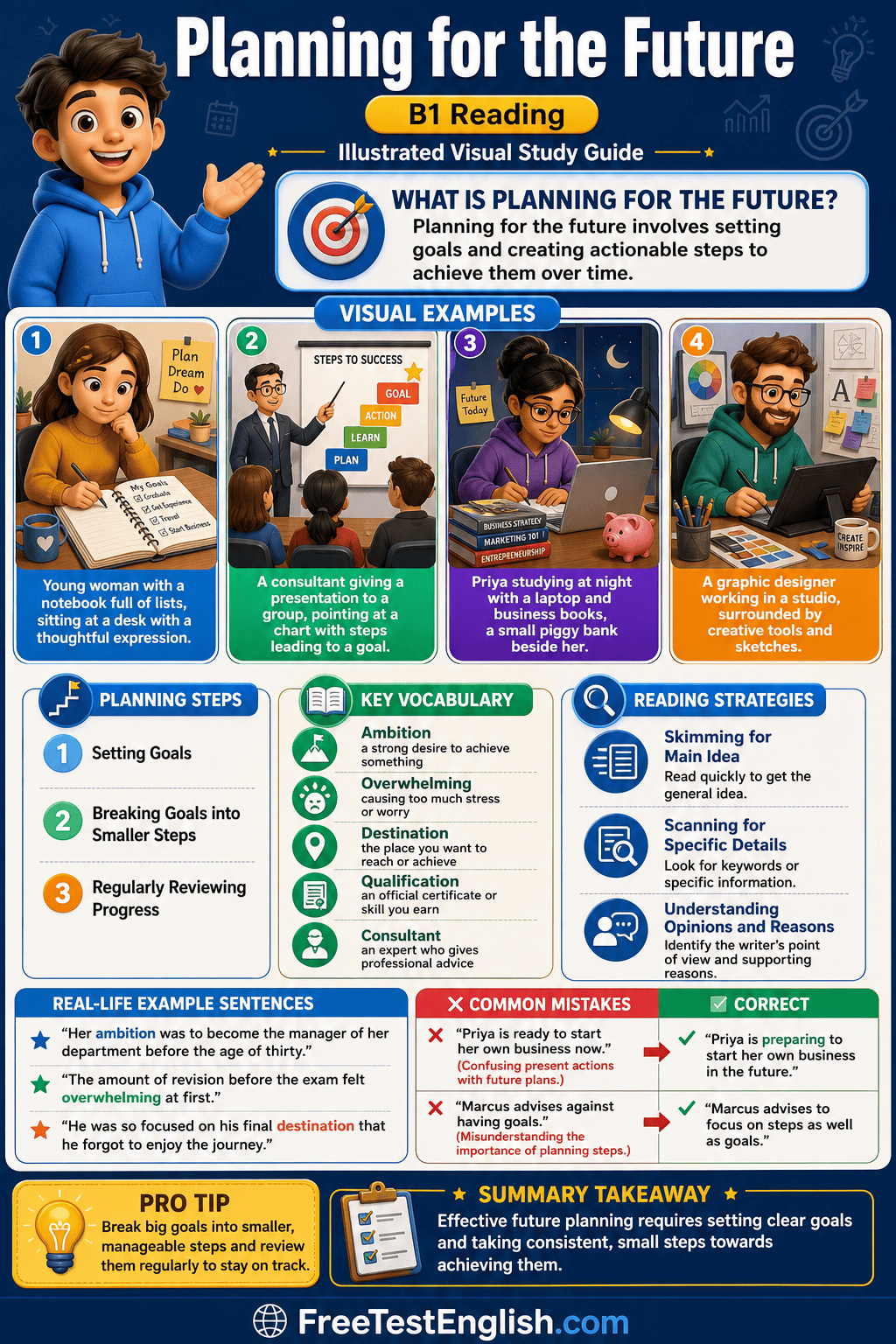
Planning for the Future: What Does Your Ideal Life Look Like?
Most of us have dreams about the future, but turning those dreams into real plans can feel overwhelming. Before you read, think about these two questions: What is one big goal you have for the next five years? And do you think it is better to plan carefully or to let life happen naturally? Keep your answers in mind as you read about how one young woman is approaching these big questions.
Reading Passage: One Step at a Time
Priya had always been someone who made lists. As a teenager growing up in Leicester, she kept notebooks full of ideas, ambitions, and half-finished plans. Now, at twenty-six, she is working as a junior graphic designer at a small agency, and she has started to think seriously about where she wants to be in ten years' time. The problem is, her list has become much longer — and more complicated — than she expected.
Last spring, Priya attended a career workshop which changed the way she thinks about planning. The workshop leader, a consultant named Marcus, told the group that most people make the mistake of focusing only on the destination. "If you only think about the end goal," he said, "you forget to plan the steps in between." His advice was simple: break your big goals into smaller ones, and review them regularly. Priya found this surprisingly difficult at first. She had always imagined that she would eventually run her own design studio, but she had never thought about what skills she still needed to develop, or how much money she would need to save.
Since the workshop, Priya has made some important changes. She is currently studying for a business qualification in the evenings, because she knows that running a company involves much more than creative work. She has also started saving a small amount each month. "I might not be ready to start my own business for another five years," she admits, "but at least I'm moving in the right direction." Although the path feels long, Priya believes that careful, honest planning is the most useful thing she can do right now. And her notebooks, of course, are still full of lists.
Key Vocabulary in Context
| Word / Phrase | Part of Speech | Definition | Example Sentence |
|---|---|---|---|
| ambition | noun | a strong desire to achieve something important in the future | Her ambition was to become the manager of her department before the age of thirty. |
| overwhelming | adjective | so large or difficult that it is hard to deal with; causing strong feelings of stress | The amount of revision before the exam felt overwhelming at first. |
| destination | noun | the place or result you are trying to reach or achieve | He was so focused on his final destination that he forgot to enjoy the journey. |
| qualification | noun | an official certificate or diploma that shows you have completed a course of study or training | She decided to study for a teaching qualification while working part-time. |
| consultant | noun | an expert who gives professional advice to people or organisations | The company hired a marketing consultant to help them reach new customers. |
| review | verb | to look at something again carefully in order to check, improve, or update it | It is a good idea to review your goals every few months to see how you are progressing. |
| develop | verb | to improve or build a skill, idea, or ability over time | He worked hard to develop his communication skills during his first job. |
| in between | phrase | in the middle; at a stage that comes between two other things | The final goal seemed clear, but the steps in between were less obvious. |
Reading Strategies & Comprehension Tips
Skimming for the Main Idea
Before reading every word, skim the passage quickly by reading the first sentence of each paragraph. This gives you a general idea of the topic. For this passage, you will quickly notice that it is about a woman who is planning her career and the challenges she faces.
Scanning for Specific Details
If a question asks about a specific fact — for example, what Priya is studying or where she grew up — do not re-read the whole text. Instead, scan for key words like Leicester, workshop, or saving to find the relevant section quickly.
Understanding Opinions and Reasons
This passage contains both facts and opinions. Look carefully at phrases like "Priya believes..." and "she admits..." — these signal personal views rather than facts. Also, notice the word because, which connects a reason to an action. Understanding these connections will help you answer "why" questions correctly.
Making Simple Inferences
The text does not always state everything directly. For example, the passage says Priya "has started to think seriously" about her future — this implies she did not think about it very seriously before. Practise reading between the lines to understand what the writer suggests but does not state directly.
Common Reading Pitfalls & Traps
Confusing Priya's Past Behaviour with Her Present Actions
The passage describes both what Priya used to do and what she is doing now. Be careful not to confuse these. For example, she always imagined running her own studio (a past thought), but she is currently studying for a qualification (a present action). Questions may test whether you understand this time difference.
Misreading Marcus's Advice
Marcus says people make the mistake of focusing only on the destination. Some readers might think he is saying that having a goal is wrong — but that is not correct. His point is that the steps in between are just as important as the final goal. Read carefully and avoid jumping to conclusions.
Watch Out for Numbers and Time Expressions
The passage mentions several time references: Priya is twenty-six, she attended the workshop last spring, and she thinks she might not be ready for another five years. These details may appear in comprehension questions. Make sure you do not mix up past events with future plans.
The Word "although" Can Be Tricky
Near the end of the passage, the sentence begins: "Although the path feels long, Priya believes..." The word although introduces a contrast — the path is difficult, but she still thinks planning is worthwhile. Do not read this sentence as purely negative. It shows a balanced, realistic attitude.
Quick Summary
This passage follows Priya, a young graphic designer from Leicester, as she thinks seriously about her career future. After attending a workshop led by a consultant named Marcus, she learns the importance of planning small steps rather than focusing only on big goals. As a result, she begins studying for a business qualification and saving money each month, even though her goal of owning her own studio may still be years away. The passage explores themes of ambition, realistic planning, and personal growth in a relatable and encouraging way.
Now read the passage carefully and complete Exercise 1 (Multiple Choice) and Exercise 2 (Fill-in-the-gap dropdown) below.
📄 Download the Planning for the Future PDF
Download this Planning for the Future grammar lesson as a free printable PDF.
It includes grammar rules, examples, and explanations so you can study offline anytime.