
Read the passage carefully before attempting Exercise 1 (Multiple Choice) and Exercise 2 (Fill in the blanks dropdown) below.
When Priya packed the last box in her small Manchester flat, she felt a mix of nerves and excitement. She was moving to Bristol for a new job — a position she had been trying to get for over a year. Her friends had already thrown her a leaving party, and now, standing in an empty room, the reality finally hit her. She was really doing this.
The first few weeks in Bristol were harder than she had expected. Although her new colleagues were friendly, she didn’t know anyone outside of work. Her flat, which was close to the city centre, felt quiet and a little lonely in the evenings. She had to figure out which buses to take, where the nearest supermarket was, and how to find a good GP. Simple tasks that she had never thought about in Manchester suddenly required real effort. However, instead of giving up, she decided to be more proactive. She joined a running club that met on Sunday mornings and signed up for a pottery class at a local community centre.
Within a couple of months, things had started to change. The pottery class had introduced her to a small group of people who met for coffee on weekends, and the running club gave her a reason to explore different parts of the city. She was beginning to feel at home. Bristol, with its colourful street art and lively harbour area, was starting to win her over. Looking back, Priya says the hardest part wasn’t the logistics of moving — it was giving herself permission to feel unsettled for a while. “If you wait until everything feels perfect,” she says, “you might miss the good parts that are already there.”

Exercise 1
Read the passage about moving to a different city carefully, then choose the correct answer for each question based on the information in the text.
Example: Why did the writer decide to move to a different city?
Answer: The writer decided to move to a different city to find better job opportunities.
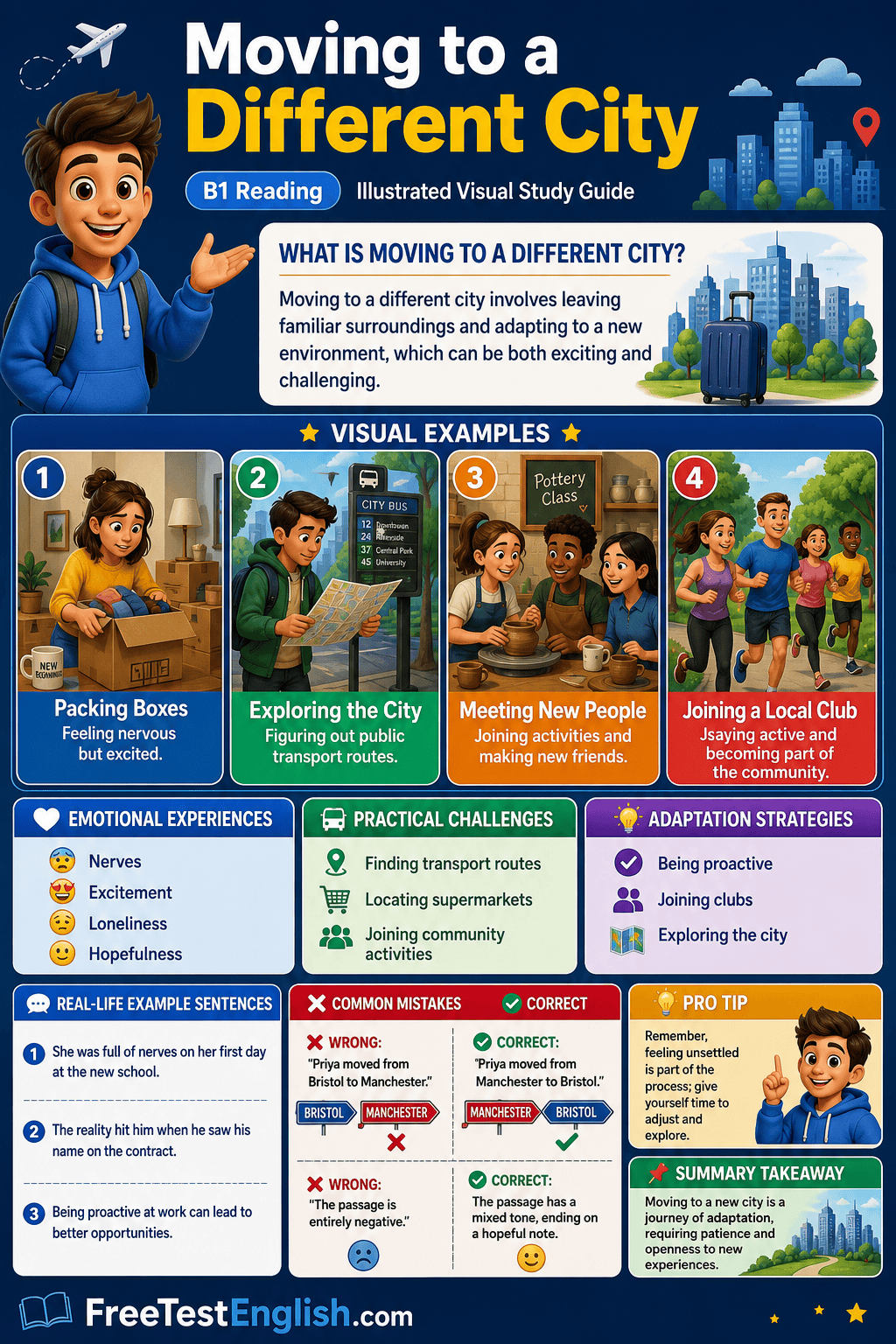
Moving to a Different City
Have you ever thought about leaving everything familiar behind and starting fresh somewhere new? Moving to a different city can feel exciting and frightening at the same time. Before you read, think about these two questions: What do you think is the most difficult part of moving to a new city? And what could make the experience easier or more enjoyable?
Reading Passage: A New City, A New Chapter
When Priya packed the last box in her small Manchester flat, she felt a mix of nerves and excitement. She was moving to Bristol for a new job — a position she had been trying to get for over a year. Her friends had already thrown her a leaving party, and now, standing in an empty room, the reality finally hit her. She was really doing this.
The first few weeks in Bristol were harder than she had expected. Although her new colleagues were friendly, she didn't know anyone outside of work. Her flat, which was close to the city centre, felt quiet and a little lonely in the evenings. She had to figure out which buses to take, where the nearest supermarket was, and how to find a good GP. Simple tasks that she had never thought about in Manchester suddenly required real effort. However, instead of giving up, she decided to be more proactive. She joined a running club that met on Sunday mornings and signed up for a pottery class at a local community centre.
Within a couple of months, things had started to change. The pottery class had introduced her to a small group of people who met for coffee on weekends, and the running club gave her a reason to explore different parts of the city. She was beginning to feel at home. Bristol, with its colourful street art and lively harbour area, was starting to win her over. Looking back, Priya says the hardest part wasn't the logistics of moving — it was giving herself permission to feel unsettled for a while. "If you wait until everything feels perfect," she says, "you might miss the good parts that are already there."
Key Vocabulary in Context
| Word / Phrase | Part of Speech | Definition | Example Sentence |
|---|---|---|---|
| nerves | noun (plural) | a feeling of worry or anxiety before something important | She was full of nerves on her first day at the new school. |
| reality hit | phrase (verb phrase) | when something suddenly feels truly real and not just a plan | The reality hit him when he saw his name on the contract. |
| proactive | adjective | taking action to make things happen rather than waiting | Being proactive at work can lead to better opportunities. |
| community centre | noun phrase | a local building where people can attend classes or social activities | The community centre offers free yoga classes on Tuesdays. |
| logistics | noun (plural) | the practical details involved in organising something | The logistics of moving to another country can be complicated. |
| unsettled | adjective | feeling uncomfortable, anxious, or not at ease in a situation | It is normal to feel unsettled during big life changes. |
| win someone over | phrasal verb | to gradually make someone like or accept something | The city's friendly atmosphere won him over within a month. |
| figure out | phrasal verb | to find a solution or understand something after thinking about it | It took her a week to figure out the local transport system. |
Reading Strategies & Comprehension Tips
Skimming for the Main Idea
Read the passage quickly the first time without stopping. Ask yourself: Who is this story about, and what is the main experience being described? You should be able to answer this after just one fast read-through, without understanding every word.
Scanning for Specific Details
If a question asks you about a specific fact — for example, which city Priya moved from, or what activities she joined — scan the text quickly for names, places, or key nouns. You do not need to re-read the whole passage every time.
Understanding Sequence and Change
This passage describes how Priya's feelings changed over time. Pay attention to time expressions such as "the first few weeks", "within a couple of months", and "looking back". These words signal important shifts in the story and are often tested in comprehension questions.
Making Inferences
Not every idea in the text is stated directly. For example, the passage does not say "Priya was unhappy at first" using those exact words, but the details about loneliness and effort suggest this. Practice reading between the lines to understand implied meaning.
Common Reading Pitfalls & Traps
Confusing Cities
The passage mentions two cities — Manchester and Bristol. Be careful not to confuse where Priya came from with where she moved to. Questions may try to test this distinction deliberately.
Missing the Tone Shift
A common mistake is to describe the whole passage as either positive or negative. In fact, the tone changes. The beginning is mixed (nervous and excited), the middle is difficult, and the ending is hopeful. Read the full passage before answering any questions about attitude or feeling.
Taking Quotes Out of Context
Priya's final quote — "you might miss the good parts that are already there" — can be misread as negative. In context, it is actually a piece of encouraging advice. Always read the sentences around a quote before deciding what it means.
Overusing General Knowledge
You might have your own opinions about moving cities, but always base your answers on what the passage actually says. Even if something seems logical, check that the text supports it before selecting an answer.
Quick Summary
This passage follows Priya, a young woman who moves from Manchester to Bristol for a new job. At first, she struggles with loneliness and practical challenges. However, by joining local activities and allowing herself time to adjust, she gradually settles in and begins to enjoy her new city. The passage explores themes of change, resilience, and finding community in an unfamiliar place.
Now read the passage carefully and complete Exercise 1 (Multiple Choice) and Exercise 2 (Fill-in-the-gap dropdown) below.
📄 Download the Moving to a Different City PDF
Download this Moving to a Different City grammar lesson as a free printable PDF.
It includes grammar rules, examples, and explanations so you can study offline anytime.