
Read the passage carefully before attempting Exercise 1 (Multiple Choice) and Exercise 2 (Fill in the blanks dropdown) below.
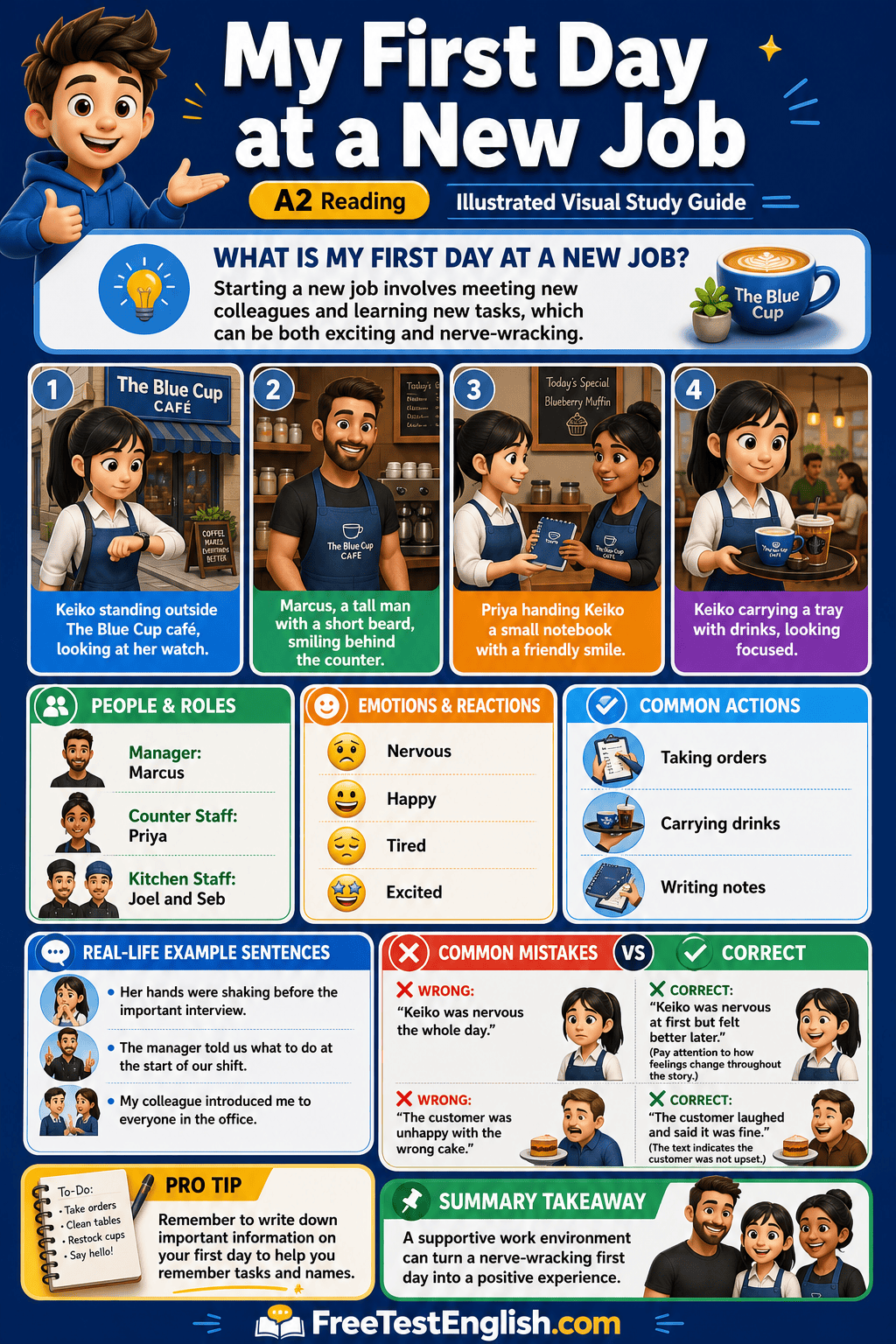
Keiko arrived at the café fifteen minutes early on her first day. Her hands were shaking a little as she pushed open the glass door. The café was called The Blue Cup and it was in the centre of Bristol. Inside, it smelled of fresh coffee and warm bread. A tall man with a short beard smiled at her from behind the counter. “You must be Keiko,” he said. “I’m Marcus, the manager. Welcome!” Keiko felt a little better immediately.
Marcus showed Keiko around the café and introduced her to the other staff. There were three other employees: a woman called Priya, who worked at the counter, and two young men, Joel and Seb, who worked in the kitchen. Everyone was friendly and helpful. Priya gave Keiko a small notebook. “Write everything down on your first day,” she said. “It really helps.” Keiko thought that was a great idea, so she started taking notes straight away.
The morning was very busy. Keiko took orders, carried drinks to the tables, and tried hard to remember the menu. She made one small mistake — she brought the wrong cake to a customer — but the customer just laughed and said it was fine. By lunchtime, Keiko was tired but happy. “This is going to be a good job,” she thought. She was already looking forward to coming back the next day.

Exercise 1
Read the passage about a person's first day at a new job carefully. Then choose the correct answer for each question based on the information in the text.
Example: Where did the person go on their first day?
Answer: They went to their new office on their first day.
My First Day at a New Job
Starting a new job can be exciting, but it can also feel a little scary. Will your new colleagues be friendly? Will you remember everything? Read the passage below and think about these two questions before you start: What do you think is the hardest part of starting a new job? And how do you usually feel when you meet new people for the first time?
Reading Passage: Nervous but Ready
Keiko arrived at the café fifteen minutes early on her first day. Her hands were shaking a little as she pushed open the glass door. The café was called The Blue Cup and it was in the centre of Bristol. Inside, it smelled of fresh coffee and warm bread. A tall man with a short beard smiled at her from behind the counter. "You must be Keiko," he said. "I'm Marcus, the manager. Welcome!" Keiko felt a little better immediately.
Marcus showed Keiko around the café and introduced her to the other staff. There were three other employees: a woman called Priya, who worked at the counter, and two young men, Joel and Seb, who worked in the kitchen. Everyone was friendly and helpful. Priya gave Keiko a small notebook. "Write everything down on your first day," she said. "It really helps." Keiko thought that was a great idea, so she started taking notes straight away.
The morning was very busy. Keiko took orders, carried drinks to the tables, and tried hard to remember the menu. She made one small mistake — she brought the wrong cake to a customer — but the customer just laughed and said it was fine. By lunchtime, Keiko was tired but happy. "This is going to be a good job," she thought. She was already looking forward to coming back the next day.
Key Vocabulary in Context
| Word / Phrase | Part of Speech | Definition | Example Sentence |
|---|---|---|---|
| shaking | verb (present participle) | moving quickly from side to side because you are nervous or cold | Her hands were shaking before the important interview. |
| manager | noun | the person who is in charge of a business or a team | The manager told us what to do at the start of our shift. |
| introduce | verb | to tell people each other's names when they meet for the first time | My colleague introduced me to everyone in the office. |
| staff | noun | all the people who work in a place | The café staff wore blue aprons. |
| employee | noun | a person who works for a company or a person and receives money for it | There are ten employees at the small bakery. |
| straight away | adverb phrase | immediately; without waiting | When the alarm rang, he got up straight away. |
| order | noun / verb | a request for food or a drink in a café or restaurant | The customer gave her order to the waiter. |
| looking forward to | phrasal verb | feeling happy and excited about something that will happen in the future | I am looking forward to starting my new job next week. |
Reading Strategies & Comprehension Tips
Skimming for the Main Idea
Before you read every word, skim the passage quickly. Read the first sentence of each paragraph. This gives you a general idea of what the text is about. For example, paragraph one is about Keiko arriving, paragraph two is about meeting her colleagues, and paragraph three is about her work during the morning.
Scanning for Specific Information
If a question asks you a specific fact — for example, the name of the café or how many employees there were — scan the text quickly. Look for capital letters (names, places) and numbers. Do not re-read the whole passage every time.
Understanding Feelings and Opinions
This text describes how Keiko feels at different moments. Look for words like nervous, better, tired, and happy. These words help you track how her feelings change from the beginning to the end of the day.
Using Context to Guess Vocabulary
If you do not know a word, look at the words around it. For example, if you do not know employee, the sentence tells you there were three of them and gives you their names and jobs. This helps you understand the meaning without a dictionary.
Common Reading Pitfalls & Traps
Pitfall 1: Confusing People's Roles
The text mentions four people besides Keiko: Marcus, Priya, Joel, and Seb. Students sometimes confuse who does what. Remember: Marcus is the manager, Priya works at the counter, and Joel and Seb work in the kitchen. Read carefully and do not mix up their roles.
Pitfall 2: Misreading Keiko's Feelings
At the start, Keiko is nervous — her hands are shaking. But this changes quickly after Marcus speaks to her. By the end, she is tired but happy. Some students think she is nervous the whole time. Pay attention to how feelings change through the story.
Pitfall 3: The Mistake with the Cake
Keiko makes a mistake during the morning, but the customer is not angry — the customer laughed and said it was fine. Be careful not to choose an answer that says the customer was unhappy or that Keiko got into trouble. The text says the opposite.
Pitfall 4: The Word "staff"
Staff is a collective noun in English. It refers to a group of workers, not just one person. Do not confuse it with one individual employee. In this text, "the other staff" means all the other workers in the café.
Quick Summary
In this passage, we follow Keiko on her first day at a café called The Blue Cup in Bristol. She arrives early, feels nervous, but quickly feels better when her manager and new colleagues are kind and welcoming. She works hard during a busy morning, makes one small mistake, and finishes the day feeling happy and positive about her new job. The text shows how a difficult or scary situation can become a good experience when people around you are supportive.
Now read the passage carefully and complete Exercise 1 (Multiple Choice) and Exercise 2 (Fill-in-the-gap dropdown) below.
📄 Download the My First Day at a New Job PDF
Download this My First Day at a New Job grammar lesson as a free printable PDF.
It includes grammar rules, examples, and explanations so you can study offline anytime.