
Read the passage carefully before attempting Exercise 1 (Multiple Choice) and Exercise 2 (Fill in the blanks dropdown) below.
Last Saturday, Priya decided to cook dinner for her family as a surprise. Her parents were both working late, and her little brother Rajan was watching TV in his room. Priya wanted to make something special, so she chose her grandmother’s chicken curry recipe. She had never cooked it alone before, but she felt ready to try.
She started at four o’clock in the afternoon. First, she chopped the onions and garlic. Her eyes were watering because of the onions, but she kept going. Then she fried the spices in hot oil until the kitchen smelled amazing. She added the chicken pieces and stirred everything carefully. While the curry was cooking slowly on the stove, she boiled some rice and set the table with the good plates — the ones her family only uses for special occasions.
When her parents came home at seven o’clock, they were very surprised. “Did you really make this?” her mother asked, smiling. The curry was a little spicier than Priya planned, but everyone said it was delicious. Rajan had two big portions. After dinner, her father washed the dishes without complaining, which was the best part of the evening. Priya is already planning to cook again next weekend.

Exercise 1
Read the passage about cooking dinner for a family carefully, then choose the correct answer for each question based on the text.
Example: What does the person cook for their family?
Answer: They cook a simple dinner with vegetables and rice.
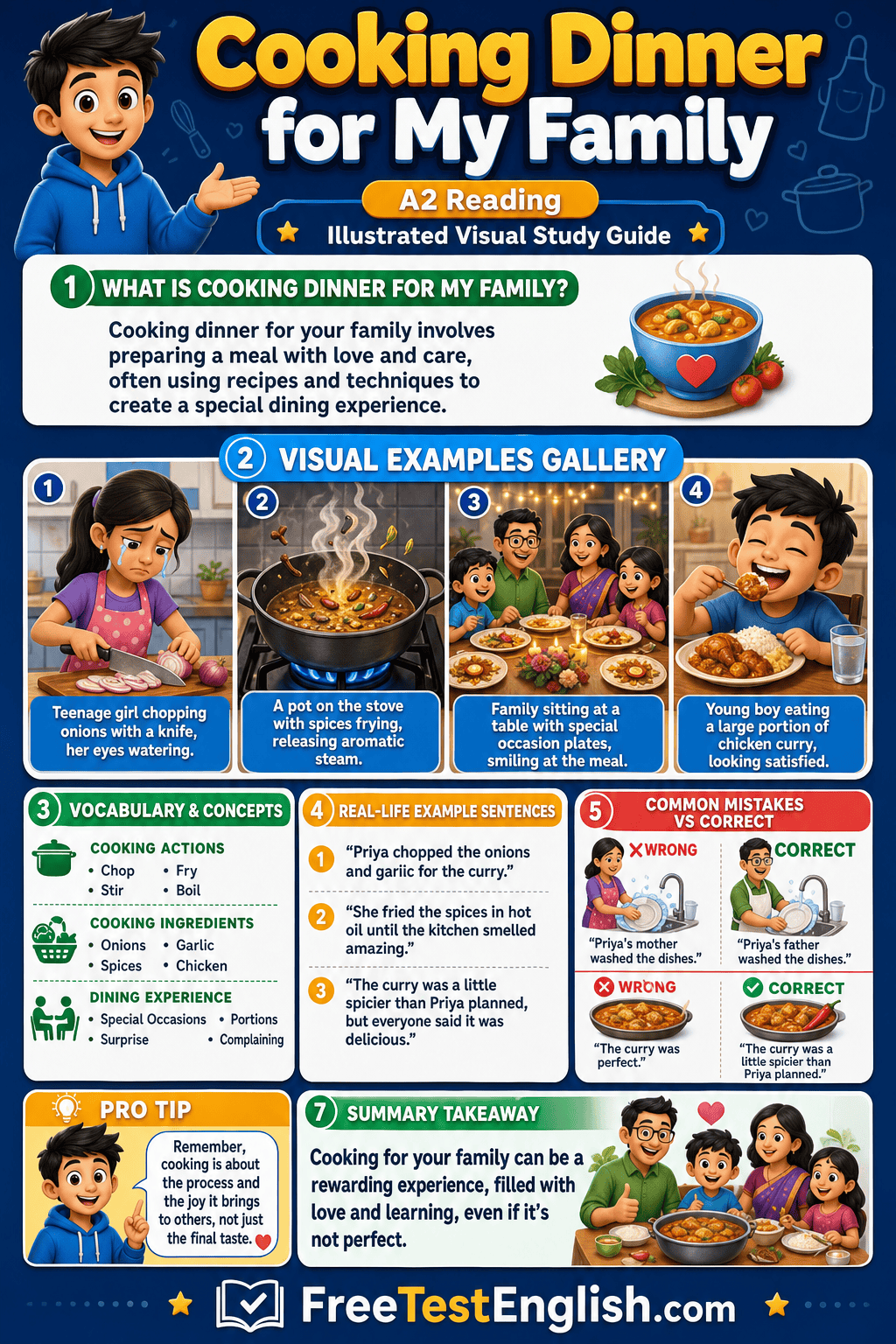
Cooking Dinner for My Family
Have you ever tried to cook a big meal for your whole family? It can be exciting — but also a little stressful! In this passage, you will read about a teenager who decides to cook dinner as a surprise. Before you read, think about these questions: What is your favourite home-cooked meal? Have you ever cooked something for someone special?
Reading Passage: The Best Dinner Ever
Last Saturday, Priya decided to cook dinner for her family as a surprise. Her parents were both working late, and her little brother Rajan was watching TV in his room. Priya wanted to make something special, so she chose her grandmother's chicken curry recipe. She had never cooked it alone before, but she felt ready to try.
She started at four o'clock in the afternoon. First, she chopped the onions and garlic. Her eyes were watering because of the onions, but she kept going. Then she fried the spices in hot oil until the kitchen smelled amazing. She added the chicken pieces and stirred everything carefully. While the curry was cooking slowly on the stove, she boiled some rice and set the table with the good plates — the ones her family only uses for special occasions.
When her parents came home at seven o'clock, they were very surprised. "Did you really make this?" her mother asked, smiling. The curry was a little spicier than Priya planned, but everyone said it was delicious. Rajan had two big portions. After dinner, her father washed the dishes without complaining, which was the best part of the evening. Priya is already planning to cook again next weekend.
Key Vocabulary in Context
| Word / Phrase | Part of Speech | Definition | Example Sentence |
|---|---|---|---|
| recipe | noun | a set of instructions that tells you how to prepare and cook a dish | I found a great recipe for banana bread online. |
| chop | verb | to cut food into small pieces with a knife | He chopped the vegetables before putting them in the pan. |
| spices | noun (plural) | dried plants or seeds used to add flavour to food, often with a strong taste or smell | She added several spices to make the soup more flavourful. |
| stir | verb | to mix food in a pot or bowl by moving it around with a spoon | You should stir the sauce regularly so it doesn't burn. |
| occasion | noun | a special or important time or event | We only use those glasses on special occasions, like birthdays. |
| portion | noun | an amount of food that is given to one person | The restaurant served very large portions of pasta. |
| complaining | verb (gerund) | saying that you are unhappy or not satisfied about something | The children did their homework without complaining. |
| surprise | noun / verb | something unexpected that you do for someone to make them happy; to do something someone did not expect | We organised a surprise party for her birthday. |
Reading Strategies & Comprehension Tips
Skimming for the Main Idea
Read the passage quickly the first time without stopping. Ask yourself: Who is this text about? What did she do? How did it go? This gives you the general meaning before you look at the details.
Scanning for Specific Information
Questions about times, numbers, or names require scanning. For example, if a question asks what time did Priya start cooking?, move your eyes quickly through the text looking only for a number. You will find "four o'clock" in paragraph two without needing to reread everything.
Understanding Sequence
This passage describes events in order. Look for sequence words like first, then, while, and after. These words help you follow the steps Priya took and understand what happened before or after something else.
Using Context to Understand New Words
If you do not know a word, look at the words around it. For example, if you are unsure about the word watering in "her eyes were watering because of the onions," the phrase because of the onions tells you that onions caused this reaction — a common experience many people know.
Common Reading Pitfalls & Traps
Pitfall 1: Confusing Who Did What
The passage mentions several family members: Priya, her parents, and her brother Rajan. Make sure you read carefully to identify who did each action. For example, it was Priya's father who washed the dishes — not her mother or Rajan. Questions may try to confuse you by mentioning the wrong family member.
Pitfall 2: Missing Negative or Comparative Details
The text says the curry was "a little spicier than Priya planned." This means it was not perfect — but it was still delicious. Be careful with questions that ask about the quality of the food. The answer is not simply "good" or "bad" — it is more nuanced than that.
Pitfall 3: Assuming Priya Cooked This Before
The passage says Priya chose "her grandmother's recipe" and that "she had never cooked it alone before." Some students may think the grandmother helped or that Priya cooked this dish previously. Read the details carefully to avoid this mistake.
Pitfall 4: The Word "Special Occasions"
The phrase "the ones her family only uses for special occasions" describes the plates. This does not mean the dinner was a formal event — it simply shows that Priya wanted the meal to feel important and special for her family.
Quick Summary
In this passage, we read about Priya, a teenager who cooked a chicken curry dinner for her family as a surprise last Saturday. She followed her grandmother's recipe, worked carefully through several cooking steps, and created a meal that everyone enjoyed — even if it was a little too spicy! The story shows that cooking for people you love can be a meaningful and rewarding experience, even when things are not completely perfect.
Now read the passage carefully and complete Exercise 1 (Multiple Choice) and Exercise 2 (Fill-in-the-gap dropdown) below.
📄 Download the Cooking Dinner for My Family PDF
Download this Cooking Dinner for My Family grammar lesson as a free printable PDF.
It includes grammar rules, examples, and explanations so you can study offline anytime.