
Read the passage carefully before attempting Exercise 1 (Multiple Choice) and Exercise 2 (Fill in the blanks dropdown) below.
Every winter, when the temperature drops and the streets get cold and quiet, something wonderful happens in our kitchen. My grandmother, Mirela, starts cooking her famous bean soup. The smell fills the whole house — thick, warm, and a little smoky — and everyone knows that our family’s winter tradition is beginning.
This tradition started about forty years ago, when Mirela was a young woman living in a small village in Croatia. She cooked the soup every Sunday for her children because it was cheap, filling, and easy to make in large amounts. When our family moved to Germany, she brought the recipe with her. Now, on the first cold Sunday of November, we all travel to her apartment in Hamburg. My aunts, uncles, cousins, and parents arrive with bread, desserts, and loud voices. The kitchen gets crowded and noisy, but nobody minds.
While Mirela stirs the soup slowly, the younger cousins play cards and the older ones help chop vegetables. My father always tells the same funny stories from his childhood, and everyone laughs even though we have heard them many times before. Last year, my cousin Petra wrote down the recipe for the first time because she is going to make the soup herself when she moves to her own flat next spring. Mirela was very proud. For our family, this soup is not just food — it is a connection between the past and the present.

Exercise 1
Read the passage about a special family tradition carefully. Then choose the correct answer for each question based on the information in the text.
Example: What does the family do every Sunday morning?
Answer: They cook breakfast together.
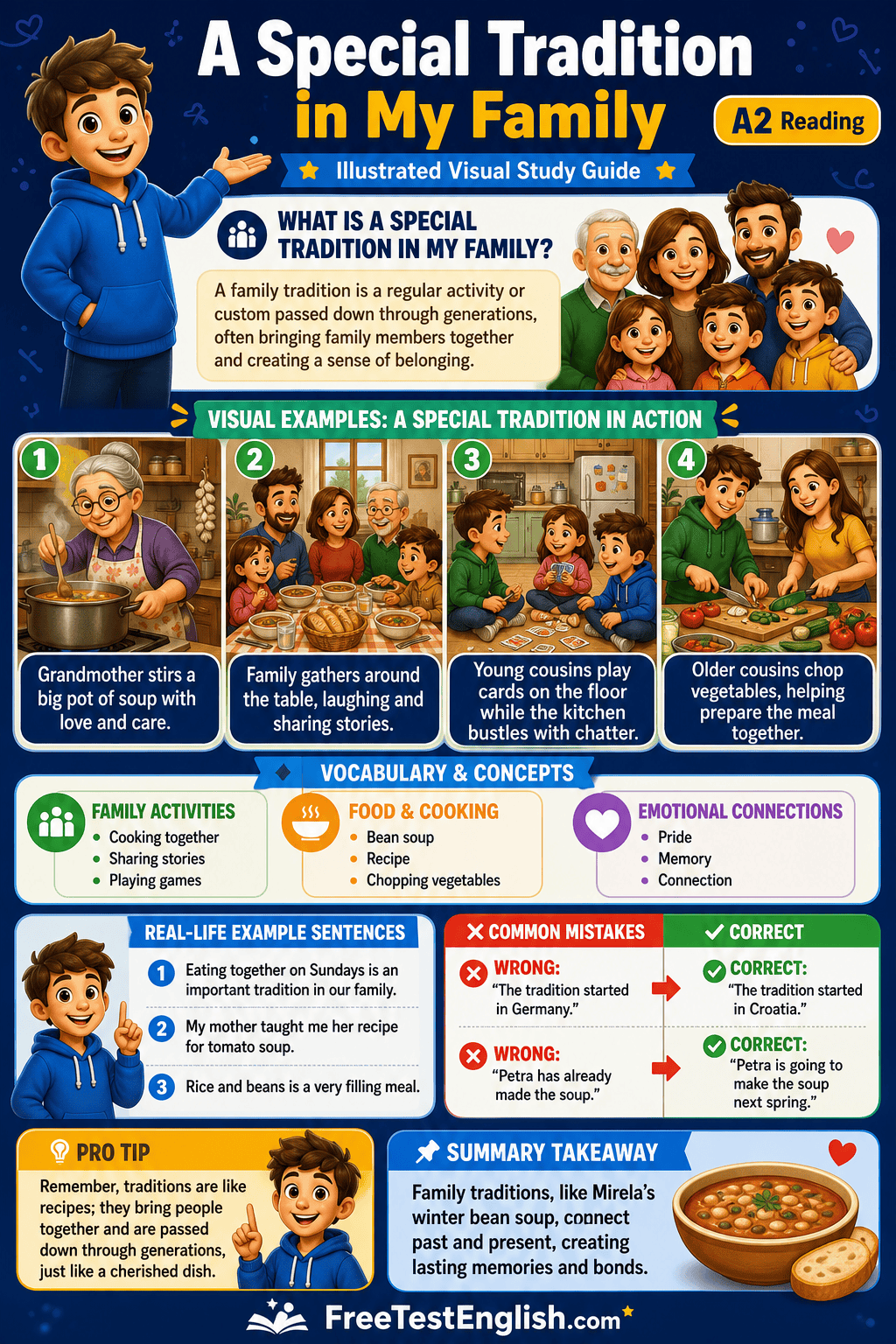
A Special Tradition in My Family
Does your family have a special tradition that you look forward to every year? Many families around the world have their own unique customs that bring them together. As you read, think about these two questions: What tradition does the writer's family celebrate, and why is it so important to them?
Reading Passage: The Sunday Soup
Every winter, when the temperature drops and the streets get cold and quiet, something wonderful happens in our kitchen. My grandmother, Mirela, starts cooking her famous bean soup. The smell fills the whole house — thick, warm, and a little smoky — and everyone knows that our family's winter tradition is beginning.
This tradition started about forty years ago, when Mirela was a young woman living in a small village in Croatia. She cooked the soup every Sunday for her children because it was cheap, filling, and easy to make in large amounts. When our family moved to Germany, she brought the recipe with her. Now, on the first cold Sunday of November, we all travel to her apartment in Hamburg. My aunts, uncles, cousins, and parents arrive with bread, desserts, and loud voices. The kitchen gets crowded and noisy, but nobody minds.
While Mirela stirs the soup slowly, the younger cousins play cards and the older ones help chop vegetables. My father always tells the same funny stories from his childhood, and everyone laughs even though we have heard them many times before. Last year, my cousin Petra wrote down the recipe for the first time because she is going to make the soup herself when she moves to her own flat next spring. Mirela was very proud. For our family, this soup is not just food — it is a connection between the past and the present.
Key Vocabulary in Context
| Word / Phrase | Part of Speech | Definition | Example Sentence |
|---|---|---|---|
| tradition | noun | something that a group of people do regularly, often for many years, because it is part of their culture or family life | Eating together on Sundays is an important tradition in our family. |
| recipe | noun | a set of instructions that tells you how to cook a particular dish | My mother taught me her recipe for tomato soup. |
| filling | adjective | describes food that makes you feel full and satisfied after eating it | Rice and beans is a very filling meal. |
| crowded | adjective | full of people, with little space to move | The bus was very crowded during the morning rush hour. |
| stir | verb | to move a liquid or mixture around slowly using a spoon | She stirred the sauce carefully so it did not burn. |
| chop | verb | to cut something into small pieces using a knife | Can you chop the onions for me, please? |
| connection | noun | a relationship or link between two things or people | There is a strong connection between language and culture. |
| proud | adjective | feeling happy and satisfied because someone you care about has done something good | Her parents were very proud when she passed her exam. |
Reading Strategies & Comprehension Tips
Skimming for the Main Idea
Before you read every word, skim the passage quickly. Look at the title "The Sunday Soup" and the first sentence of each paragraph. This tells you the text is about a family food tradition that has been passed down through generations. You do not need to understand every word to get the general idea.
Scanning for Specific Information
If a question asks you about a specific detail — for example, where the tradition started or who wrote down the recipe — scan the passage quickly for key words like names, places, or numbers. Look for "Croatia", "Hamburg", "Petra", or "forty years ago" to find the answer quickly without re-reading everything.
Using Context to Understand New Words
If you see a word you do not know, look at the words around it for clues. For example, if you are not sure what "filling" means, the sentence says the soup was "cheap, filling, and easy to make." The context suggests it is a positive quality of food — something that satisfies hunger.
Following the Sequence of Events
This passage describes events in time order. Look for time words like "forty years ago," "when our family moved," "now," and "last year." These words help you understand the order of events and how the tradition changed over time.
Common Reading Pitfalls & Traps
Confusing Locations
The passage mentions two places: Croatia and Germany (Hamburg). Be careful — the tradition started in Croatia, but the family now lives in Hamburg. A common mistake is to say the tradition started in Germany. Always check the exact detail in the text.
Who Does What in the Kitchen?
The passage describes several family members doing different things. Mirela stirs the soup, the younger cousins play cards, and the older cousins help chop vegetables. Students sometimes mix up who does which activity. Read carefully and match the person to their action.
Petra's Plan — Future or Past?
The sentence "she is going to make the soup herself when she moves to her own flat next spring" describes a future plan, not something that has already happened. Do not confuse this with the past event of Mirela teaching the recipe. Petra has written down the recipe (past simple), but she has not cooked it yet.
Watch Out for "Nobody Minds"
The phrase "nobody minds" means nobody is upset or bothered by it. Some students may think it means people do not pay attention or do not care in a negative way. In this context, it is positive — the family is happy, even though the kitchen is noisy and crowded.
Quick Summary
This passage tells the personal story of a family tradition centred around a simple but meaningful recipe: Mirela's winter bean soup. The tradition began in Croatia forty years ago and continues today in Hamburg. It is a story about food, family, memory, and how traditions can travel across countries and generations. The vocabulary is mostly high-frequency and everyday, but a few words — like tradition, recipe, and connection — are important for you to understand and remember.
Now read the passage carefully and complete Exercise 1 (Multiple Choice) and Exercise 2 (Fill-in-the-gap dropdown) below.
📄 Download the A Special Tradition in My Family PDF
Download this A Special Tradition in My Family grammar lesson as a free printable PDF.
It includes grammar rules, examples, and explanations so you can study offline anytime.