

Exercise 1
Choose the correct word to complete each sentence about environment and climate change.
Example: The release of carbon dioxide into the atmosphere contributes to the ______ effect. (greenhouse / ozone / carbon)
Answer: The release of carbon dioxide into the atmosphere contributes to the greenhouse effect.
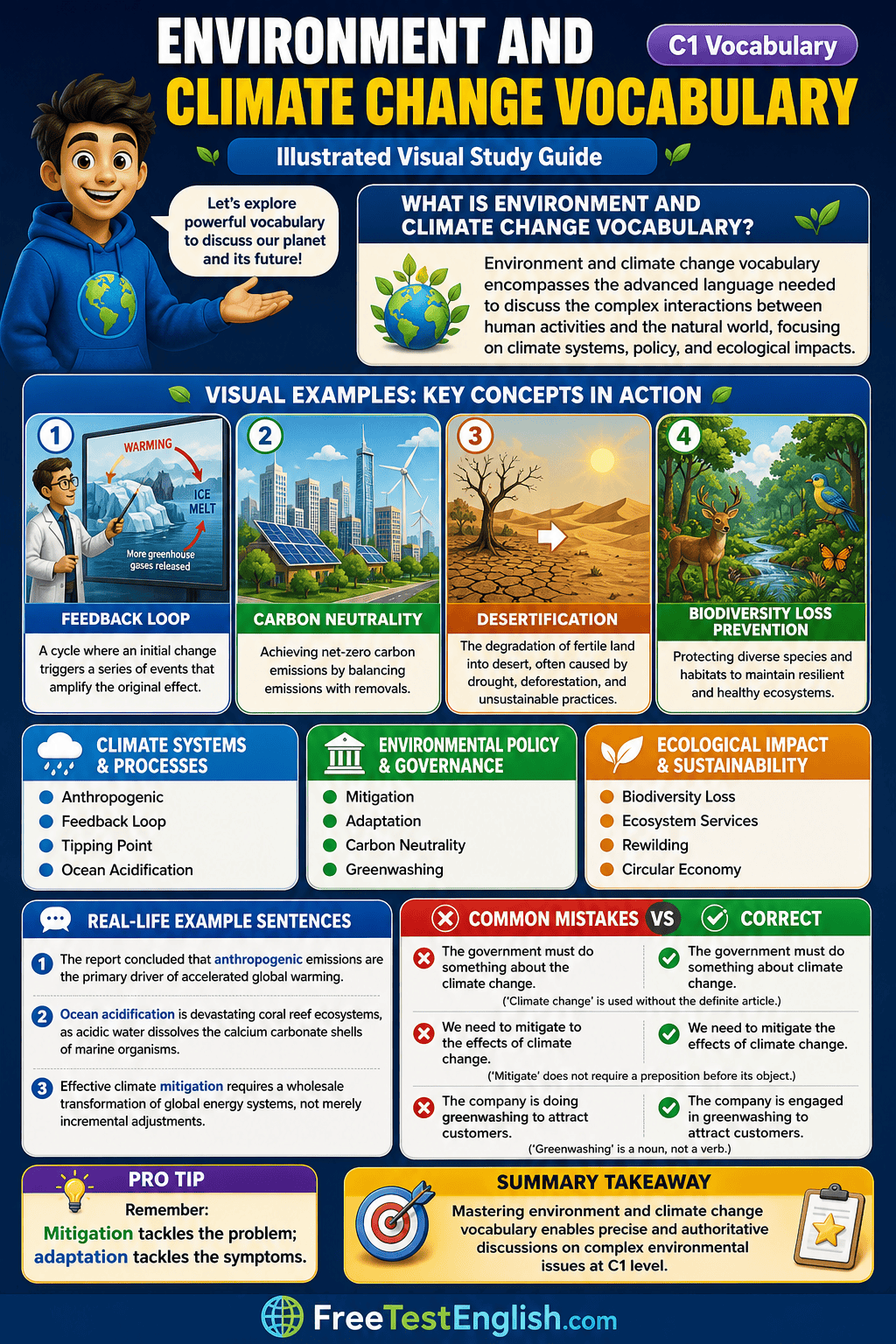
Environment and Climate Change Vocabulary
Climate change is one of the most pressing and complex issues of our time, demanding precise, sophisticated language to discuss effectively. Whether you are reading academic journals, engaging in professional debates, or following international environmental policy discussions, a strong command of advanced environmental vocabulary is essential at C1 level.
Consider this scenario: Dr Amara Osei, an environmental policy adviser, is presenting her findings to a parliamentary committee. She needs to articulate the nuanced relationship between industrial emissions, biodiversity loss, and governmental inaction — using precise, register-appropriate language that conveys both urgency and analytical rigour.
In this lesson, you will acquire the sophisticated vocabulary needed to engage with environmental and climate change discourse at an advanced level — including academic collocations, formal register expressions, and the subtle distinctions that separate precise environmental language from vague generalisations.
Key Vocabulary & Meaning Breakdown
1. Climate Systems, Processes, and Phenomena
| Word / Phrase | Part of Speech & Meaning | Example Sentence | Collocations / Notes |
|---|---|---|---|
| anthropogenic | adjective — caused or influenced directly by human activity, particularly in relation to environmental change | The report concluded that anthropogenic emissions are the primary driver of accelerated global warming. | anthropogenic emissions; anthropogenic climate change; anthropogenic factors; anthropogenic forcing |
| carbon sequestration | noun phrase — the long-term capture and storage of atmospheric carbon dioxide, typically by forests, soils, or geological formations | Restoring degraded peatlands dramatically increases carbon sequestration capacity in the region. | enhance / improve carbon sequestration; natural / geological carbon sequestration; carbon sequestration rates |
| feedback loop | noun phrase — a process in which the effects of a change amplify or dampen the original cause, creating a self-reinforcing or self-correcting cycle | The melting of Arctic ice creates a dangerous feedback loop, as darker ocean water absorbs more heat than reflective ice. | positive / negative feedback loop; trigger / reinforce / break a feedback loop; climate feedback loop |
| tipping point | noun phrase — a critical threshold at which a small change can cause a large, irreversible shift in a system's state | Many scientists warn that we are dangerously close to reaching irreversible climate tipping points. | reach / cross / approach a tipping point; climate tipping point; ecological tipping point |
| albedo effect | noun phrase — the phenomenon by which surfaces reflect solar radiation; high-albedo surfaces (e.g. ice) reflect more heat than low-albedo surfaces (e.g. ocean) | The reduction in snow cover diminishes the albedo effect, causing further warming of the planet's surface. | albedo effect; surface albedo; reduce / alter the albedo effect |
| permafrost thaw | noun phrase — the melting of permanently frozen ground, which releases large quantities of stored methane and carbon dioxide | Accelerating permafrost thaw in Siberia poses a serious threat of large-scale methane release into the atmosphere. | accelerate / trigger permafrost thaw; permafrost degradation; thawing permafrost |
| ocean acidification | noun phrase — the ongoing decrease in the pH of Earth's oceans, caused by their absorption of atmospheric carbon dioxide | Ocean acidification is devastating coral reef ecosystems, as acidic water dissolves the calcium carbonate shells of marine organisms. | exacerbate / accelerate ocean acidification; ocean acidification levels; effects / consequences of ocean acidification |
| desertification | noun — the process by which fertile land becomes desert, typically as a result of drought, deforestation, or inappropriate agriculture | Unchecked desertification in sub-Saharan Africa is forcing millions of people to abandon their agricultural livelihoods. | accelerate / combat desertification; land degradation and desertification; desertification threatens |
2. Environmental Policy, Governance, and Action
| Word / Phrase | Part of Speech & Meaning | Example Sentence | Collocations / Notes |
|---|---|---|---|
| mitigation | noun — action taken to reduce the severity, seriousness, or impact of something, particularly climate change | Effective climate mitigation requires a wholesale transformation of global energy systems, not merely incremental adjustments. | climate mitigation; mitigation strategies / measures / efforts; mitigation and adaptation |
| adaptation | noun — the process of adjusting to new conditions caused by climate change, such as building flood defences or developing drought-resistant crops | Coastal communities must invest in climate adaptation measures before rising sea levels render their homes uninhabitable. | climate adaptation; adaptation strategies / policies; adaptation and resilience; adaptive capacity |
| carbon neutrality | noun phrase — a state in which the net amount of carbon dioxide emitted into the atmosphere is equal to the amount removed or offset | The corporation pledged to achieve carbon neutrality across its entire supply chain by 2040. | achieve / reach / commit to carbon neutrality; carbon-neutral target; carbon neutrality goals |
| net zero | noun phrase / adjective — a state in which greenhouse gas emissions are balanced by removals, resulting in no net addition to the atmosphere | The government's net zero commitment by 2050 has been widely criticised as insufficiently ambitious given the pace of warming. | achieve / reach net zero; net zero target / commitment / ambition; net-zero economy; net zero emissions |
| carbon offset | noun — a reduction in emissions, or an increase in carbon storage, used to compensate for emissions produced elsewhere | Critics argue that relying on carbon offsets allows corporations to avoid making genuine structural reductions in their emissions. | purchase / buy / sell carbon offsets; carbon offset scheme / programme; voluntary carbon offsets |
| greenwashing | noun — the practice of making misleading or exaggerated claims about the environmental benefits of a product, policy, or organisation | Consumer groups accused the airline of greenwashing after it marketed heavily-polluting flights as "eco-friendly". | accused of greenwashing; greenwashing claims; corporate greenwashing; expose / call out greenwashing |
| Paris Agreement | proper noun — an internationally binding climate accord adopted in 2015, committing signatory nations to limit global warming to well below 2°C above pre-industrial levels | Several major economies have fallen far short of the emissions reductions required under the Paris Agreement. | Paris Agreement targets / commitments; comply with / withdraw from / ratify the Paris Agreement |
| climate justice | noun phrase — the principle that the burdens of climate change should be distributed fairly, with particular attention to vulnerable and historically marginalised communities | Climate justice advocates argue that wealthier nations, which have historically produced the most emissions, must bear a disproportionate share of the cost of addressing climate change. | climate justice movement / framework / principles; advocate for climate justice; climate justice and equity |
| loss and damage | noun phrase — in climate policy, the harm caused by climate change that cannot be avoided through mitigation or adaptation, particularly in vulnerable nations | The contentious issue of loss and damage dominated negotiations at the COP summit, with developing nations demanding financial compensation from wealthier polluters. | loss and damage mechanism / fund / framework; address loss and damage; loss and damage negotiations |
3. Ecological Impact, Biodiversity, and Sustainability
| Word / Phrase | Part of Speech & Meaning | Example Sentence | Collocations / Notes |
|---|---|---|---|
| biodiversity loss | noun phrase — the decline or disappearance of biological diversity, including the variety of species, ecosystems, and genetic variation on Earth | Biodiversity loss is occurring at a rate unprecedented in human history, with scientists warning of a sixth mass extinction. | accelerate / exacerbate / halt biodiversity loss; biodiversity loss and ecosystem collapse; drivers of biodiversity loss |
| ecosystem services | noun phrase — the direct and indirect benefits that functioning ecosystems provide to human societies, such as clean water, pollination, and climate regulation | The economic valuation of ecosystem services is a growing field, as policymakers recognise the staggering financial cost of environmental degradation. | value / protect / preserve ecosystem services; ecosystem services and biodiversity; loss of ecosystem services |
| rewilding | noun / gerund — the large-scale restoration of ecosystems to a natural, self-sustaining state, often involving the reintroduction of native species | The rewilding of Scottish Highlands with native woodland has significantly increased local biodiversity within just a decade. | large-scale rewilding; rewilding projects / initiatives; rewilding and ecosystem restoration |
| ecological footprint | noun phrase — a measure of the demand human activities place on the Earth's ecosystems, expressed in terms of the biologically productive land and sea required to sustain those activities | If all global citizens consumed resources at the same rate as the average American, humanity would require five Earths to sustain its ecological footprint. | reduce / measure / calculate an ecological footprint; per capita ecological footprint; shrink the ecological footprint |
| deforestation | noun — the large-scale clearing or destruction of forests, primarily to make land available for agriculture, industry, or urbanisation | Rampant deforestation in the Amazon basin is not only accelerating climate change but also displacing indigenous communities whose livelihoods depend on the forest. | rampant / unchecked deforestation; halt / combat deforestation; deforestation rates; drivers of deforestation |
| invasive species | noun phrase — a non-native organism introduced to an ecosystem, often causing significant ecological harm by outcompeting or preying on native species | The spread of invasive species is considered one of the leading causes of biodiversity loss globally, second only to habitat destruction. | spread of invasive species; control / eradicate invasive species; invasive species threaten; non-native / alien invasive species |
| circular economy | noun phrase — an economic model designed to eliminate waste by continually reusing, repairing, and recycling materials and products, minimising resource extraction | Transitioning to a circular economy is increasingly seen as essential for decoupling economic growth from environmental degradation. | transition to / adopt a circular economy; circular economy principles / model; circular economy and sustainability |
Collocations & Useful Expressions
At C1 level, using precise and natural collocations is what distinguishes an advanced speaker. Below are the most important collocations and expressions in environmental and climate change discourse.
Verbs + Environmental Nouns
exacerbate + climate change / biodiversity loss / desertification
Industrial agriculture practices significantly exacerbate biodiversity loss by destroying natural habitats.
mitigate + emissions / the effects of climate change / risk
Planting urban tree canopies can help mitigate the effects of extreme heat in densely populated city centres.
curb + emissions / deforestation / consumption
The legislation was designed to curb emissions from the aviation sector by introducing a frequent flyer levy.
accelerate + warming / biodiversity loss / ecological collapse
The destruction of peatlands accelerates warming by releasing centuries of stored carbon into the atmosphere.
drive + climate change / species extinction / environmental degradation
Unsustainable consumption patterns in wealthy nations continue to drive environmental degradation worldwide.
commit to + net zero / carbon neutrality / emissions targets
All member states committed to halving their carbon emissions by 2035 under the new accord.
Adjective + Noun Collocations
irreversible + damage / change / ecological collapse
Once certain tipping points are crossed, the resulting ecological damage may be irreversible on any human timescale.
unprecedented + warming / biodiversity loss / extreme weather
The planet is experiencing unprecedented warming, with each of the last eight years ranking among the hottest on record.
renewable + energy / resources / infrastructure
Massive investment in renewable energy infrastructure is a prerequisite for achieving net zero targets.
fossil + fuels / energy / industry
A rapid phase-out of fossil fuels remains the most critical step in limiting global temperature rise to 1.5°C.
sustainable + development / agriculture / consumption / living
Sustainable development must balance economic growth with the long-term preservation of natural resources.
Formal Expressions and Fixed Phrases
in the face of + climate change / ecological collapse / mounting evidence
In the face of mounting scientific evidence, continued governmental inaction is increasingly difficult to justify.
at the forefront of + environmental policy / climate action / green innovation
The Nordic countries remain at the forefront of environmental policy, consistently setting ambitious emissions reduction targets.
fall short of + targets / commitments / expectations
Most signatory nations have fallen short of the emissions reduction targets pledged under the Paris Agreement.
a watershed moment — a turning point of great significance
The 2015 Paris Agreement was widely regarded as a watershed moment in international climate diplomacy.
to bear the brunt of — to suffer the worst effects of something
It is developing nations in the Global South that disproportionately bear the brunt of climate change, despite contributing least to global emissions.
to take stock of — to carefully assess a situation before proceeding
World leaders must take stock of decades of environmental neglect before designing truly effective climate policy.
Important Differences & Confusing Words
Mitigation vs Adaptation
These two terms are frequently encountered together but refer to fundamentally different approaches to addressing climate change.
Mitigation refers to actions that reduce or prevent greenhouse gas emissions in order to limit the extent of future climate change. It is concerned with addressing the causes.
Example: Investing in solar and wind energy is a key mitigation strategy.
Adaptation refers to adjusting human systems and behaviours in response to existing or anticipated climate impacts. It is concerned with managing the consequences.
Example: Building sea walls and redesigning drainage systems are examples of coastal adaptation.
A useful way to remember the distinction: mitigation tackles the problem; adaptation tackles the symptoms.
Carbon Neutral vs Net Zero vs Climate Positive
These three terms are often used interchangeably, but they carry meaningfully different implications in environmental discourse.
Carbon neutral means that the carbon dioxide emissions produced are fully offset or balanced by carbon removal. It may refer only to CO₂, not all greenhouse gases.
Example: The company claims to be carbon neutral by purchasing offsets for its flight emissions.
Net zero is a broader and more rigorous target: all greenhouse gases (not just CO₂) are balanced by removals. It typically requires actual emissions reductions, not simply offsetting.
Example: The nation aims to reach net zero across all sectors of its economy by 2050.
Climate positive (also called carbon negative) means going beyond net zero — removing more greenhouse gases from the atmosphere than are emitted, resulting in a net benefit for the climate.
Example: Bhutan is often cited as a climate positive nation, as its forests absorb far more carbon than the country produces.
Deforestation vs Degradation vs Reforestation vs Afforestation
Deforestation — the outright clearing and removal of forest cover, typically permanently.
Illegal deforestation in protected areas is a criminal offence under the new environmental law.
Forest degradation — a reduction in the quality, biodiversity, or carbon stock of a forest without complete removal of tree cover. The forest still exists but is weakened.
Selective logging and wildfires contribute significantly to forest degradation even when the canopy remains partly intact.
Reforestation — the replanting of trees in an area where forests previously existed and were cleared.
The reforestation programme aims to restore 100,000 hectares of degraded land to native woodland.
Afforestation — the planting of trees in an area where there was no previous forest cover.
Critics of afforestation schemes caution that planting non-native species in grasslands can damage existing ecosystems.
Emissions vs Pollution
Emissions refers specifically to gases — particularly greenhouse gases such as CO₂, methane, and nitrous oxide — released into the atmosphere as a result of human activities. It is the standard term in climate science and policy.
The transport sector accounts for approximately 20% of global carbon emissions.
Pollution is a broader term referring to the introduction of harmful substances into the environment — including air, water, and soil — and encompasses solid waste, chemicals, and noise, as well as gases.
Plastic pollution in the world's oceans is reaching catastrophic levels, with devastating consequences for marine biodiversity.
Note: While all harmful greenhouse gas releases are emissions, not all pollution involves emissions. Use emissions precisely when referring to climate-relevant gases; use pollution for broader environmental contamination.
Common Mistakes
❌ The government must do something about the climate change.
✅ Climate change is used without the definite article as a general concept. The government must do something about climate change.
❌ We need to mitigate to the effects of climate change.
✅ Mitigate does not require a preposition before its object. We need to mitigate the effects of climate change.
❌ The company is doing greenwashing to attract customers.
✅ Greenwashing is a noun, not a verb; use it as a noun with appropriate verbs. The company is engaged in greenwashing to attract customers. / The company is accused of greenwashing.
❌ Scientists are concerned about the carbon footprint of the planet.
✅ Carbon footprint refers to the emissions of a specific entity (a person, company, or product). The broader term for the planet's capacity is ecological footprint. Scientists are concerned about humanity's growing ecological footprint.
❌ Afforestation is when you plant trees where they were before.
✅ Afforestation involves planting trees where no forest previously existed; the correct term for replanting is reforestation. Reforestation involves replanting trees in areas where forest cover previously existed.
❌ The country reached its net zero by 2030.
✅ Net zero is typically used without a possessive when referring to a target or state. The country reached net zero by 2030.
❌ Renewable energy is a very good alternative to fossil fuels for reducing pollution.
✅ In advanced environmental discourse, use precise technical language rather than vague evaluative terms. Transitioning to renewable energy is a critical mitigation strategy for reducing anthropogenic greenhouse gas emissions.
Environment and Climate Change Vocabulary: Quick Summary & Review
In this lesson, you have explored a sophisticated and comprehensive range of environmental and climate change vocabulary at C1 level, organised into three key thematic areas:
- Climate systems and processes — including terms such as anthropogenic, feedback loop, tipping point, ocean acidification, and carbon sequestration, which are essential for discussing the science of climate change with precision.
- Environmental policy and governance — including critical distinctions between mitigation and adaptation, as well as key terms such as net zero, carbon offset, greenwashing, climate justice, and loss and damage, which are central to policy and diplomatic discourse.
- Ecological impact and sustainability — including terms such as biodiversity loss, ecosystem services, rewilding, circular economy, and ecological footprint, which are vital for discussing the broader environmental consequences of climate change.
You have also practised:
- Precise and natural collocations used in academic and professional environmental discourse.
- Critical distinctions between closely related but meaningfully different terms, such as mitigation vs adaptation, carbon neutral vs net zero, and reforestation vs afforestation.
- Common mistakes to avoid when discussing environmental topics in formal and academic English.
Mastering this vocabulary will allow you to engage confidently and critically with environmental issues in academic essays, professional settings, and international policy discussions — articulating complex ideas with the precision and authority expected at C1 level.
Now practise Environment and Climate Change vocabulary in the exercises below.
📄 Download the Environment and Climate Change Vocabulary PDF
Download this Environment and Climate Change Vocabulary grammar lesson as a free printable PDF.
It includes grammar rules, examples, and explanations so you can study offline anytime.